

4.3 Accurate Computational Models
123
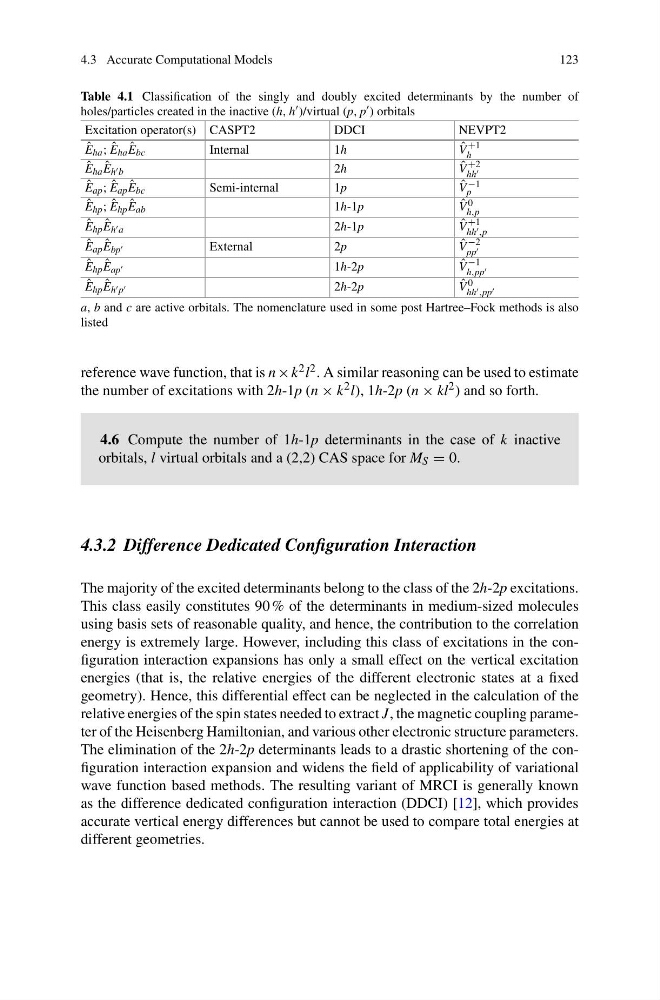
Table 4.1 Classification of the singly and doubly excited determinants by the number of
holes/particles created in the inactive (h, h ′ )/virtual (p, p ′ )orbitals
Excitation operator(s) CASPT2
DDCI
NEVPT2
ˆ
E ha ; ˆ
E ha ˆ
E bc
Internal
1h
ˆ
V
+1
h
ˆ
E ha ˆ
E h ′ b
2h
ˆ
V
+2
hh ′
ˆ
E ap ; ˆ
E ap ˆ
E bc
Semi-internal
1p
ˆ
V −1
p
ˆ
E hp ; ˆ
E hp ˆ
E ab
1h-1p
ˆ
V 0
h,p
ˆ
E hp ˆ
E h ′ a
2h-1p
ˆ
V
+1
hh ′ ,p
ˆ
E ap ˆ
E bp ′
External
2p
ˆ
V
−2
pp ′
ˆ
E hp ˆ
E ap ′
1h-2p
ˆ
V
−1
h,pp ′
ˆ
E hp ˆ
E h ′ p ′
2h-2p
ˆ
V 0
hh ′ ,pp ′
a, b and c are active orbitals. The nomenclature used in some post Hartree–Fock methods is also
listed
reference wave function, that is n × k 2 l 2 . A similar reasoning can be used to estimate
the number of excitations with 2h-1p (n × k 2 l), 1h-2p (n × kl 2 ) and so forth.
4.6 Compute the number of 1h-1p determinants in the case of k inactive
orbitals, l virtual orbitals and a (2,2) CAS space for M S = 0.
4.3.2 Difference Dedicated Configuration Interaction
The majority of the excited determinants belong to the class of the 2h-2p excitations.
This class easily constitutes 90 % of the determinants in medium-sized molecules
using basis sets of reasonable quality, and hence, the contribution to the correlation
energy is extremely large. However, including this class of excitations in the configuration interaction expansions has only a small effect on the vertical excitation
energies (that is, the relative energies of the different electronic states at a fixed
geometry). Hence, this differential effect can be neglected in the calculation of the
relative energies of the spin states needed to extract J, the magnetic coupling parameter of the Heisenberg Hamiltonian, and various other electronic structure parameters.
The elimination of the 2h-2p determinants leads to a drastic shortening of the configuration interaction expansion and widens the field of applicability of variational
wave function based methods. The resulting variant of MRCI is generally known
as the difference dedicated configuration interaction (DDCI) [12], which provides
accurate vertical energy differences but cannot be used to compare total energies at
different geometries.
123
Table 4.1 Classification of the singly and doubly excited determinants by the number of
holes/particles created in the inactive (h, h ′ )/virtual (p, p ′ )orbitals
Excitation operator(s) CASPT2
DDCI
NEVPT2
ˆ
E ha ; ˆ
E ha ˆ
E bc
Internal
1h
ˆ
V
+1
h
ˆ
E ha ˆ
E h ′ b
2h
ˆ
V
+2
hh ′
ˆ
E ap ; ˆ
E ap ˆ
E bc
Semi-internal
1p
ˆ
V −1
p
ˆ
E hp ; ˆ
E hp ˆ
E ab
1h-1p
ˆ
V 0
h,p
ˆ
E hp ˆ
E h ′ a
2h-1p
ˆ
V
+1
hh ′ ,p
ˆ
E ap ˆ
E bp ′
External
2p
ˆ
V
−2
pp ′
ˆ
E hp ˆ
E ap ′
1h-2p
ˆ
V
−1
h,pp ′
ˆ
E hp ˆ
E h ′ p ′
2h-2p
ˆ
V 0
hh ′ ,pp ′
a, b and c are active orbitals. The nomenclature used in some post Hartree–Fock methods is also
listed
reference wave function, that is n × k 2 l 2 . A similar reasoning can be used to estimate
the number of excitations with 2h-1p (n × k 2 l), 1h-2p (n × kl 2 ) and so forth.
4.6 Compute the number of 1h-1p determinants in the case of k inactive
orbitals, l virtual orbitals and a (2,2) CAS space for M S = 0.
4.3.2 Difference Dedicated Configuration Interaction
The majority of the excited determinants belong to the class of the 2h-2p excitations.
This class easily constitutes 90 % of the determinants in medium-sized molecules
using basis sets of reasonable quality, and hence, the contribution to the correlation
energy is extremely large. However, including this class of excitations in the configuration interaction expansions has only a small effect on the vertical excitation
energies (that is, the relative energies of the different electronic states at a fixed
geometry). Hence, this differential effect can be neglected in the calculation of the
relative energies of the spin states needed to extract J, the magnetic coupling parameter of the Heisenberg Hamiltonian, and various other electronic structure parameters.
The elimination of the 2h-2p determinants leads to a drastic shortening of the configuration interaction expansion and widens the field of applicability of variational
wave function based methods. The resulting variant of MRCI is generally known
as the difference dedicated configuration interaction (DDCI) [12], which provides
accurate vertical energy differences but cannot be used to compare total energies at
different geometries.