

100
3 Two (or More) Magnetic Centers
|T + | T 0 | T − | S
T + |
−
1
4 (J − D zz )
1
2
√
2
(D xz − iD yz )
1
4 (D xx − D yy
−
1
2
√
2
(d xz − id yz )
+2iD yz )
T 0 |
1
2
√
2
(D xz + iD yz ) −
1
4 (J − D xx
−
1
2
√
2
(D xz − iD yz ) −
1
2 id xy
−D yy + D zz )
T − |
1
4 (D xx − D yy
−
1
2
√
2
(D xz + iD yz ) −
1
4 (J − D zz )
−
1
2
√
2
(d xz + id yz )
+2iD yz )
S|
−
1
2
√
2
(d xz + id yz )
1
2 id xy
−
1
2
√
2
(d xz − id yz )
3
4 J −
1
4 (D xx
+D yy + D zz )
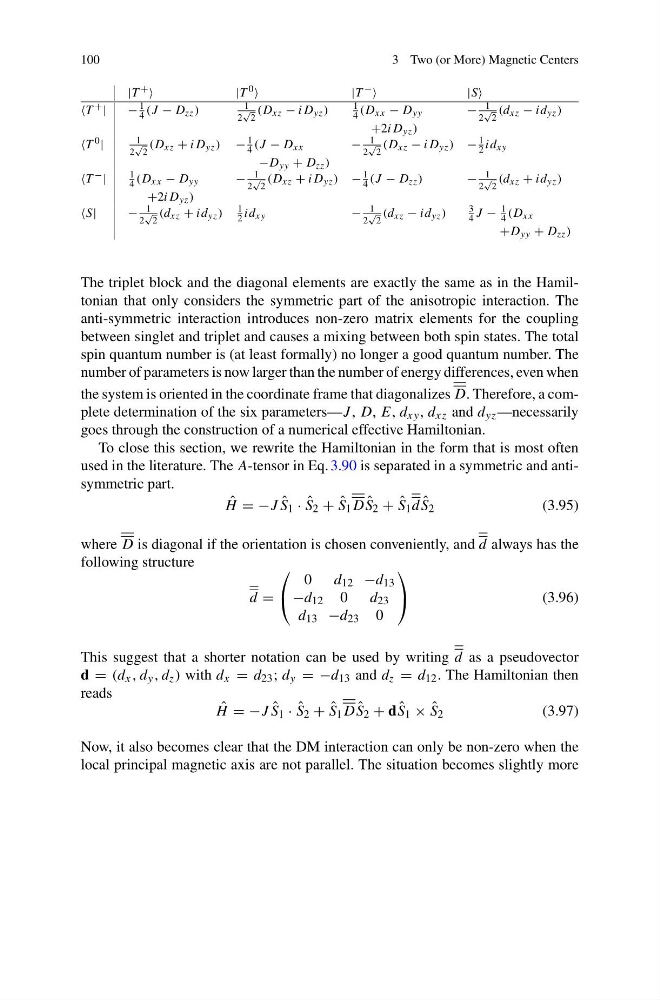
The triplet block and the diagonal elements are exactly the same as in the Hamiltonian that only considers the symmetric part of the anisotropic interaction. The
anti-symmetric interaction introduces non-zero matrix elements for the coupling
between singlet and triplet and causes a mixing between both spin states. The total
spin quantum number is (at least formally) no longer a good quantum number. The
number of parameters is now larger than the number of energy differences, even when
the system is oriented in the coordinate frame that diagonalizes D. Therefore, a complete determination of the six parameters—J , D, E, d xy , d xz and d yz —necessarily
goes through the construction of a numerical effective Hamiltonian.
To close this section, we rewrite the Hamiltonian in the form that is most often
used in the literature. The A-tensor in Eq. 3.90 is separated in a symmetric and antisymmetric part.
ˆ
H =−J ˆ
S 1 · ˆ
S 2 + ˆ
S 1 D ˆ
S 2 + ˆ
S 1 d ˆ
S 2
(3.95)
where D is diagonal if the orientation is chosen conveniently, and d always has the
following structure
d =
⎛
⎝
0 d 12 −d 13
−d 12 0 d 23
d 13 −d 23 0
⎞
⎠
(3.96)
This suggest that a shorter notation can be used by writing d as a pseudovector
d = (d x , d y , d z ) with d x = d 23 ; d y =− d 13 and d z = d 12 . The Hamiltonian then
reads
ˆ
H =−J ˆ
S 1 · ˆ
S 2 + ˆ
S 1 D ˆ
S 2 + d ˆ
S 1 × ˆ
S 2
(3.97)
Now, it also becomes clear that the DM interaction can only be non-zero when the
local principal magnetic axis are not parallel. The situation becomes slightly more
3 Two (or More) Magnetic Centers
|T + | T 0 | T − | S
T + |
−
1
4 (J − D zz )
1
2
√
2
(D xz − iD yz )
1
4 (D xx − D yy
−
1
2
√
2
(d xz − id yz )
+2iD yz )
T 0 |
1
2
√
2
(D xz + iD yz ) −
1
4 (J − D xx
−
1
2
√
2
(D xz − iD yz ) −
1
2 id xy
−D yy + D zz )
T − |
1
4 (D xx − D yy
−
1
2
√
2
(D xz + iD yz ) −
1
4 (J − D zz )
−
1
2
√
2
(d xz + id yz )
+2iD yz )
S|
−
1
2
√
2
(d xz + id yz )
1
2 id xy
−
1
2
√
2
(d xz − id yz )
3
4 J −
1
4 (D xx
+D yy + D zz )
The triplet block and the diagonal elements are exactly the same as in the Hamiltonian that only considers the symmetric part of the anisotropic interaction. The
anti-symmetric interaction introduces non-zero matrix elements for the coupling
between singlet and triplet and causes a mixing between both spin states. The total
spin quantum number is (at least formally) no longer a good quantum number. The
number of parameters is now larger than the number of energy differences, even when
the system is oriented in the coordinate frame that diagonalizes D. Therefore, a complete determination of the six parameters—J , D, E, d xy , d xz and d yz —necessarily
goes through the construction of a numerical effective Hamiltonian.
To close this section, we rewrite the Hamiltonian in the form that is most often
used in the literature. The A-tensor in Eq. 3.90 is separated in a symmetric and antisymmetric part.
ˆ
H =−J ˆ
S 1 · ˆ
S 2 + ˆ
S 1 D ˆ
S 2 + ˆ
S 1 d ˆ
S 2
(3.95)
where D is diagonal if the orientation is chosen conveniently, and d always has the
following structure
d =
⎛
⎝
0 d 12 −d 13
−d 12 0 d 23
d 13 −d 23 0
⎞
⎠
(3.96)
This suggest that a shorter notation can be used by writing d as a pseudovector
d = (d x , d y , d z ) with d x = d 23 ; d y =− d 13 and d z = d 12 . The Hamiltonian then
reads
ˆ
H =−J ˆ
S 1 · ˆ
S 2 + ˆ
S 1 D ˆ
S 2 + d ˆ
S 1 × ˆ
S 2
(3.97)
Now, it also becomes clear that the DM interaction can only be non-zero when the
local principal magnetic axis are not parallel. The situation becomes slightly more