

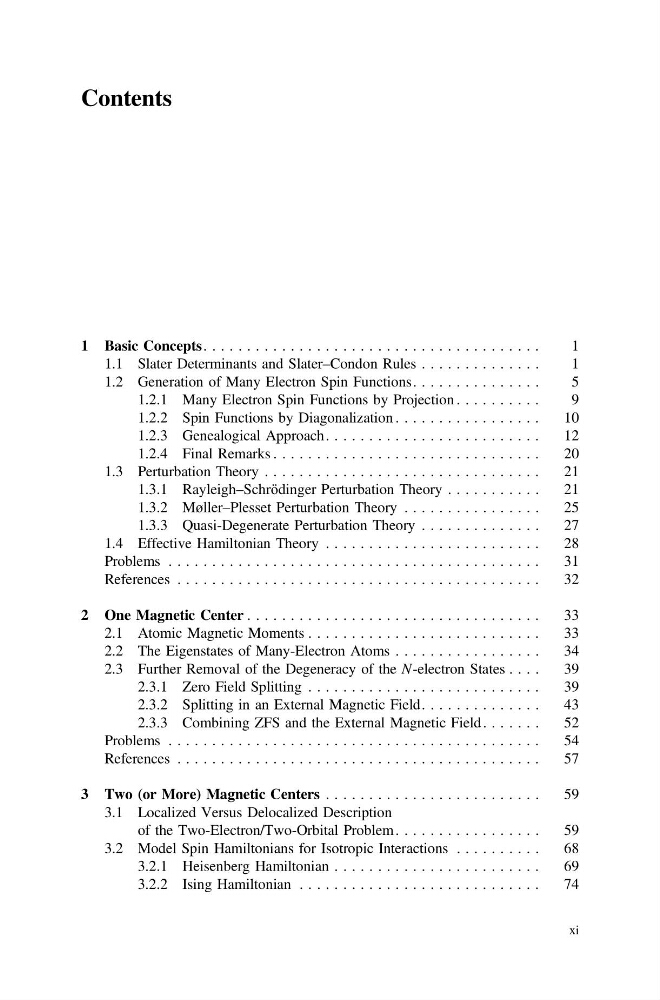
Contents
1 Basic Concepts .......................................
1
1.1 Slater Determinants and Slater–Condon Rules . . . . . . . . . . . . . .
1
1.2 Generation of Many Electron Spin Functions. . . . . . . . . . . . . . .
5
1.2.1 Many Electron Spin Functions by Projection . . . . . . . . . .
9
1.2.2 Spin Functions by Diagonalization . . . . . . . . . . . . . . . . .
10
1.2.3 Genealogical Approach. . . . . . . . . . . . . . . . . . . . . . . . .
12
1.2.4 Final Remarks . . . . . . . . . . . . . . . . . . . . . . . . . . . . . . .
20
1.3 Perturbation Theory . . . . . . . . . . . . . . . . . . . . . . . . . . . . . . . .
21
1.3.1 Rayleigh–Schrödinger Perturbation Theory . . . . . . . . . . .
21
1.3.2 Møller–Plesset Perturbation Theory . . . . . . . . . . . . . . . .
25
1.3.3 Quasi-Degenerate Perturbation Theory . . . . . . . . . . . . . .
27
1.4 Effective Hamiltonian Theory . . . . . . . . . . . . . . . . . . . . . . . . .
28
Problems . . . . . . . . . . . . . . . . . . . . . . . . . . . . . . . . . . . . . . . . . . .
31
References . . . . . . . . . . . . . . . . . . . . . . . . . . . . . . . . . . . . . . . . . .
32
2 One Magnetic Center ..................................
3 3
2.1 Atomic Magnetic Moments . . . . . . . . . . . . . . . . . . . . . . . . . . .
33
2.2 The Eigenstates of Many-Electron Atoms . . . . . . . . . . . . . . . . .
34
2.3 Further Removal of the Degeneracy of the N-electron States . . . .
39
2.3.1 Zero Field Splitting . . . . . . . . . . . . . . . . . . . . . . . . . . .
39
2.3.2 Splitting in an External Magnetic Field. . . . . . . . . . . . . .
43
2.3.3 Combining ZFS and the External Magnetic Field . . . . . . .
52
Problems . . . . . . . . . . . . . . . . . . . . . . . . . . . . . . . . . . . . . . . . . . .
54
References . . . . . . . . . . . . . . . . . . . . . . . . . . . . . . . . . . . . . . . . . .
57
3 Two (or More) Magnetic Centers .........................
5 9
3.1 Localized Versus Delocalized Description
of the Two-Electron/Two-Orbital Problem . . . . . . . . . . . . . . . . .
59
3.2 Model Spin Hamiltonians for Isotropic Interactions . . . . . . . . . .
68
3.2.1 Heisenberg Hamiltonian . . . . . . . . . . . . . . . . . . . . . . . .
69
3.2.2 Ising Hamiltonian . . . . . . . . . . . . . . . . . . . . . . . . . . . .
74
xi
1 Basic Concepts .......................................
1
1.1 Slater Determinants and Slater–Condon Rules . . . . . . . . . . . . . .
1
1.2 Generation of Many Electron Spin Functions. . . . . . . . . . . . . . .
5
1.2.1 Many Electron Spin Functions by Projection . . . . . . . . . .
9
1.2.2 Spin Functions by Diagonalization . . . . . . . . . . . . . . . . .
10
1.2.3 Genealogical Approach. . . . . . . . . . . . . . . . . . . . . . . . .
12
1.2.4 Final Remarks . . . . . . . . . . . . . . . . . . . . . . . . . . . . . . .
20
1.3 Perturbation Theory . . . . . . . . . . . . . . . . . . . . . . . . . . . . . . . .
21
1.3.1 Rayleigh–Schrödinger Perturbation Theory . . . . . . . . . . .
21
1.3.2 Møller–Plesset Perturbation Theory . . . . . . . . . . . . . . . .
25
1.3.3 Quasi-Degenerate Perturbation Theory . . . . . . . . . . . . . .
27
1.4 Effective Hamiltonian Theory . . . . . . . . . . . . . . . . . . . . . . . . .
28
Problems . . . . . . . . . . . . . . . . . . . . . . . . . . . . . . . . . . . . . . . . . . .
31
References . . . . . . . . . . . . . . . . . . . . . . . . . . . . . . . . . . . . . . . . . .
32
2 One Magnetic Center ..................................
3 3
2.1 Atomic Magnetic Moments . . . . . . . . . . . . . . . . . . . . . . . . . . .
33
2.2 The Eigenstates of Many-Electron Atoms . . . . . . . . . . . . . . . . .
34
2.3 Further Removal of the Degeneracy of the N-electron States . . . .
39
2.3.1 Zero Field Splitting . . . . . . . . . . . . . . . . . . . . . . . . . . .
39
2.3.2 Splitting in an External Magnetic Field. . . . . . . . . . . . . .
43
2.3.3 Combining ZFS and the External Magnetic Field . . . . . . .
52
Problems . . . . . . . . . . . . . . . . . . . . . . . . . . . . . . . . . . . . . . . . . . .
54
References . . . . . . . . . . . . . . . . . . . . . . . . . . . . . . . . . . . . . . . . . .
57
3 Two (or More) Magnetic Centers .........................
5 9
3.1 Localized Versus Delocalized Description
of the Two-Electron/Two-Orbital Problem . . . . . . . . . . . . . . . . .
59
3.2 Model Spin Hamiltonians for Isotropic Interactions . . . . . . . . . .
68
3.2.1 Heisenberg Hamiltonian . . . . . . . . . . . . . . . . . . . . . . . .
69
3.2.2 Ising Hamiltonian . . . . . . . . . . . . . . . . . . . . . . . . . . . .
74
xi