

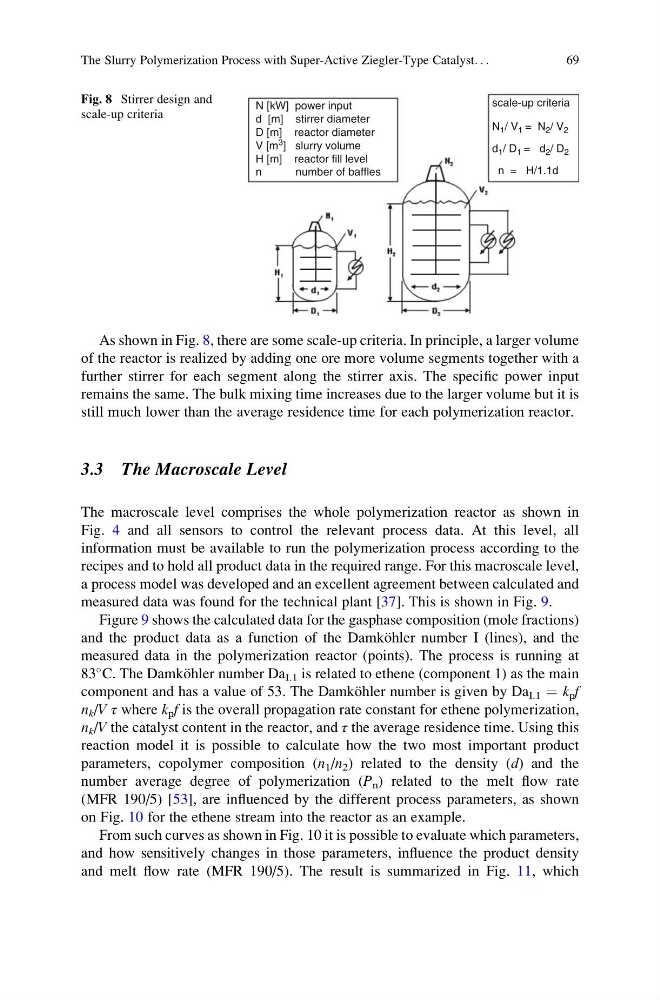
As shown in Fig. 8, there are some scale-up criteria. In principle, a larger volume
of the reactor is realized by adding one ore more volume segments together with a
further stirrer for each segment along the stirrer axis. The specific power input
remains the same. The bulk mixing time increases due to the larger volume but it is
still much lower than the average residence time for each polymerization reactor.
3.3 The Macroscale Level
The macroscale level comprises the whole polymerization reactor as shown in
Fig. 4 and all sensors to control the relevant process data. At this level, all
information must be available to run the polymerization process according to the
recipes and to hold all product data in the required range. For this macroscale level,
a process model was developed and an excellent agreement between calculated and
measured data was found for the technical plant [37]. This is shown in Fig. 9.
Figure 9 shows the calculated data for the gasphase composition (mole fractions)
and the product data as a function of the Damko ¨hler number I (lines), and the
measured data in the polymerization reactor (points). The process is running at
83
C. The Damko ¨hler number Da I.1 is related to ethene (component 1) as the main
component and has a value of 53. The Damko ¨hler number is given by Da I.1 ¼ k p f
n k /V τ where k p f is the overall propagation rate constant for ethene polymerization,
n k /V the catalyst content in the reactor, and τ the average residence time. Using this
reaction model it is possible to calculate how the two most important product
parameters, copolymer composition (n 1 /n 2 ) related to the density (d) and the
number average degree of polymerization (P n ) related to the melt flow rate
(MFR 190/5) [53], are influenced by the different process parameters, as shown
on Fig. 10 for the ethene stream into the reactor as an example.
From such curves as shown in Fig. 10 it is possible to evaluate which parameters,
and how sensitively changes in those parameters, influence the product density
and melt flow rate (MFR 190/5). The result is summarized in Fig. 11, which
N [kW] power input
d [m] stirrer diameter
D [m] reactor diameter
V [m 3 ] slurry volume
H [m] reactor fill level
n
number of baffles
scale-up criteria
N 1 / V 1 = N 2 / V 2
d 1 / D 1 = d 2 / D 2
n = H/1.1d
Fig. 8 Stirrer design and
scale-up criteria
The Slurry Polymerization Process with Super-Active Ziegler-Type Catalyst. . .
69
of the reactor is realized by adding one ore more volume segments together with a
further stirrer for each segment along the stirrer axis. The specific power input
remains the same. The bulk mixing time increases due to the larger volume but it is
still much lower than the average residence time for each polymerization reactor.
3.3 The Macroscale Level
The macroscale level comprises the whole polymerization reactor as shown in
Fig. 4 and all sensors to control the relevant process data. At this level, all
information must be available to run the polymerization process according to the
recipes and to hold all product data in the required range. For this macroscale level,
a process model was developed and an excellent agreement between calculated and
measured data was found for the technical plant [37]. This is shown in Fig. 9.
Figure 9 shows the calculated data for the gasphase composition (mole fractions)
and the product data as a function of the Damko ¨hler number I (lines), and the
measured data in the polymerization reactor (points). The process is running at
83
C. The Damko ¨hler number Da I.1 is related to ethene (component 1) as the main
component and has a value of 53. The Damko ¨hler number is given by Da I.1 ¼ k p f
n k /V τ where k p f is the overall propagation rate constant for ethene polymerization,
n k /V the catalyst content in the reactor, and τ the average residence time. Using this
reaction model it is possible to calculate how the two most important product
parameters, copolymer composition (n 1 /n 2 ) related to the density (d) and the
number average degree of polymerization (P n ) related to the melt flow rate
(MFR 190/5) [53], are influenced by the different process parameters, as shown
on Fig. 10 for the ethene stream into the reactor as an example.
From such curves as shown in Fig. 10 it is possible to evaluate which parameters,
and how sensitively changes in those parameters, influence the product density
and melt flow rate (MFR 190/5). The result is summarized in Fig. 11, which
N [kW] power input
d [m] stirrer diameter
D [m] reactor diameter
V [m 3 ] slurry volume
H [m] reactor fill level
n
number of baffles
scale-up criteria
N 1 / V 1 = N 2 / V 2
d 1 / D 1 = d 2 / D 2
n = H/1.1d
Fig. 8 Stirrer design and
scale-up criteria
The Slurry Polymerization Process with Super-Active Ziegler-Type Catalyst. . .
69