

the active sites at the outer surface of the catalyst particle start to polymerize.
Further activation of the titanium complexes is achieved in the polymerization
vessel by the diffusion of the dissolved aluminumalkyl compound into the
polymerizing particle to create further active centers. This means that the activity
increases over time to finally reach maximum activity. This activation process
can be influenced via the aluminumalkyl compound used as cocatalyst, via the
preactivation step of the virgin catalyst, and via the concentration of the aluminumalkyl compound in the polymerization reactor to realize the best start-up
behavior without any problems due to overheating of the polymerizing particle.
This demonstrates that there are many parameters for optimizing the start-up
behavior as well as the overall performance of the catalyst–cocatalyst system.
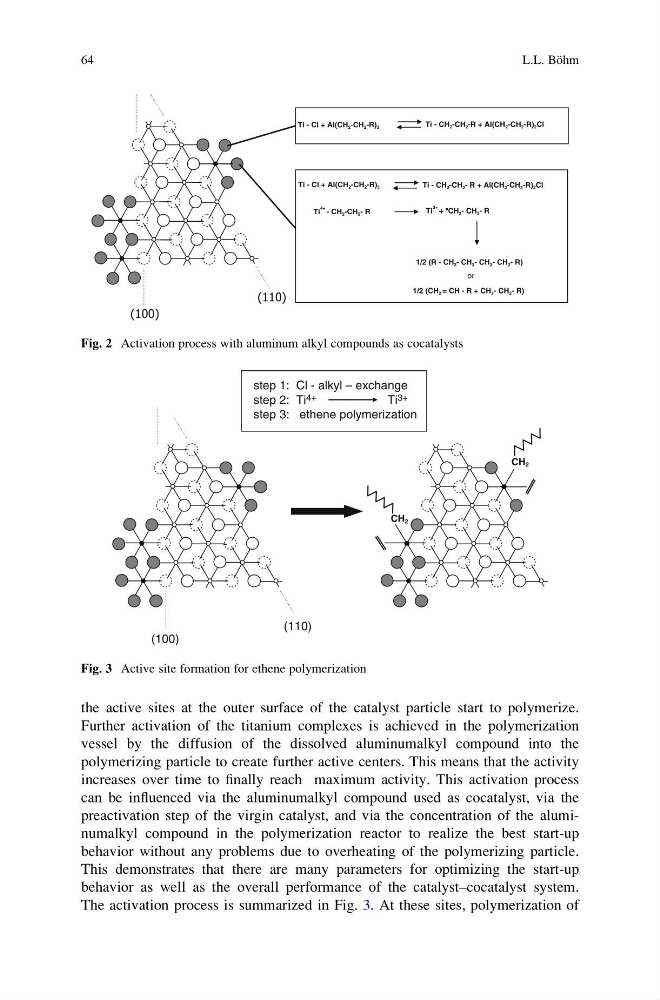
The activation process is summarized in Fig. 3. At these sites, polymerization of
(110)
(100)
Ti - Cl + Al(CH2-CH2-R)3
Ti - CH2-CH2-R + Al(CH2-CH2-R)2Cl
Ti - Cl + Al(CH2-CH2-R)3
Ti - CH2-CH2- R + Al(CH2-CH2-R)2Cl
Ti
4+ - CH2-CH2- R
Ti
3+ + + •CH 2- CH2- R
1/2 (R - CH2- CH2- CH2- CH2- R)
1/2 (CH2 = CH - R + CH3- CH2- R)
or
Fig. 2 Activation process with aluminum alkyl compounds as cocatalysts
CH2
CH2
(100)
(110)
step 1: Cl - alkyl – exchange
step 2: Ti 4+
Ti 3+
step 3: ethene polymerization
Fig. 3 Active site formation for ethene polymerization
64
L.L. Bo ¨hm
Further activation of the titanium complexes is achieved in the polymerization
vessel by the diffusion of the dissolved aluminumalkyl compound into the
polymerizing particle to create further active centers. This means that the activity
increases over time to finally reach maximum activity. This activation process
can be influenced via the aluminumalkyl compound used as cocatalyst, via the
preactivation step of the virgin catalyst, and via the concentration of the aluminumalkyl compound in the polymerization reactor to realize the best start-up
behavior without any problems due to overheating of the polymerizing particle.
This demonstrates that there are many parameters for optimizing the start-up
behavior as well as the overall performance of the catalyst–cocatalyst system.
The activation process is summarized in Fig. 3. At these sites, polymerization of
(110)
(100)
Ti - Cl + Al(CH2-CH2-R)3
Ti - CH2-CH2-R + Al(CH2-CH2-R)2Cl
Ti - Cl + Al(CH2-CH2-R)3
Ti - CH2-CH2- R + Al(CH2-CH2-R)2Cl
Ti
4+ - CH2-CH2- R
Ti
3+ + + •CH 2- CH2- R
1/2 (R - CH2- CH2- CH2- CH2- R)
1/2 (CH2 = CH - R + CH3- CH2- R)
or
Fig. 2 Activation process with aluminum alkyl compounds as cocatalysts
CH2
CH2
(100)
(110)
step 1: Cl - alkyl – exchange
step 2: Ti 4+
Ti 3+
step 3: ethene polymerization
Fig. 3 Active site formation for ethene polymerization
64
L.L. Bo ¨hm