

2 Super-Active Catalysts
The breakthrough in preparation of super-active Ti-based catalysts was achieved
by using anhydrous δ MgCl 2 as a support being treated with TiCl 4 in a hydrocarbon
diluent [11–18]. The reason for this outstanding role of δ MgCl 2 is its crystal
structure in comparison to δ TiCl 3 , as shown on Table 1.
At the δ MgCl 2 surface, TiCl 4 can be bound as described by Corradini et al.
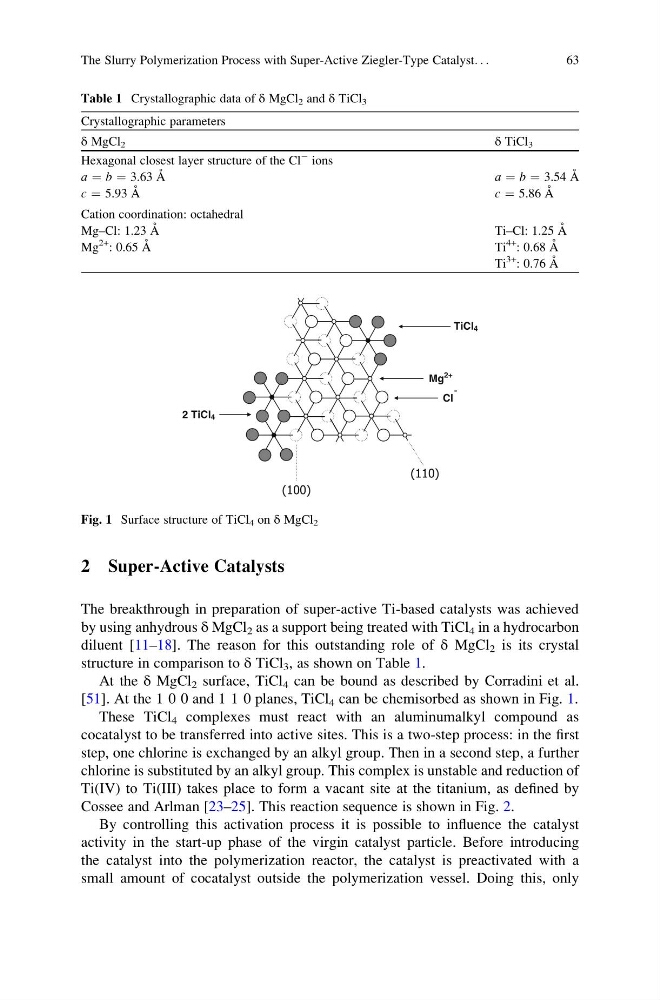
[51]. At the 1 0 0 and 1 1 0 planes, TiCl 4 can be chemisorbed as shown in Fig. 1.
These TiCl 4 complexes must react with an aluminumalkyl compound as
cocatalyst to be transferred into active sites. This is a two-step process: in the first
step, one chlorine is exchanged by an alkyl group. Then in a second step, a further
chlorine is substituted by an alkyl group. This complex is unstable and reduction of
Ti(IV) to Ti(III) takes place to form a vacant site at the titanium, as defined by
Cossee and Arlman [23–25]. This reaction sequence is shown in Fig. 2.
By controlling this activation process it is possible to influence the catalyst
activity in the start-up phase of the virgin catalyst particle. Before introducing
the catalyst into the polymerization reactor, the catalyst is preactivated with a
small amount of cocatalyst outside the polymerization vessel. Doing this, only
Table 1 Crystallographic data of δ MgCl 2 and δ TiCl 3
Crystallographic parameters
δ MgCl 2
δ TiCl 3
Hexagonal closest layer structure of the Cl
À ions
a ¼ b ¼ 3.63 A ˚
a ¼ b ¼ 3.54 A ˚
c ¼ 5.93 A ˚
c ¼ 5.86 A ˚
Cation coordination: octahedral
Mg–Cl: 1.23 A ˚
Ti–Cl: 1.25 A ˚
Mg
2+ : 0.65 A ˚
Ti
4+ : 0.68 A ˚
Ti
3+ : 0.76 A ˚
(110)
(100)
Mg
2+
Cl
-
TiCl4
2 TiCl4
Fig. 1 Surface structure of TiCl 4 on δ MgCl 2
The Slurry Polymerization Process with Super-Active Ziegler-Type Catalyst. . .
63
The breakthrough in preparation of super-active Ti-based catalysts was achieved
by using anhydrous δ MgCl 2 as a support being treated with TiCl 4 in a hydrocarbon
diluent [11–18]. The reason for this outstanding role of δ MgCl 2 is its crystal
structure in comparison to δ TiCl 3 , as shown on Table 1.
At the δ MgCl 2 surface, TiCl 4 can be bound as described by Corradini et al.
[51]. At the 1 0 0 and 1 1 0 planes, TiCl 4 can be chemisorbed as shown in Fig. 1.
These TiCl 4 complexes must react with an aluminumalkyl compound as
cocatalyst to be transferred into active sites. This is a two-step process: in the first
step, one chlorine is exchanged by an alkyl group. Then in a second step, a further
chlorine is substituted by an alkyl group. This complex is unstable and reduction of
Ti(IV) to Ti(III) takes place to form a vacant site at the titanium, as defined by
Cossee and Arlman [23–25]. This reaction sequence is shown in Fig. 2.
By controlling this activation process it is possible to influence the catalyst
activity in the start-up phase of the virgin catalyst particle. Before introducing
the catalyst into the polymerization reactor, the catalyst is preactivated with a
small amount of cocatalyst outside the polymerization vessel. Doing this, only
Table 1 Crystallographic data of δ MgCl 2 and δ TiCl 3
Crystallographic parameters
δ MgCl 2
δ TiCl 3
Hexagonal closest layer structure of the Cl
À ions
a ¼ b ¼ 3.63 A ˚
a ¼ b ¼ 3.54 A ˚
c ¼ 5.93 A ˚
c ¼ 5.86 A ˚
Cation coordination: octahedral
Mg–Cl: 1.23 A ˚
Ti–Cl: 1.25 A ˚
Mg
2+ : 0.65 A ˚
Ti
4+ : 0.68 A ˚
Ti
3+ : 0.76 A ˚
(110)
(100)
Mg
2+
Cl
-
TiCl4
2 TiCl4
Fig. 1 Surface structure of TiCl 4 on δ MgCl 2
The Slurry Polymerization Process with Super-Active Ziegler-Type Catalyst. . .
63