

Industrial Chemistry, at Turin Polytechnic first and at Milan Polytechnic from 1938
until his retirement in 1973. As for many academic chemists in Europe at that time, the
forthcoming war prompted Natta to move the focus of his research to the synthesis of
strategic materials. In particular, he expanded his studies in catalysis, which were
pre-existing and had already led him to important achievements in oxosynthesis in the
early 1930s, to the production of synthetic rubber. The interest in polymers with
elastomeric properties never faded, and is another key part of the puzzle. After the
war, Italy entered the most vital and productive period of its recent history, and the
Italian chemical industry began an impressive growth. At that point Fate played a wild
card and made the young Natta meet Piero Giustiniani, on the way to becoming CEO
of Montecatini, one of the largest and most advanced Italian chemical companies. The
two began a collaboration that in 1947 led them to travel to the USA, where they
discovered the modern organization of the American chemical companies, employing
hundreds of researchers and well ahead in the transition from coal to oil chemistry.
That journey imprinted both of them and resulted in a strategic alliance that made
Montecatini associate Natta as a consultant and establish at the Milan Polytechnic
an “Advanced School in Aliphatic Chemistry,” where brilliant chemistry and chemical
engineering graduates from all over Italy received hands-on research training in
chemical syntheses and characterizations. They joined the academic staff on fundamental and applied projects under Natta’s leadership, in most cases in preparation to
a career in Montecatini. The modernity of this organization, with a strong multidisciplinary character and a simple albeit efficient structure, amazes me when I
compare it with the present painful situation of Italian chemical research. When in
1952 Natta attended the Achema Conference in Frankfurt, where Karl Ziegler gave an
account of his work on the “Aufbau-Reaktion,” all parts of the puzzle could perfectly
fit together. Natta had no difficulty in convincing Giustiniani and Montecatini to
contract Ziegler as a consultant and to take a license on the developments of
Al-mediated ethene oligomerization, even though the real industrial interest of that
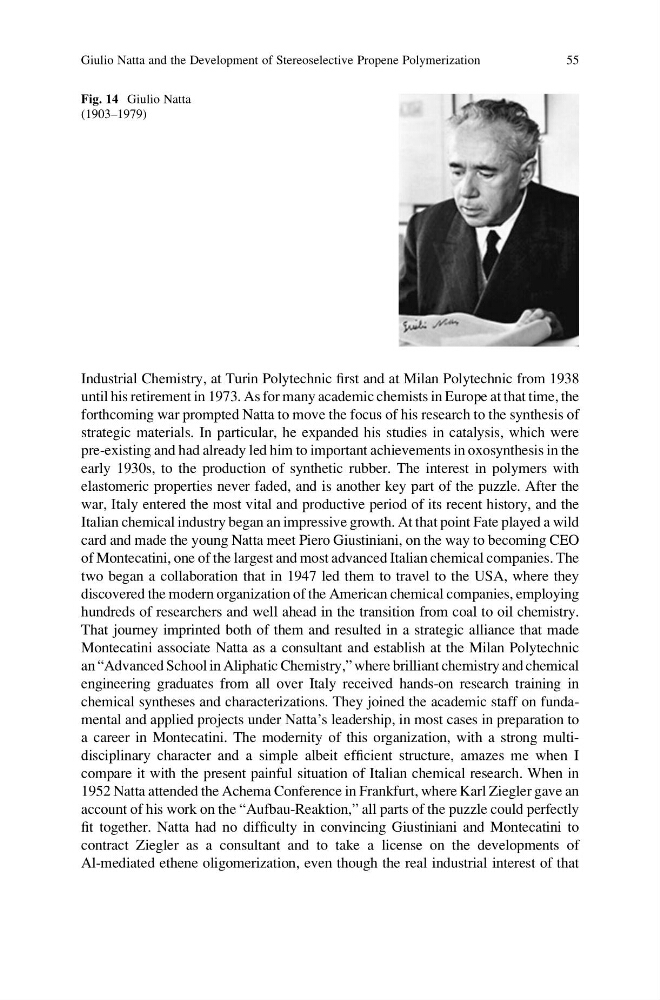
Fig. 14 Giulio Natta
(1903–1979)
Giulio Natta and the Development of Stereoselective Propene Polymerization
55
until his retirement in 1973. As for many academic chemists in Europe at that time, the
forthcoming war prompted Natta to move the focus of his research to the synthesis of
strategic materials. In particular, he expanded his studies in catalysis, which were
pre-existing and had already led him to important achievements in oxosynthesis in the
early 1930s, to the production of synthetic rubber. The interest in polymers with
elastomeric properties never faded, and is another key part of the puzzle. After the
war, Italy entered the most vital and productive period of its recent history, and the
Italian chemical industry began an impressive growth. At that point Fate played a wild
card and made the young Natta meet Piero Giustiniani, on the way to becoming CEO
of Montecatini, one of the largest and most advanced Italian chemical companies. The
two began a collaboration that in 1947 led them to travel to the USA, where they
discovered the modern organization of the American chemical companies, employing
hundreds of researchers and well ahead in the transition from coal to oil chemistry.
That journey imprinted both of them and resulted in a strategic alliance that made
Montecatini associate Natta as a consultant and establish at the Milan Polytechnic
an “Advanced School in Aliphatic Chemistry,” where brilliant chemistry and chemical
engineering graduates from all over Italy received hands-on research training in
chemical syntheses and characterizations. They joined the academic staff on fundamental and applied projects under Natta’s leadership, in most cases in preparation to
a career in Montecatini. The modernity of this organization, with a strong multidisciplinary character and a simple albeit efficient structure, amazes me when I
compare it with the present painful situation of Italian chemical research. When in
1952 Natta attended the Achema Conference in Frankfurt, where Karl Ziegler gave an
account of his work on the “Aufbau-Reaktion,” all parts of the puzzle could perfectly
fit together. Natta had no difficulty in convincing Giustiniani and Montecatini to
contract Ziegler as a consultant and to take a license on the developments of
Al-mediated ethene oligomerization, even though the real industrial interest of that
Fig. 14 Giulio Natta
(1903–1979)
Giulio Natta and the Development of Stereoselective Propene Polymerization
55