

fragmentation, which progresses concentrically from the surface to the center of the
support particles. This comprehensive kinetic and mathematical polymer growth
and particle expansion model [41, 48] – based on the ideas of the multigrain model
[49–51] and extended for this complex polymerization process – includes the rate
constants for all relevant activation, propagation, transfer, and termination steps
and also for the different diffusion coefficients.
It was intended to observe the initial polymer growth directly below the
forming polymer shell. Therefore, the active centers on the particle surface were
specifically deactivated, and a catalyst prepared in such a way was used for
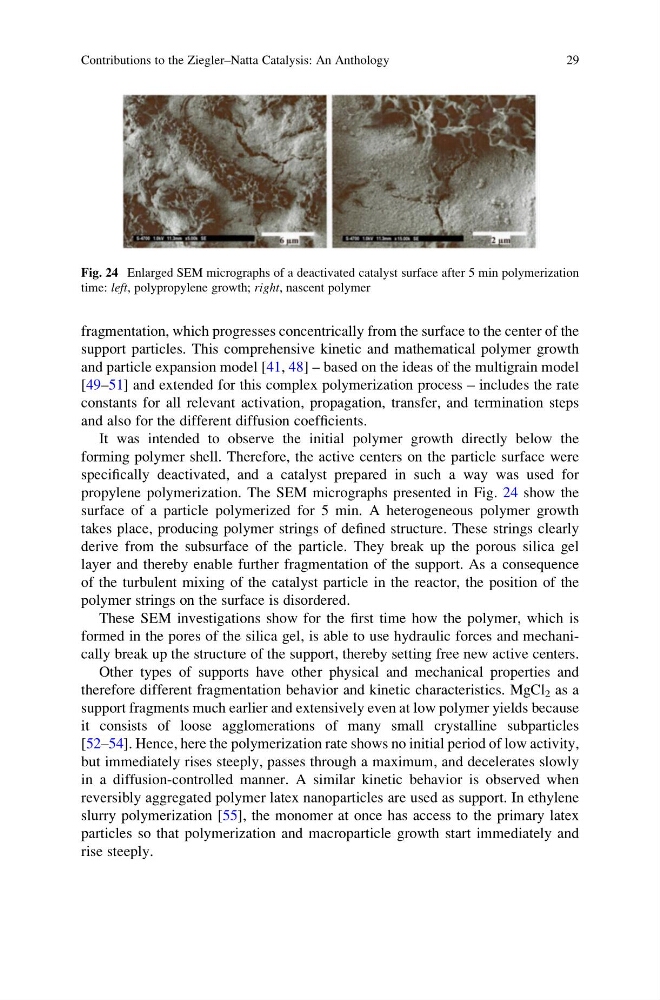
propylene polymerization. The SEM micrographs presented in Fig. 24 show the
surface of a particle polymerized for 5 min. A heterogeneous polymer growth
takes place, producing polymer strings of defined structure. These strings clearly
derive from the subsurface of the particle. They break up the porous silica gel
layer and thereby enable further fragmentation of the support. As a consequence
of the turbulent mixing of the catalyst particle in the reactor, the position of the
polymer strings on the surface is disordered.
These SEM investigations show for the first time how the polymer, which is
formed in the pores of the silica gel, is able to use hydraulic forces and mechanically break up the structure of the support, thereby setting free new active centers.
Other types of supports have other physical and mechanical properties and
therefore different fragmentation behavior and kinetic characteristics. MgCl 2 as a
support fragments much earlier and extensively even at low polymer yields because
it consists of loose agglomerations of many small crystalline subparticles
[52–54]. Hence, here the polymerization rate shows no initial period of low activity,
but immediately rises steeply, passes through a maximum, and decelerates slowly
in a diffusion-controlled manner. A similar kinetic behavior is observed when
reversibly aggregated polymer latex nanoparticles are used as support. In ethylene
slurry polymerization [55], the monomer at once has access to the primary latex
particles so that polymerization and macroparticle growth start immediately and
rise steeply.
Fig. 24 Enlarged SEM micrographs of a deactivated catalyst surface after 5 min polymerization
time: left, polypropylene growth; right, nascent polymer
Contributions to the Ziegler–Natta Catalysis: An Anthology
29
support particles. This comprehensive kinetic and mathematical polymer growth
and particle expansion model [41, 48] – based on the ideas of the multigrain model
[49–51] and extended for this complex polymerization process – includes the rate
constants for all relevant activation, propagation, transfer, and termination steps
and also for the different diffusion coefficients.
It was intended to observe the initial polymer growth directly below the
forming polymer shell. Therefore, the active centers on the particle surface were
specifically deactivated, and a catalyst prepared in such a way was used for
propylene polymerization. The SEM micrographs presented in Fig. 24 show the
surface of a particle polymerized for 5 min. A heterogeneous polymer growth
takes place, producing polymer strings of defined structure. These strings clearly
derive from the subsurface of the particle. They break up the porous silica gel
layer and thereby enable further fragmentation of the support. As a consequence
of the turbulent mixing of the catalyst particle in the reactor, the position of the
polymer strings on the surface is disordered.
These SEM investigations show for the first time how the polymer, which is
formed in the pores of the silica gel, is able to use hydraulic forces and mechanically break up the structure of the support, thereby setting free new active centers.
Other types of supports have other physical and mechanical properties and
therefore different fragmentation behavior and kinetic characteristics. MgCl 2 as a
support fragments much earlier and extensively even at low polymer yields because
it consists of loose agglomerations of many small crystalline subparticles
[52–54]. Hence, here the polymerization rate shows no initial period of low activity,
but immediately rises steeply, passes through a maximum, and decelerates slowly
in a diffusion-controlled manner. A similar kinetic behavior is observed when
reversibly aggregated polymer latex nanoparticles are used as support. In ethylene
slurry polymerization [55], the monomer at once has access to the primary latex
particles so that polymerization and macroparticle growth start immediately and
rise steeply.
Fig. 24 Enlarged SEM micrographs of a deactivated catalyst surface after 5 min polymerization
time: left, polypropylene growth; right, nascent polymer
Contributions to the Ziegler–Natta Catalysis: An Anthology
29