

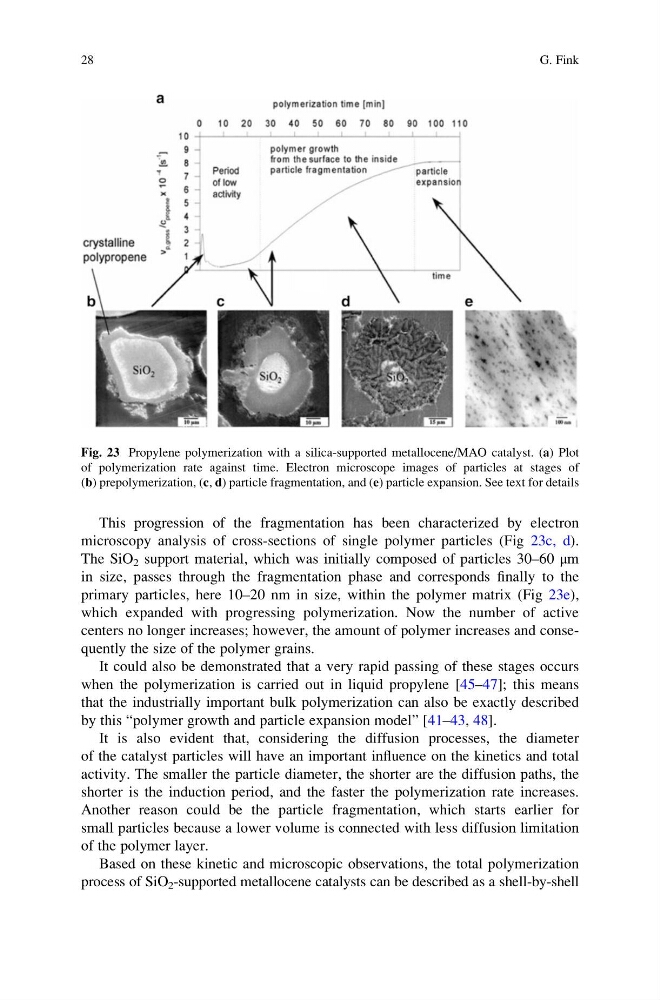
This progression of the fragmentation has been characterized by electron
microscopy analysis of cross-sections of single polymer particles (Fig 23c, d).
The SiO 2 support material, which was initially composed of particles 30–60 μm
in size, passes through the fragmentation phase and corresponds finally to the
primary particles, here 10–20 nm in size, within the polymer matrix (Fig 23e),
which expanded with progressing polymerization. Now the number of active
centers no longer increases; however, the amount of polymer increases and consequently the size of the polymer grains.
It could also be demonstrated that a very rapid passing of these stages occurs
when the polymerization is carried out in liquid propylene [45–47]; this means
that the industrially important bulk polymerization can also be exactly described
by this “polymer growth and particle expansion model” [41–43, 48].
It is also evident that, considering the diffusion processes, the diameter
of the catalyst particles will have an important influence on the kinetics and total
activity. The smaller the particle diameter, the shorter are the diffusion paths, the
shorter is the induction period, and the faster the polymerization rate increases.
Another reason could be the particle fragmentation, which starts earlier for
small particles because a lower volume is connected with less diffusion limitation
of the polymer layer.
Based on these kinetic and microscopic observations, the total polymerization
process of SiO 2 -supported metallocene catalysts can be described as a shell-by-shell
Fig. 23 Propylene polymerization with a silica-supported metallocene/MAO catalyst. (a) Plot
of polymerization rate against time. Electron microscope images of particles at stages of
(b) prepolymerization, (c, d) particle fragmentation, and (e) particle expansion. See text for details
28
G. Fink
microscopy analysis of cross-sections of single polymer particles (Fig 23c, d).
The SiO 2 support material, which was initially composed of particles 30–60 μm
in size, passes through the fragmentation phase and corresponds finally to the
primary particles, here 10–20 nm in size, within the polymer matrix (Fig 23e),
which expanded with progressing polymerization. Now the number of active
centers no longer increases; however, the amount of polymer increases and consequently the size of the polymer grains.
It could also be demonstrated that a very rapid passing of these stages occurs
when the polymerization is carried out in liquid propylene [45–47]; this means
that the industrially important bulk polymerization can also be exactly described
by this “polymer growth and particle expansion model” [41–43, 48].
It is also evident that, considering the diffusion processes, the diameter
of the catalyst particles will have an important influence on the kinetics and total
activity. The smaller the particle diameter, the shorter are the diffusion paths, the
shorter is the induction period, and the faster the polymerization rate increases.
Another reason could be the particle fragmentation, which starts earlier for
small particles because a lower volume is connected with less diffusion limitation
of the polymer layer.
Based on these kinetic and microscopic observations, the total polymerization
process of SiO 2 -supported metallocene catalysts can be described as a shell-by-shell
Fig. 23 Propylene polymerization with a silica-supported metallocene/MAO catalyst. (a) Plot
of polymerization rate against time. Electron microscope images of particles at stages of
(b) prepolymerization, (c, d) particle fragmentation, and (e) particle expansion. See text for details
28
G. Fink