

contributions on this theme, e.g., from Busico [27], Kaminsky and Sinn [28], and
Brintzinger and Fischer [29].
The chiral metallocene-based catalysts are characterized by a defined active
center, forming a sound basis for establishing relationships between the molecular
structure of the catalyst and the microstructure of the resulting polymer. Catalyst–
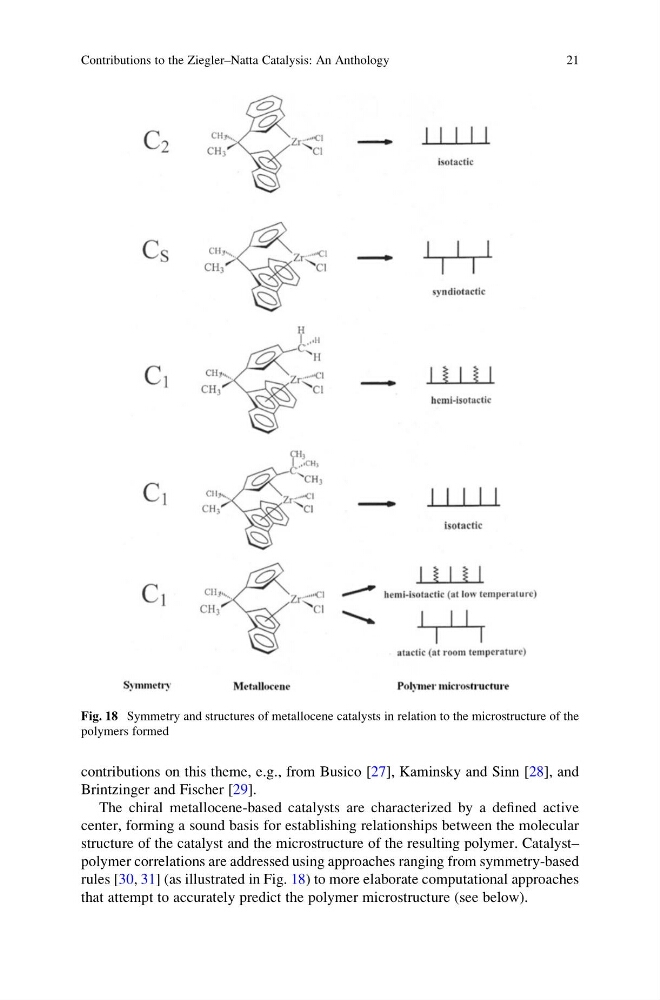
polymer correlations are addressed using approaches ranging from symmetry-based
rules [30, 31] (as illustrated in Fig. 18) to more elaborate computational approaches
that attempt to accurately predict the polymer microstructure (see below).
Fig. 18 Symmetry and structures of metallocene catalysts in relation to the microstructure of the
polymers formed
Contributions to the Ziegler–Natta Catalysis: An Anthology
21
Brintzinger and Fischer [29].
The chiral metallocene-based catalysts are characterized by a defined active
center, forming a sound basis for establishing relationships between the molecular
structure of the catalyst and the microstructure of the resulting polymer. Catalyst–
polymer correlations are addressed using approaches ranging from symmetry-based
rules [30, 31] (as illustrated in Fig. 18) to more elaborate computational approaches
that attempt to accurately predict the polymer microstructure (see below).
Fig. 18 Symmetry and structures of metallocene catalysts in relation to the microstructure of the
polymers formed
Contributions to the Ziegler–Natta Catalysis: An Anthology
21