

analyzed as shown in the analysis of ethylene octene copolymers in Fig. 32.
Another advantage of SGIC2D is that a light scattering or viscometer detector
could be added in the second isocratic dimension.
Ginsburg et al. [118] have used SGIC2D for the characterization of ethylene
propylene and ethylene propylene diene (EPDM) rubbers; the technique provides
a new approach to full characterization of resins in terms of composition–molar
mass interdependence that cannot be fully analyzed by TREF-GPC because of
the low crystallinity of the resins. Cheruthazhekatt et al. [119] have used SGIC2D
together with other techniques to fully characterize high impact polypropylene.
The SGIC technique attracted interest at the recent International Conference
on Polyolefin Characterization (ICPC, Houston, October 2012), with general
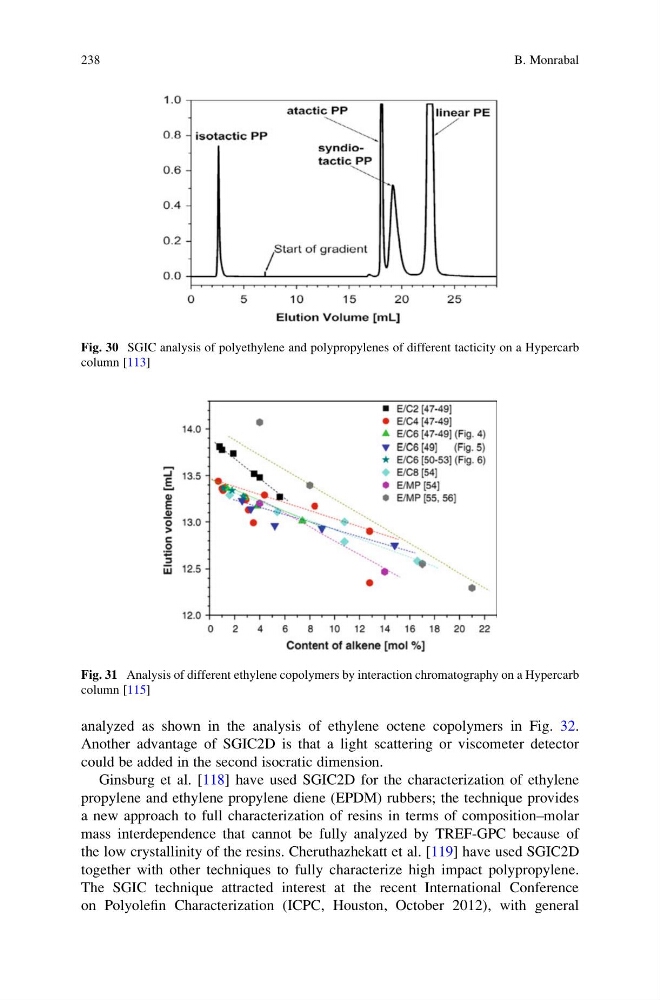
Fig. 31 Analysis of different ethylene copolymers by interaction chromatography on a Hypercarb
column [115]
Fig. 30 SGIC analysis of polyethylene and polypropylenes of different tacticity on a Hypercarb
column [113]
238
B. Monrabal
Another advantage of SGIC2D is that a light scattering or viscometer detector
could be added in the second isocratic dimension.
Ginsburg et al. [118] have used SGIC2D for the characterization of ethylene
propylene and ethylene propylene diene (EPDM) rubbers; the technique provides
a new approach to full characterization of resins in terms of composition–molar
mass interdependence that cannot be fully analyzed by TREF-GPC because of
the low crystallinity of the resins. Cheruthazhekatt et al. [119] have used SGIC2D
together with other techniques to fully characterize high impact polypropylene.
The SGIC technique attracted interest at the recent International Conference
on Polyolefin Characterization (ICPC, Houston, October 2012), with general
Fig. 31 Analysis of different ethylene copolymers by interaction chromatography on a Hypercarb
column [115]
Fig. 30 SGIC analysis of polyethylene and polypropylenes of different tacticity on a Hypercarb
column [113]
238
B. Monrabal