

other components of lower crystallinity, still in solution, move along the column
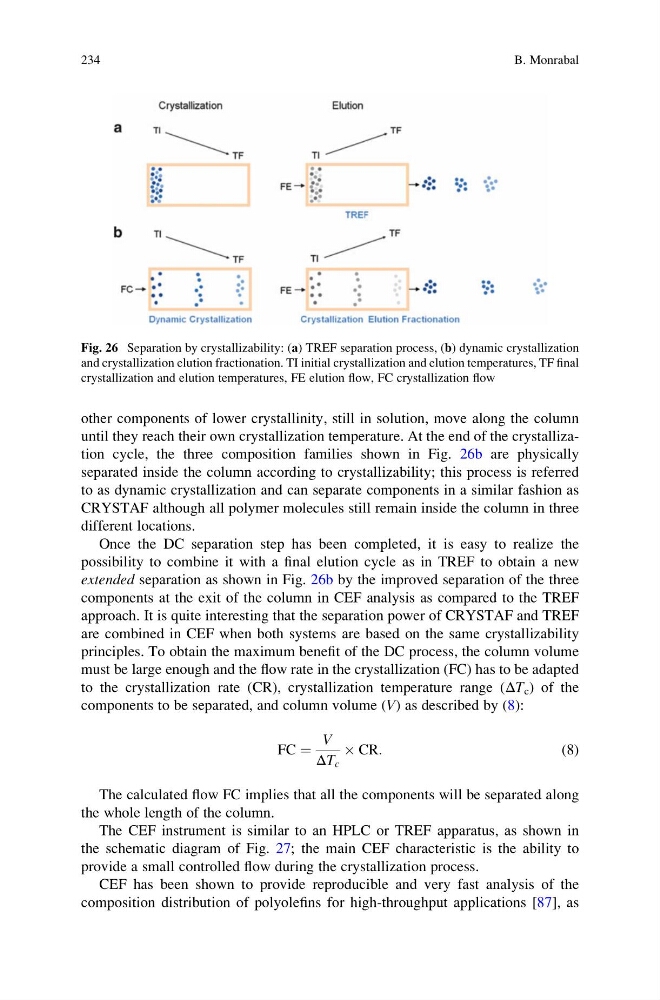
until they reach their own crystallization temperature. At the end of the crystallization cycle, the three composition families shown in Fig. 26b are physically
separated inside the column according to crystallizability; this process is referred
to as dynamic crystallization and can separate components in a similar fashion as
CRYSTAF although all polymer molecules still remain inside the column in three
different locations.
Once the DC separation step has been completed, it is easy to realize the
possibility to combine it with a final elution cycle as in TREF to obtain a new
extended separation as shown in Fig. 26b by the improved separation of the three
components at the exit of the column in CEF analysis as compared to the TREF
approach. It is quite interesting that the separation power of CRYSTAF and TREF
are combined in CEF when both systems are based on the same crystallizability
principles. To obtain the maximum benefit of the DC process, the column volume
must be large enough and the flow rate in the crystallization (FC) has to be adapted
to the crystallization rate (CR), crystallization temperature range (ΔT c ) of the
components to be separated, and column volume (V) as described by (8):
FC ¼
V
ΔT c
 CR:
(8)
The calculated flow FC implies that all the components will be separated along
the whole length of the column.
The CEF instrument is similar to an HPLC or TREF apparatus, as shown in
the schematic diagram of Fig. 27; the main CEF characteristic is the ability to
provide a small controlled flow during the crystallization process.
CEF has been shown to provide reproducible and very fast analysis of the
composition distribution of polyolefins for high-throughput applications [87], as
Fig. 26 Separation by crystallizability: (a) TREF separation process, (b) dynamic crystallization
and crystallization elution fractionation. TI initial crystallization and elution temperatures, TF final
crystallization and elution temperatures, FE elution flow, FC crystallization flow
234
B. Monrabal
until they reach their own crystallization temperature. At the end of the crystallization cycle, the three composition families shown in Fig. 26b are physically
separated inside the column according to crystallizability; this process is referred
to as dynamic crystallization and can separate components in a similar fashion as
CRYSTAF although all polymer molecules still remain inside the column in three
different locations.
Once the DC separation step has been completed, it is easy to realize the
possibility to combine it with a final elution cycle as in TREF to obtain a new
extended separation as shown in Fig. 26b by the improved separation of the three
components at the exit of the column in CEF analysis as compared to the TREF
approach. It is quite interesting that the separation power of CRYSTAF and TREF
are combined in CEF when both systems are based on the same crystallizability
principles. To obtain the maximum benefit of the DC process, the column volume
must be large enough and the flow rate in the crystallization (FC) has to be adapted
to the crystallization rate (CR), crystallization temperature range (ΔT c ) of the
components to be separated, and column volume (V) as described by (8):
FC ¼
V
ΔT c
 CR:
(8)
The calculated flow FC implies that all the components will be separated along
the whole length of the column.
The CEF instrument is similar to an HPLC or TREF apparatus, as shown in
the schematic diagram of Fig. 27; the main CEF characteristic is the ability to
provide a small controlled flow during the crystallization process.
CEF has been shown to provide reproducible and very fast analysis of the
composition distribution of polyolefins for high-throughput applications [87], as
Fig. 26 Separation by crystallizability: (a) TREF separation process, (b) dynamic crystallization
and crystallization elution fractionation. TI initial crystallization and elution temperatures, TF final
crystallization and elution temperatures, FE elution flow, FC crystallization flow
234
B. Monrabal