

4.1.4 Crystallization Elution Fractionation
Crystallization elution fractionation (CEF) is a new separation technique developed
by Monrabal [102] for the analysis of the CCD that combines the separation power
of CRYSTAF and TREF. The CEF technique is based on a new and patented
separation principle, referred to as dynamic crystallization (DC) [87], that separates
fractions inside a column according to crystallizability while a small flow of solvent
passes through the column. The separation by DC occurs during the crystallization
step. CEF combines the separation power of DC in the crystallization step with the
separation during dissolution of the TREF technique.
The principles of DC and CEF are presented in Fig. 26 and compared with
classical TREF analysis. In TREF, the crystal aggregates formed during crystallization from the various composition families in the resin are all mixed together
at the column spot where the sample was loaded. In Fig. 26a, the three different
composition families crystallized in this example are deposited at the head of the
column with no physical separation of the corresponding molecules. The physical
separation in TREF takes place in the elution cycle.
CEF analysis follows similar steps as in TREF, but during the crystallization
cycle a small solvent flow, FC, is passed through the column in such a way that
when molecules of a given composition reach their crystallization temperature,
they are segregated from solution and anchored on the support. Meanwhile, the
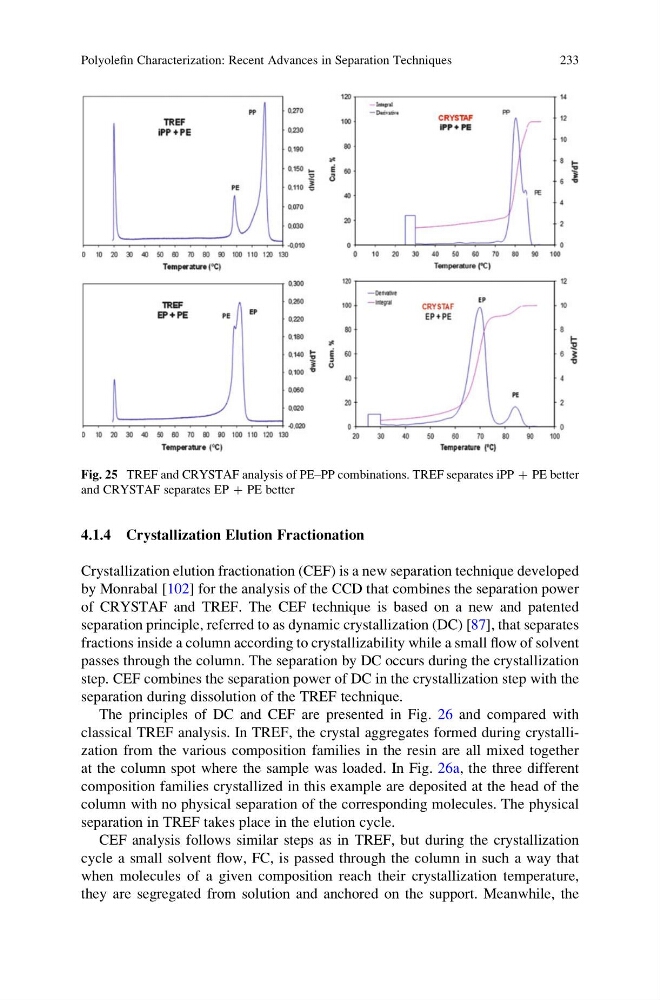
Fig. 25 TREF and CRYSTAF analysis of PE–PP combinations. TREF separates iPP þ PE better
and CRYSTAF separates EP þ PE better
Polyolefin Characterization: Recent Advances in Separation Techniques
233
Crystallization elution fractionation (CEF) is a new separation technique developed
by Monrabal [102] for the analysis of the CCD that combines the separation power
of CRYSTAF and TREF. The CEF technique is based on a new and patented
separation principle, referred to as dynamic crystallization (DC) [87], that separates
fractions inside a column according to crystallizability while a small flow of solvent
passes through the column. The separation by DC occurs during the crystallization
step. CEF combines the separation power of DC in the crystallization step with the
separation during dissolution of the TREF technique.
The principles of DC and CEF are presented in Fig. 26 and compared with
classical TREF analysis. In TREF, the crystal aggregates formed during crystallization from the various composition families in the resin are all mixed together
at the column spot where the sample was loaded. In Fig. 26a, the three different
composition families crystallized in this example are deposited at the head of the
column with no physical separation of the corresponding molecules. The physical
separation in TREF takes place in the elution cycle.
CEF analysis follows similar steps as in TREF, but during the crystallization
cycle a small solvent flow, FC, is passed through the column in such a way that
when molecules of a given composition reach their crystallization temperature,
they are segregated from solution and anchored on the support. Meanwhile, the
Fig. 25 TREF and CRYSTAF analysis of PE–PP combinations. TREF separates iPP þ PE better
and CRYSTAF separates EP þ PE better
Polyolefin Characterization: Recent Advances in Separation Techniques
233