

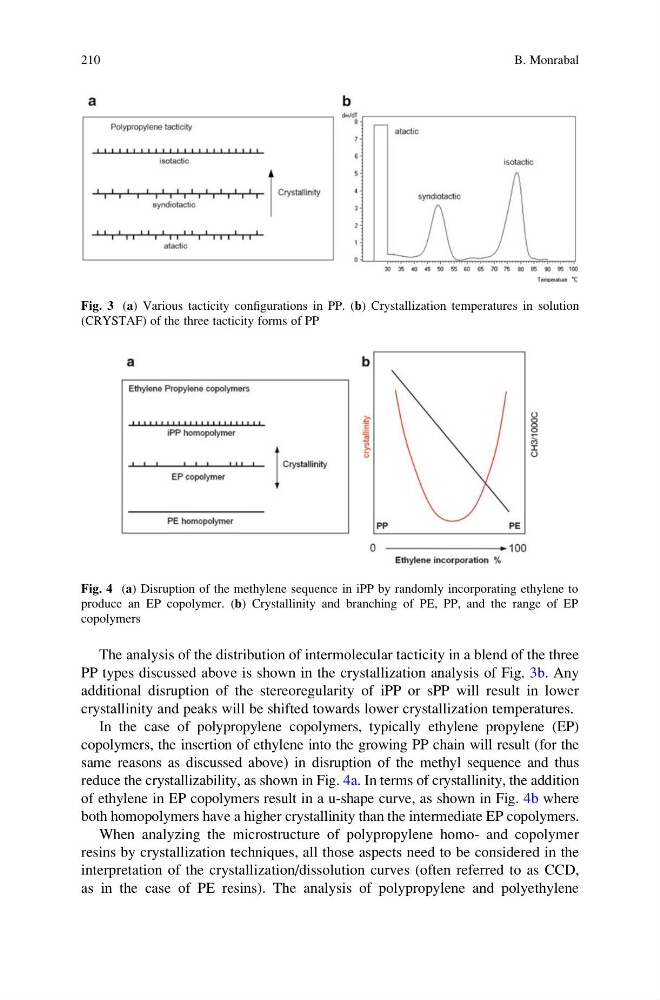
The analysis of the distribution of intermolecular tacticity in a blend of the three
PP types discussed above is shown in the crystallization analysis of Fig. 3b. Any
additional disruption of the stereoregularity of iPP or sPP will result in lower
crystallinity and peaks will be shifted towards lower crystallization temperatures.
In the case of polypropylene copolymers, typically ethylene propylene (EP)
copolymers, the insertion of ethylene into the growing PP chain will result (for the
same reasons as discussed above) in disruption of the methyl sequence and thus
reduce the crystallizability, as shown in Fig. 4a. In terms of crystallinity, the addition
of ethylene in EP copolymers result in a u-shape curve, as shown in Fig. 4b where
both homopolymers have a higher crystallinity than the intermediate EP copolymers.
When analyzing the microstructure of polypropylene homo- and copolymer
resins by crystallization techniques, all those aspects need to be considered in the
interpretation of the crystallization/dissolution curves (often referred to as CCD,
as in the case of PE resins). The analysis of polypropylene and polyethylene
Fig. 3 (a) Various tacticity configurations in PP. (b) Crystallization temperatures in solution
(CRYSTAF) of the three tacticity forms of PP
Fig. 4 (a) Disruption of the methylene sequence in iPP by randomly incorporating ethylene to
produce an EP copolymer. (b) Crystallinity and branching of PE, PP, and the range of EP
copolymers
210
B. Monrabal
PP types discussed above is shown in the crystallization analysis of Fig. 3b. Any
additional disruption of the stereoregularity of iPP or sPP will result in lower
crystallinity and peaks will be shifted towards lower crystallization temperatures.
In the case of polypropylene copolymers, typically ethylene propylene (EP)
copolymers, the insertion of ethylene into the growing PP chain will result (for the
same reasons as discussed above) in disruption of the methyl sequence and thus
reduce the crystallizability, as shown in Fig. 4a. In terms of crystallinity, the addition
of ethylene in EP copolymers result in a u-shape curve, as shown in Fig. 4b where
both homopolymers have a higher crystallinity than the intermediate EP copolymers.
When analyzing the microstructure of polypropylene homo- and copolymer
resins by crystallization techniques, all those aspects need to be considered in the
interpretation of the crystallization/dissolution curves (often referred to as CCD,
as in the case of PE resins). The analysis of polypropylene and polyethylene
Fig. 3 (a) Various tacticity configurations in PP. (b) Crystallization temperatures in solution
(CRYSTAF) of the three tacticity forms of PP
Fig. 4 (a) Disruption of the methylene sequence in iPP by randomly incorporating ethylene to
produce an EP copolymer. (b) Crystallinity and branching of PE, PP, and the range of EP
copolymers
210
B. Monrabal