

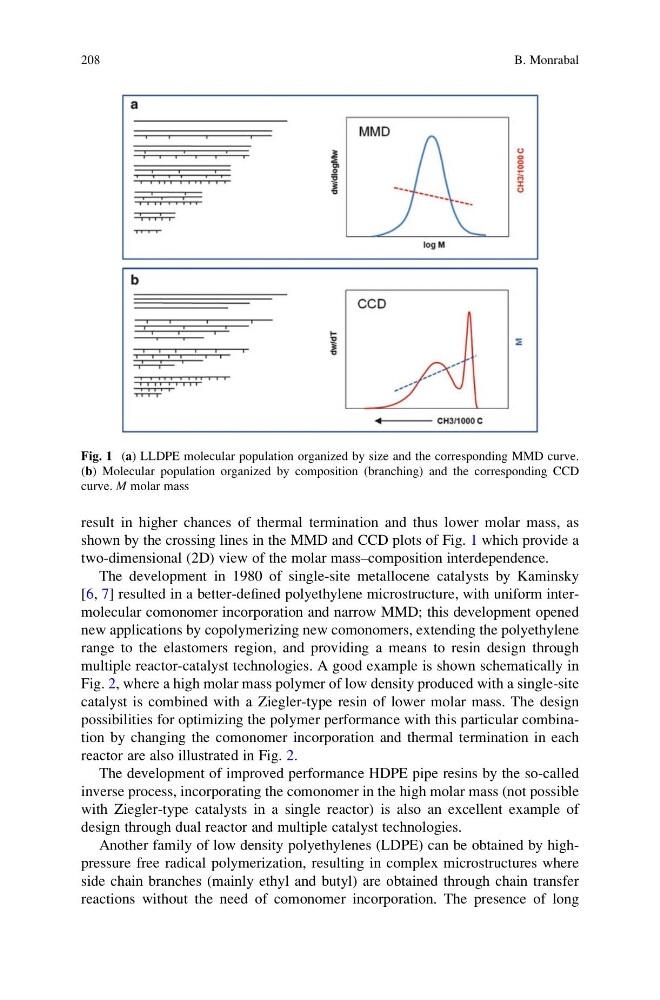
result in higher chances of thermal termination and thus lower molar mass, as
shown by the crossing lines in the MMD and CCD plots of Fig. 1 which provide a
two-dimensional (2D) view of the molar mass–composition interdependence.
The development in 1980 of single-site metallocene catalysts by Kaminsky
[6, 7] resulted in a better-defined polyethylene microstructure, with uniform intermolecular comonomer incorporation and narrow MMD; this development opened
new applications by copolymerizing new comonomers, extending the polyethylene
range to the elastomers region, and providing a means to resin design through
multiple reactor-catalyst technologies. A good example is shown schematically in
Fig. 2, where a high molar mass polymer of low density produced with a single-site
catalyst is combined with a Ziegler-type resin of lower molar mass. The design
possibilities for optimizing the polymer performance with this particular combination by changing the comonomer incorporation and thermal termination in each
reactor are also illustrated in Fig. 2.
The development of improved performance HDPE pipe resins by the so-called
inverse process, incorporating the comonomer in the high molar mass (not possible
with Ziegler-type catalysts in a single reactor) is also an excellent example of
design through dual reactor and multiple catalyst technologies.
Another family of low density polyethylenes (LDPE) can be obtained by highpressure free radical polymerization, resulting in complex microstructures where
side chain branches (mainly ethyl and butyl) are obtained through chain transfer
reactions without the need of comonomer incorporation. The presence of long
Fig. 1 (a) LLDPE molecular population organized by size and the corresponding MMD curve.
(b) Molecular population organized by composition (branching) and the corresponding CCD
curve. M molar mass
208
B. Monrabal
shown by the crossing lines in the MMD and CCD plots of Fig. 1 which provide a
two-dimensional (2D) view of the molar mass–composition interdependence.
The development in 1980 of single-site metallocene catalysts by Kaminsky
[6, 7] resulted in a better-defined polyethylene microstructure, with uniform intermolecular comonomer incorporation and narrow MMD; this development opened
new applications by copolymerizing new comonomers, extending the polyethylene
range to the elastomers region, and providing a means to resin design through
multiple reactor-catalyst technologies. A good example is shown schematically in
Fig. 2, where a high molar mass polymer of low density produced with a single-site
catalyst is combined with a Ziegler-type resin of lower molar mass. The design
possibilities for optimizing the polymer performance with this particular combination by changing the comonomer incorporation and thermal termination in each
reactor are also illustrated in Fig. 2.
The development of improved performance HDPE pipe resins by the so-called
inverse process, incorporating the comonomer in the high molar mass (not possible
with Ziegler-type catalysts in a single reactor) is also an excellent example of
design through dual reactor and multiple catalyst technologies.
Another family of low density polyethylenes (LDPE) can be obtained by highpressure free radical polymerization, resulting in complex microstructures where
side chain branches (mainly ethyl and butyl) are obtained through chain transfer
reactions without the need of comonomer incorporation. The presence of long
Fig. 1 (a) LLDPE molecular population organized by size and the corresponding MMD curve.
(b) Molecular population organized by composition (branching) and the corresponding CCD
curve. M molar mass
208
B. Monrabal