

By similar method, a new chiral organo-silanol species, methyl (1-naphthyl)
phenylsilanol has been successfully introduced onto Phillips catalyst PC600 calcined at 600
C in order to synthesize a novel Phillips-type catalyst (Cat-B)
[164]. There was a decrease in BE values of the Cr 2p core level in the XPS spectra
for the catalyst samples with increasing molar ratios of chiral ligand to Cr from
chiral ligand-free 1:0 (PC600), 1:1 (Cat-B/600-S) to 1:4 (Cat-B/600-4S). This could
be explained by the electron donation effect of chiral organo-siloxane ligand and
the formation of hydroxyl groups after anchoring of the ligand, which can release
the strong surface tension on the silica support formed during high temperature
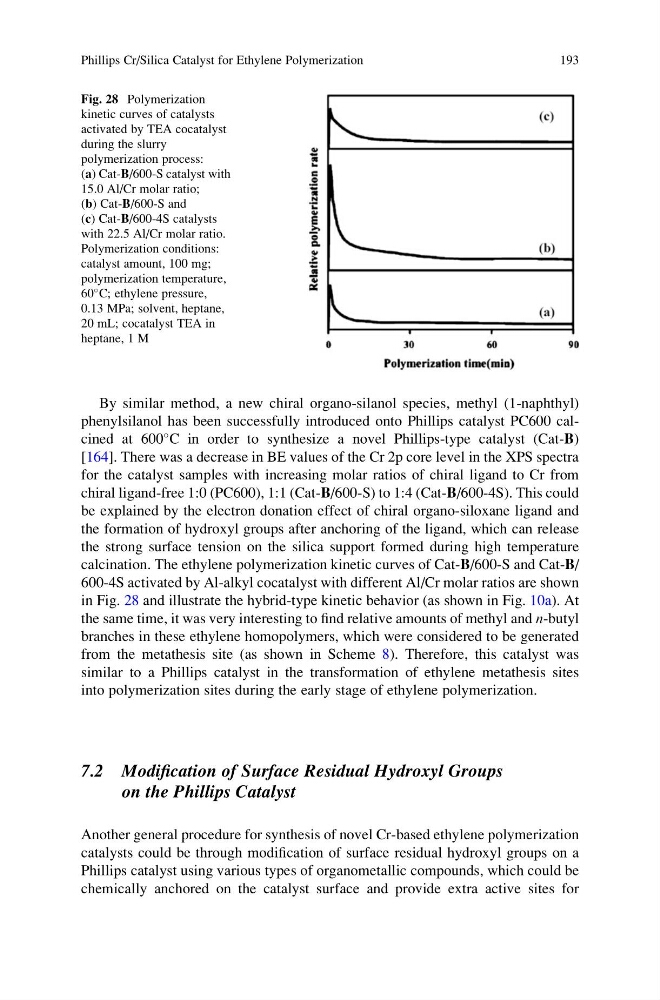
calcination. The ethylene polymerization kinetic curves of Cat-B/600-S and Cat-B/
600-4S activated by Al-alkyl cocatalyst with different Al/Cr molar ratios are shown
in Fig. 28 and illustrate the hybrid-type kinetic behavior (as shown in Fig. 10a). At
the same time, it was very interesting to find relative amounts of methyl and n-butyl
branches in these ethylene homopolymers, which were considered to be generated
from the metathesis site (as shown in Scheme 8). Therefore, this catalyst was
similar to a Phillips catalyst in the transformation of ethylene metathesis sites
into polymerization sites during the early stage of ethylene polymerization.
7.2 Modification of Surface Residual Hydroxyl Groups
on the Phillips Catalyst
Another general procedure for synthesis of novel Cr-based ethylene polymerization
catalysts could be through modification of surface residual hydroxyl groups on a
Phillips catalyst using various types of organometallic compounds, which could be
chemically anchored on the catalyst surface and provide extra active sites for
Fig. 28 Polymerization
kinetic curves of catalysts
activated by TEA cocatalyst
during the slurry
polymerization process:
(a) Cat-B/600-S catalyst with
15.0 Al/Cr molar ratio;
(b) Cat-B/600-S and
(c) Cat-B/600-4S catalysts
with 22.5 Al/Cr molar ratio.
Polymerization conditions:
catalyst amount, 100 mg;
polymerization temperature,
60
C; ethylene pressure,
0.13 MPa; solvent, heptane,
20 mL; cocatalyst TEA in
heptane, 1 M
Phillips Cr/Silica Catalyst for Ethylene Polymerization
193
phenylsilanol has been successfully introduced onto Phillips catalyst PC600 calcined at 600
C in order to synthesize a novel Phillips-type catalyst (Cat-B)
[164]. There was a decrease in BE values of the Cr 2p core level in the XPS spectra
for the catalyst samples with increasing molar ratios of chiral ligand to Cr from
chiral ligand-free 1:0 (PC600), 1:1 (Cat-B/600-S) to 1:4 (Cat-B/600-4S). This could
be explained by the electron donation effect of chiral organo-siloxane ligand and
the formation of hydroxyl groups after anchoring of the ligand, which can release
the strong surface tension on the silica support formed during high temperature
calcination. The ethylene polymerization kinetic curves of Cat-B/600-S and Cat-B/
600-4S activated by Al-alkyl cocatalyst with different Al/Cr molar ratios are shown
in Fig. 28 and illustrate the hybrid-type kinetic behavior (as shown in Fig. 10a). At
the same time, it was very interesting to find relative amounts of methyl and n-butyl
branches in these ethylene homopolymers, which were considered to be generated
from the metathesis site (as shown in Scheme 8). Therefore, this catalyst was
similar to a Phillips catalyst in the transformation of ethylene metathesis sites
into polymerization sites during the early stage of ethylene polymerization.
7.2 Modification of Surface Residual Hydroxyl Groups
on the Phillips Catalyst
Another general procedure for synthesis of novel Cr-based ethylene polymerization
catalysts could be through modification of surface residual hydroxyl groups on a
Phillips catalyst using various types of organometallic compounds, which could be
chemically anchored on the catalyst surface and provide extra active sites for
Fig. 28 Polymerization
kinetic curves of catalysts
activated by TEA cocatalyst
during the slurry
polymerization process:
(a) Cat-B/600-S catalyst with
15.0 Al/Cr molar ratio;
(b) Cat-B/600-S and
(c) Cat-B/600-4S catalysts
with 22.5 Al/Cr molar ratio.
Polymerization conditions:
catalyst amount, 100 mg;
polymerization temperature,
60
C; ethylene pressure,
0.13 MPa; solvent, heptane,
20 mL; cocatalyst TEA in
heptane, 1 M
Phillips Cr/Silica Catalyst for Ethylene Polymerization
193