

hydroxyl group very close to the active Cr site. Therefore, a detailed study on the
synthesis of Cat-A was further carried out by a combination of experimental and
theoretical methods [28]. The results showed that the molar ratio of TPS to Cr was
important for the catalyst structure and the polymerization performance as well as
the structure and properties of the PE products. An increase in TPS amount seemed
to accelerate the loss of surface hexavalent chromium species from the support,
suggesting that the conversion from Phillips catalyst to S-2 catalyst by the addition
of TPS could not occur completely. The optimal molar ratio of TPS to Cr was 1.5
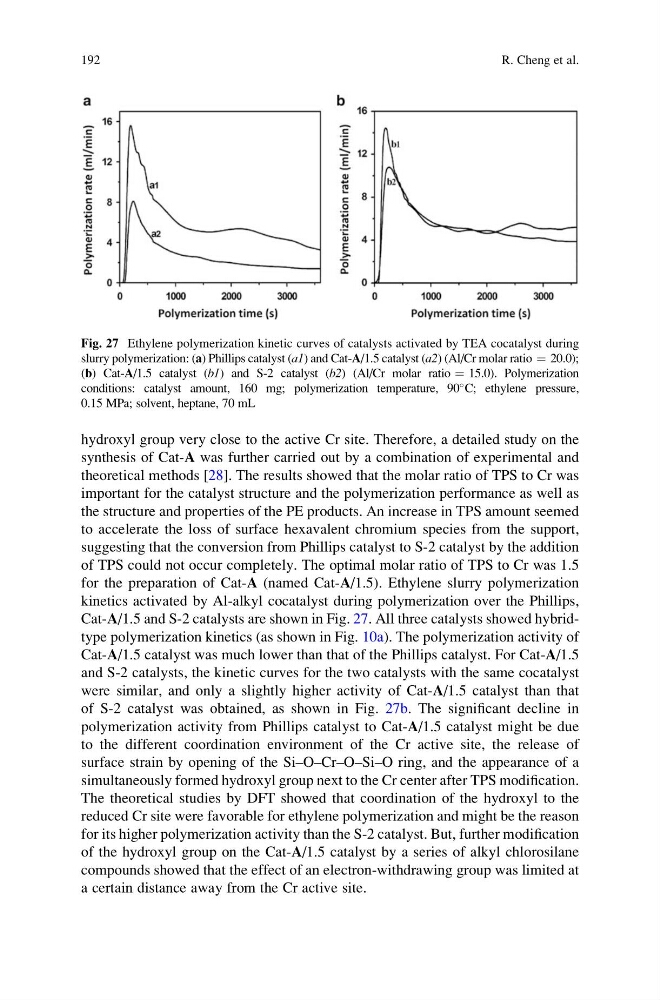
for the preparation of Cat-A (named Cat-A/1.5). Ethylene slurry polymerization
kinetics activated by Al-alkyl cocatalyst during polymerization over the Phillips,
Cat-A/1.5 and S-2 catalysts are shown in Fig. 27. All three catalysts showed hybridtype polymerization kinetics (as shown in Fig. 10a). The polymerization activity of
Cat-A/1.5 catalyst was much lower than that of the Phillips catalyst. For Cat-A/1.5
and S-2 catalysts, the kinetic curves for the two catalysts with the same cocatalyst
were similar, and only a slightly higher activity of Cat-A/1.5 catalyst than that
of S-2 catalyst was obtained, as shown in Fig. 27b. The significant decline in
polymerization activity from Phillips catalyst to Cat-A/1.5 catalyst might be due
to the different coordination environment of the Cr active site, the release of
surface strain by opening of the Si–O–Cr–O–Si–O ring, and the appearance of a
simultaneously formed hydroxyl group next to the Cr center after TPS modification.
The theoretical studies by DFT showed that coordination of the hydroxyl to the
reduced Cr site were favorable for ethylene polymerization and might be the reason
for its higher polymerization activity than the S-2 catalyst. But, further modification
of the hydroxyl group on the Cat-A/1.5 catalyst by a series of alkyl chlorosilane
compounds showed that the effect of an electron-withdrawing group was limited at
a certain distance away from the Cr active site.
Fig. 27 Ethylene polymerization kinetic curves of catalysts activated by TEA cocatalyst during
slurry polymerization: (a) Phillips catalyst (a1) and Cat-A/1.5 catalyst (a2) (Al/Cr molar ratio ¼ 20.0);
(b) Cat-A/1.5 catalyst (b1) and S-2 catalyst (b2) (Al/Cr molar ratio ¼ 15.0). Polymerization
conditions: catalyst amount, 160 mg; polymerization temperature, 90
C; ethylene pressure,
0.15 MPa; solvent, heptane, 70 mL
192
R. Cheng et al.
synthesis of Cat-A was further carried out by a combination of experimental and
theoretical methods [28]. The results showed that the molar ratio of TPS to Cr was
important for the catalyst structure and the polymerization performance as well as
the structure and properties of the PE products. An increase in TPS amount seemed
to accelerate the loss of surface hexavalent chromium species from the support,
suggesting that the conversion from Phillips catalyst to S-2 catalyst by the addition
of TPS could not occur completely. The optimal molar ratio of TPS to Cr was 1.5
for the preparation of Cat-A (named Cat-A/1.5). Ethylene slurry polymerization
kinetics activated by Al-alkyl cocatalyst during polymerization over the Phillips,
Cat-A/1.5 and S-2 catalysts are shown in Fig. 27. All three catalysts showed hybridtype polymerization kinetics (as shown in Fig. 10a). The polymerization activity of
Cat-A/1.5 catalyst was much lower than that of the Phillips catalyst. For Cat-A/1.5
and S-2 catalysts, the kinetic curves for the two catalysts with the same cocatalyst
were similar, and only a slightly higher activity of Cat-A/1.5 catalyst than that
of S-2 catalyst was obtained, as shown in Fig. 27b. The significant decline in
polymerization activity from Phillips catalyst to Cat-A/1.5 catalyst might be due
to the different coordination environment of the Cr active site, the release of
surface strain by opening of the Si–O–Cr–O–Si–O ring, and the appearance of a
simultaneously formed hydroxyl group next to the Cr center after TPS modification.
The theoretical studies by DFT showed that coordination of the hydroxyl to the
reduced Cr site were favorable for ethylene polymerization and might be the reason
for its higher polymerization activity than the S-2 catalyst. But, further modification
of the hydroxyl group on the Cat-A/1.5 catalyst by a series of alkyl chlorosilane
compounds showed that the effect of an electron-withdrawing group was limited at
a certain distance away from the Cr active site.
Fig. 27 Ethylene polymerization kinetic curves of catalysts activated by TEA cocatalyst during
slurry polymerization: (a) Phillips catalyst (a1) and Cat-A/1.5 catalyst (a2) (Al/Cr molar ratio ¼ 20.0);
(b) Cat-A/1.5 catalyst (b1) and S-2 catalyst (b2) (Al/Cr molar ratio ¼ 15.0). Polymerization
conditions: catalyst amount, 160 mg; polymerization temperature, 90
C; ethylene pressure,
0.15 MPa; solvent, heptane, 70 mL
192
R. Cheng et al.