

6.2 Reaction Mechanism During the Induction Period
In the absence of organometallic cocatalyst, the hexavalent chromate species on the
Phillips catalyst is first reduced to a lower valence state by ethylene monomers.
Experimentally, we found that the exposure of ethylene to Phillips catalyst during
the induction period at RT led to the reduction of Cr(VI)O x,surf precursors to Cr(II)
O x,surf species with the simultaneous formation of formaldehyde and unsaturated
hydrocarbon species, such as propylene and butene. The proposed reaction
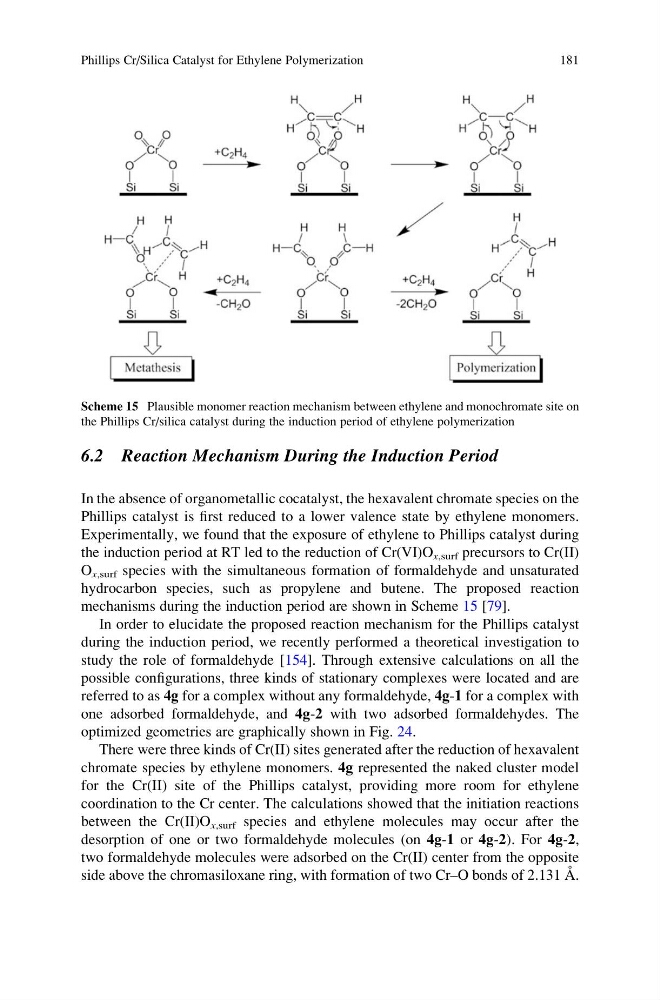
mechanisms during the induction period are shown in Scheme 15 [79].
In order to elucidate the proposed reaction mechanism for the Phillips catalyst
during the induction period, we recently performed a theoretical investigation to
study the role of formaldehyde [154]. Through extensive calculations on all the
possible configurations, three kinds of stationary complexes were located and are
referred to as 4g for a complex without any formaldehyde, 4g-1 for a complex with
one adsorbed formaldehyde, and 4g-2 with two adsorbed formaldehydes. The
optimized geometries are graphically shown in Fig. 24.
There were three kinds of Cr(II) sites generated after the reduction of hexavalent
chromate species by ethylene monomers. 4g represented the naked cluster model
for the Cr(II) site of the Phillips catalyst, providing more room for ethylene
coordination to the Cr center. The calculations showed that the initiation reactions
between the Cr(II)O x,surf species and ethylene molecules may occur after the
desorption of one or two formaldehyde molecules (on 4g-1 or 4g-2). For 4g-2,
two formaldehyde molecules were adsorbed on the Cr(II) center from the opposite
side above the chromasiloxane ring, with formation of two Cr–O bonds of 2.131 A ˚ .
Scheme 15 Plausible monomer reaction mechanism between ethylene and monochromate site on
the Phillips Cr/silica catalyst during the induction period of ethylene polymerization
Phillips Cr/Silica Catalyst for Ethylene Polymerization
181
In the absence of organometallic cocatalyst, the hexavalent chromate species on the
Phillips catalyst is first reduced to a lower valence state by ethylene monomers.
Experimentally, we found that the exposure of ethylene to Phillips catalyst during
the induction period at RT led to the reduction of Cr(VI)O x,surf precursors to Cr(II)
O x,surf species with the simultaneous formation of formaldehyde and unsaturated
hydrocarbon species, such as propylene and butene. The proposed reaction
mechanisms during the induction period are shown in Scheme 15 [79].
In order to elucidate the proposed reaction mechanism for the Phillips catalyst
during the induction period, we recently performed a theoretical investigation to
study the role of formaldehyde [154]. Through extensive calculations on all the
possible configurations, three kinds of stationary complexes were located and are
referred to as 4g for a complex without any formaldehyde, 4g-1 for a complex with
one adsorbed formaldehyde, and 4g-2 with two adsorbed formaldehydes. The
optimized geometries are graphically shown in Fig. 24.
There were three kinds of Cr(II) sites generated after the reduction of hexavalent
chromate species by ethylene monomers. 4g represented the naked cluster model
for the Cr(II) site of the Phillips catalyst, providing more room for ethylene
coordination to the Cr center. The calculations showed that the initiation reactions
between the Cr(II)O x,surf species and ethylene molecules may occur after the
desorption of one or two formaldehyde molecules (on 4g-1 or 4g-2). For 4g-2,
two formaldehyde molecules were adsorbed on the Cr(II) center from the opposite
side above the chromasiloxane ring, with formation of two Cr–O bonds of 2.131 A ˚ .
Scheme 15 Plausible monomer reaction mechanism between ethylene and monochromate site on
the Phillips Cr/silica catalyst during the induction period of ethylene polymerization
Phillips Cr/Silica Catalyst for Ethylene Polymerization
181