

development and utilization of novel and more realistic homogeneous Phillips
catalysts are still great challenges and are expected for further progress in this
important field in the near future.
6 Approaches Using Molecular Modeling
Although numerous experiments and spectroscopic characterizations have been
conducted on the Phillips catalyst, the precise structure of the active site on the
silica surface, reduction of the surface chromate species during the induction
period, the formation of the first chromium–carbon bond, and the mechanism for
ethylene polymerization still need to be further clarified [11]. In order to achieve
more specific information, molecular modeling approaches could provide a useful
complement to the experiments and enable us to study these obscure mechanistic
problems directly at the atomic and molecular level. In the last decade, very precise
mechanistic pictures of the Cr-based polymerization catalysts have been obtained
using different theoretical methods, especially through a combination of the experimental findings with theoretical calculations.
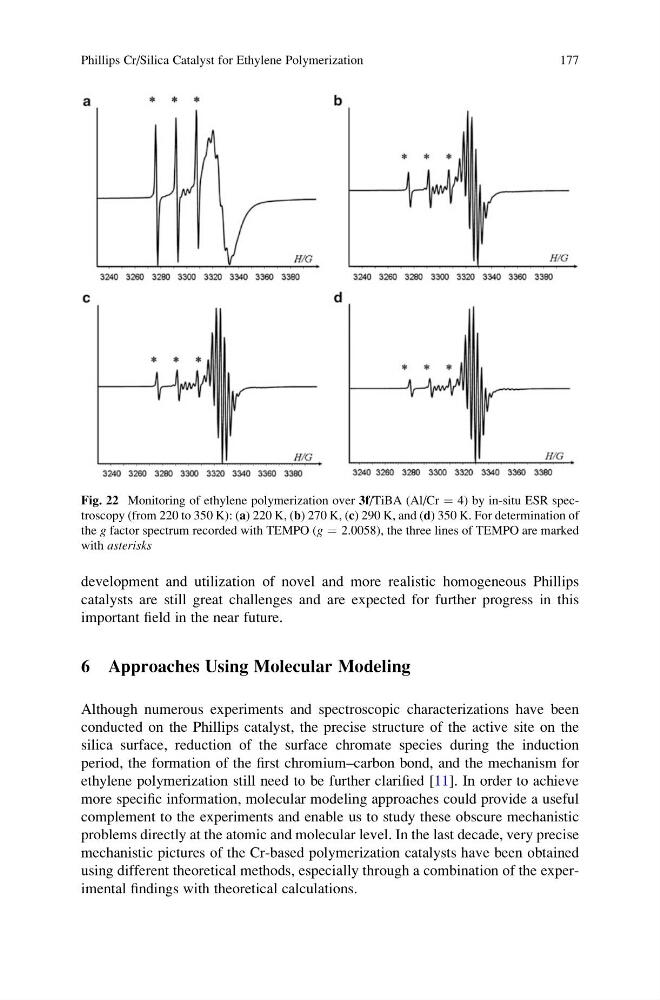
Fig. 22 Monitoring of ethylene polymerization over 3f/TiBA (Al/Cr ¼ 4) by in-situ ESR spectroscopy (from 220 to 350 K): (a) 220 K, (b) 270 K, (c) 290 K, and (d) 350 K. For determination of
the g factor spectrum recorded with TEMPO (g ¼ 2.0058), the three lines of TEMPO are marked
with asterisks
Phillips Cr/Silica Catalyst for Ethylene Polymerization
177
catalysts are still great challenges and are expected for further progress in this
important field in the near future.
6 Approaches Using Molecular Modeling
Although numerous experiments and spectroscopic characterizations have been
conducted on the Phillips catalyst, the precise structure of the active site on the
silica surface, reduction of the surface chromate species during the induction
period, the formation of the first chromium–carbon bond, and the mechanism for
ethylene polymerization still need to be further clarified [11]. In order to achieve
more specific information, molecular modeling approaches could provide a useful
complement to the experiments and enable us to study these obscure mechanistic
problems directly at the atomic and molecular level. In the last decade, very precise
mechanistic pictures of the Cr-based polymerization catalysts have been obtained
using different theoretical methods, especially through a combination of the experimental findings with theoretical calculations.
Fig. 22 Monitoring of ethylene polymerization over 3f/TiBA (Al/Cr ¼ 4) by in-situ ESR spectroscopy (from 220 to 350 K): (a) 220 K, (b) 270 K, (c) 290 K, and (d) 350 K. For determination of
the g factor spectrum recorded with TEMPO (g ¼ 2.0058), the three lines of TEMPO are marked
with asterisks
Phillips Cr/Silica Catalyst for Ethylene Polymerization
177