

limited experimental results, because it was generally observed by ESR spectroscopy at very low temperatures up to 77 K. Further mechanistic study through
combined experimental and theoretical modeling is now still in progress in order
to clarify the nature of the active sites and their transformation behavior.
In summary, two homogeneous model catalysts with triphenylsiloxy ligands of
chromium(II) and chromium(VI) (models 3f and 9f) were systematically studied for
ethylene polymerization in the presence of Al-alkyl cocatalyst. Similar transformation phenomenon from ethylene polymerization to nonselective oligomerization
was discovered over both model catalysts using MAO as a cocatalyst depending on
the Al/Cr molar ratios. A cationic [Cr(I)(η
6 -arene) 2 ]
+ sandwich complex was
observed for both catalyst systems combined with MAO or TiBA and was excluded
as being the active site for ethylene polymerization. Further mechanistic
investigations on these model catalyst systems as well as their relevance to the
Phillips catalyst are still in progress in order to elucidate the mechanisms of such
interesting phenomena. The well-defined molecular structure of homogeneous
catalysts provide good basis for their investigation with molecular modeling as
well as other spectroscopic methods, especially in-situ or operando techniques. The
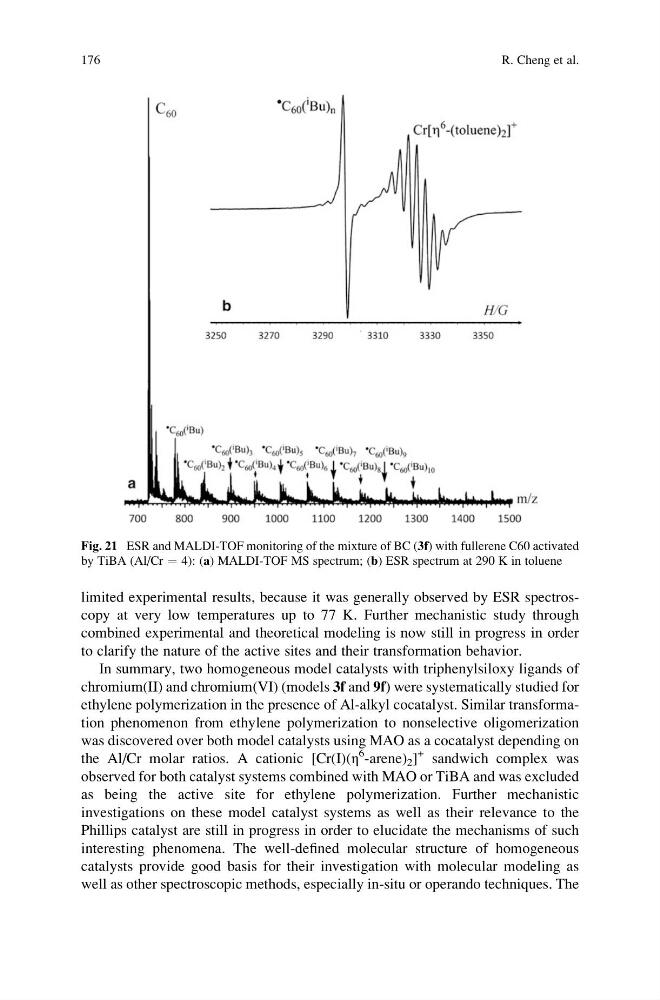
Fig. 21 ESR and MALDI-TOF monitoring of the mixture of BC (3f) with fullerene C60 activated
by TiBA (Al/Cr ¼ 4): (a) MALDI-TOF MS spectrum; (b) ESR spectrum at 290 K in toluene
176
R. Cheng et al.
combined experimental and theoretical modeling is now still in progress in order
to clarify the nature of the active sites and their transformation behavior.
In summary, two homogeneous model catalysts with triphenylsiloxy ligands of
chromium(II) and chromium(VI) (models 3f and 9f) were systematically studied for
ethylene polymerization in the presence of Al-alkyl cocatalyst. Similar transformation phenomenon from ethylene polymerization to nonselective oligomerization
was discovered over both model catalysts using MAO as a cocatalyst depending on
the Al/Cr molar ratios. A cationic [Cr(I)(η
6 -arene) 2 ]
+ sandwich complex was
observed for both catalyst systems combined with MAO or TiBA and was excluded
as being the active site for ethylene polymerization. Further mechanistic
investigations on these model catalyst systems as well as their relevance to the
Phillips catalyst are still in progress in order to elucidate the mechanisms of such
interesting phenomena. The well-defined molecular structure of homogeneous
catalysts provide good basis for their investigation with molecular modeling as
well as other spectroscopic methods, especially in-situ or operando techniques. The
Fig. 21 ESR and MALDI-TOF monitoring of the mixture of BC (3f) with fullerene C60 activated
by TiBA (Al/Cr ¼ 4): (a) MALDI-TOF MS spectrum; (b) ESR spectrum at 290 K in toluene
176
R. Cheng et al.