

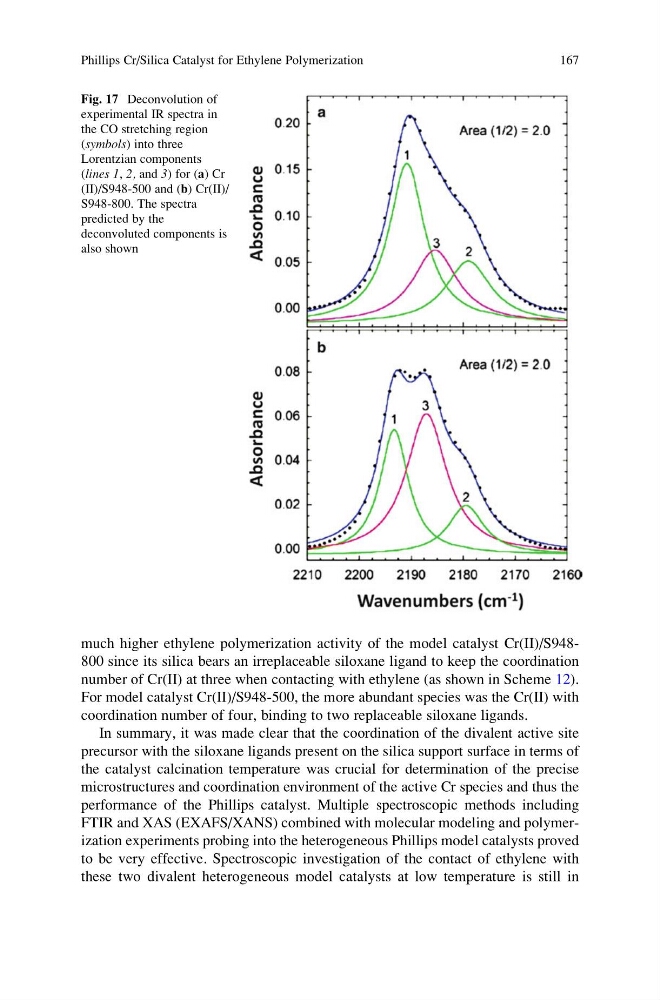
much higher ethylene polymerization activity of the model catalyst Cr(II)/S948800 since its silica bears an irreplaceable siloxane ligand to keep the coordination
number of Cr(II) at three when contacting with ethylene (as shown in Scheme 12).
For model catalyst Cr(II)/S948-500, the more abundant species was the Cr(II) with
coordination number of four, binding to two replaceable siloxane ligands.
In summary, it was made clear that the coordination of the divalent active site
precursor with the siloxane ligands present on the silica support surface in terms of
the catalyst calcination temperature was crucial for determination of the precise
microstructures and coordination environment of the active Cr species and thus the
performance of the Phillips catalyst. Multiple spectroscopic methods including
FTIR and XAS (EXAFS/XANS) combined with molecular modeling and polymerization experiments probing into the heterogeneous Phillips model catalysts proved
to be very effective. Spectroscopic investigation of the contact of ethylene with
these two divalent heterogeneous model catalysts at low temperature is still in
Fig. 17 Deconvolution of
experimental IR spectra in
the CO stretching region
(symbols) into three
Lorentzian components
(lines 1, 2, and 3) for (a) Cr
(II)/S948-500 and (b) Cr(II)/
S948-800. The spectra
predicted by the
deconvoluted components is
also shown
Phillips Cr/Silica Catalyst for Ethylene Polymerization
167
number of Cr(II) at three when contacting with ethylene (as shown in Scheme 12).
For model catalyst Cr(II)/S948-500, the more abundant species was the Cr(II) with
coordination number of four, binding to two replaceable siloxane ligands.
In summary, it was made clear that the coordination of the divalent active site
precursor with the siloxane ligands present on the silica support surface in terms of
the catalyst calcination temperature was crucial for determination of the precise
microstructures and coordination environment of the active Cr species and thus the
performance of the Phillips catalyst. Multiple spectroscopic methods including
FTIR and XAS (EXAFS/XANS) combined with molecular modeling and polymerization experiments probing into the heterogeneous Phillips model catalysts proved
to be very effective. Spectroscopic investigation of the contact of ethylene with
these two divalent heterogeneous model catalysts at low temperature is still in
Fig. 17 Deconvolution of
experimental IR spectra in
the CO stretching region
(symbols) into three
Lorentzian components
(lines 1, 2, and 3) for (a) Cr
(II)/S948-500 and (b) Cr(II)/
S948-800. The spectra
predicted by the
deconvoluted components is
also shown
Phillips Cr/Silica Catalyst for Ethylene Polymerization
167