

reported a flat surface model catalyst by impregnating aqueous CrO 3 on a flat Si (100)
substrate covered by an amorphous silica layer, shown as model 6c. This flat catalyst
covered with monochromate showed ethylene polymerization activity at 160
C,
whereas the pre-reduced surface Cr(II) species failed to polymerize ethylene due to
its extreme sensitivity to air and moisture [53]. Recently, Terano and colleagues [116]
chose different starting materials [Cr(η
3
-allyl) 3 and Cr 2 (η
3
-allyl) 4 ] to vary the surface
structures of the catalysts (monochromate and dichromate, shown as models 9c and
10c, respectively). It was found that the surface dichromate model catalyst 10c
produced more methyl branching in its PE products. Models 3c, 4c, and 5c were
reported by Scott and coworkers [90–94, 117] via grafting of tetravalent Cr[CH 2 C
(CH 3 ) 3 ] 4 onto silica pretreated at 200
C (3c) or 500
C (4c). Upon mild heating at
60
C, a supported Cr-alkylidene complex 5c was formed on silica pretreated at
200
C, which showed instant ethylene polymerization activity without using any
cocatalyst. Monoi and coworkers [118, 119] reported a trivalent model catalyst by the
supporting of Cr[CH(SiMe 3 ) 2 ] 3 on silica pretreated at 200 or 600
C. When the
pretreating temperature was 200
C, Cr species were supported on silica through
two Si–O–Cr bonds, shown as model 7c, whereas for the case of 600
C, the grafting
took place via only one Si–O–Cr bond to silica to form model 8c. Compared to the
Phillips catalyst, these catalysts showed high ethylene polymerization activity without using any cocatalyst and displayed very similar performance except for increased
sensitivity of the hydrogen response. In addition, further reaction over 8c with excess
Cr[CH(SiMe 3 ) 2 ] 3 was likely to lead to the formation of new active sites for ethylene
trimerization [119]. Although the above-mentioned heterogeneous model catalysts
displayed representative polymerization activity at certain temperatures with or
without the cocatalyst and offered the opportunity for further understanding of
Phillips catalysts, no direct evidence on the real active sites and polymerization
mechanisms has yet been achieved.
Very recently, we performed further studies over extremely air-sensitive divalent
model Phillips catalysts via CO reduction (at 300
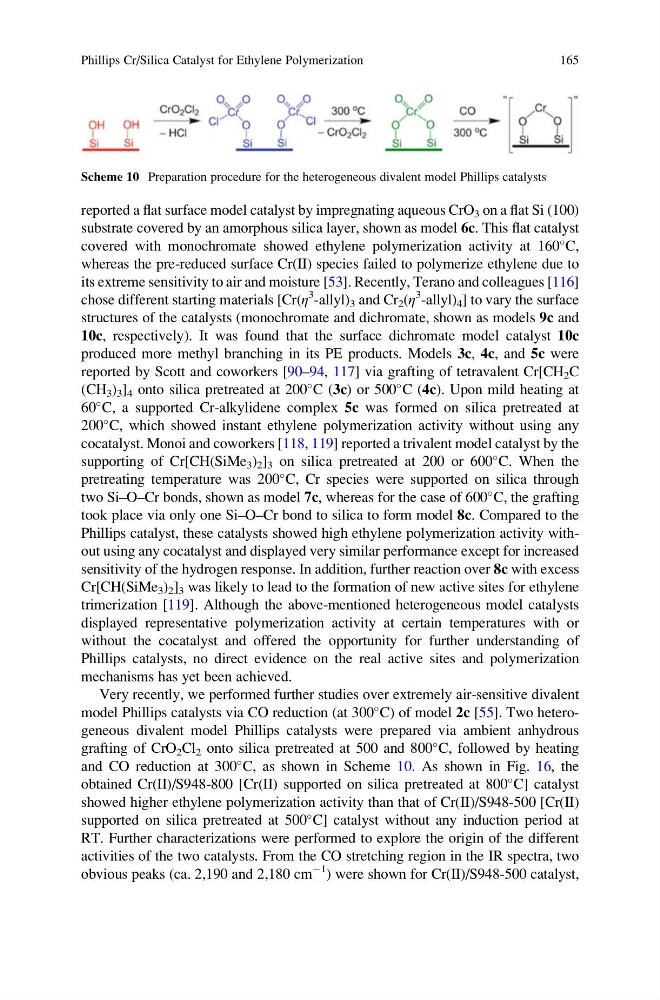
C) of model 2c [55]. Two heterogeneous divalent model Phillips catalysts were prepared via ambient anhydrous
grafting of CrO 2 Cl 2 onto silica pretreated at 500 and 800
C, followed by heating
and CO reduction at 300
C, as shown in Scheme 10. As shown in Fig. 16, the
obtained Cr(II)/S948-800 [Cr(II) supported on silica pretreated at 800
C] catalyst
showed higher ethylene polymerization activity than that of Cr(II)/S948-500 [Cr(II)
supported on silica pretreated at 500
C] catalyst without any induction period at
RT. Further characterizations were performed to explore the origin of the different
activities of the two catalysts. From the CO stretching region in the IR spectra, two
obvious peaks (ca. 2,190 and 2,180 cm
À1
) were shown for Cr(II)/S948-500 catalyst,
Scheme 10 Preparation procedure for the heterogeneous divalent model Phillips catalysts
Phillips Cr/Silica Catalyst for Ethylene Polymerization
165
substrate covered by an amorphous silica layer, shown as model 6c. This flat catalyst
covered with monochromate showed ethylene polymerization activity at 160
C,
whereas the pre-reduced surface Cr(II) species failed to polymerize ethylene due to
its extreme sensitivity to air and moisture [53]. Recently, Terano and colleagues [116]
chose different starting materials [Cr(η
3
-allyl) 3 and Cr 2 (η
3
-allyl) 4 ] to vary the surface
structures of the catalysts (monochromate and dichromate, shown as models 9c and
10c, respectively). It was found that the surface dichromate model catalyst 10c
produced more methyl branching in its PE products. Models 3c, 4c, and 5c were
reported by Scott and coworkers [90–94, 117] via grafting of tetravalent Cr[CH 2 C
(CH 3 ) 3 ] 4 onto silica pretreated at 200
C (3c) or 500
C (4c). Upon mild heating at
60
C, a supported Cr-alkylidene complex 5c was formed on silica pretreated at
200
C, which showed instant ethylene polymerization activity without using any
cocatalyst. Monoi and coworkers [118, 119] reported a trivalent model catalyst by the
supporting of Cr[CH(SiMe 3 ) 2 ] 3 on silica pretreated at 200 or 600
C. When the
pretreating temperature was 200
C, Cr species were supported on silica through
two Si–O–Cr bonds, shown as model 7c, whereas for the case of 600
C, the grafting
took place via only one Si–O–Cr bond to silica to form model 8c. Compared to the
Phillips catalyst, these catalysts showed high ethylene polymerization activity without using any cocatalyst and displayed very similar performance except for increased
sensitivity of the hydrogen response. In addition, further reaction over 8c with excess
Cr[CH(SiMe 3 ) 2 ] 3 was likely to lead to the formation of new active sites for ethylene
trimerization [119]. Although the above-mentioned heterogeneous model catalysts
displayed representative polymerization activity at certain temperatures with or
without the cocatalyst and offered the opportunity for further understanding of
Phillips catalysts, no direct evidence on the real active sites and polymerization
mechanisms has yet been achieved.
Very recently, we performed further studies over extremely air-sensitive divalent
model Phillips catalysts via CO reduction (at 300
C) of model 2c [55]. Two heterogeneous divalent model Phillips catalysts were prepared via ambient anhydrous
grafting of CrO 2 Cl 2 onto silica pretreated at 500 and 800
C, followed by heating
and CO reduction at 300
C, as shown in Scheme 10. As shown in Fig. 16, the
obtained Cr(II)/S948-800 [Cr(II) supported on silica pretreated at 800
C] catalyst
showed higher ethylene polymerization activity than that of Cr(II)/S948-500 [Cr(II)
supported on silica pretreated at 500
C] catalyst without any induction period at
RT. Further characterizations were performed to explore the origin of the different
activities of the two catalysts. From the CO stretching region in the IR spectra, two
obvious peaks (ca. 2,190 and 2,180 cm
À1
) were shown for Cr(II)/S948-500 catalyst,
Scheme 10 Preparation procedure for the heterogeneous divalent model Phillips catalysts
Phillips Cr/Silica Catalyst for Ethylene Polymerization
165