

and 3.2 will discuss how the type of cocatalyst (AlR 3 or AlR 2 OR), the timing of
introduction of cocatalyst (before or during polymerization), and the type of
polymerization (slurry or gas phase), can dramatically affect the polymerization
kinetics as shown in Fig. 10.
3.1 Activation by Al-alkyl Cocatalyst Before Polymerization
In the previous sections, a combined XPS and solid state NMR spectroscopic
investigation of Phillips catalysts (PC400/TEA, PC600/TEA, and PC800/TEA)
calcined at 400
C, 600
C, and 800
C, respectively, followed by activation with
TEA cocatalyst before slurry polymerization showed that 4-coordinated Al species,
rather than the 5- or 6-coordinated Al species, were directly related with the
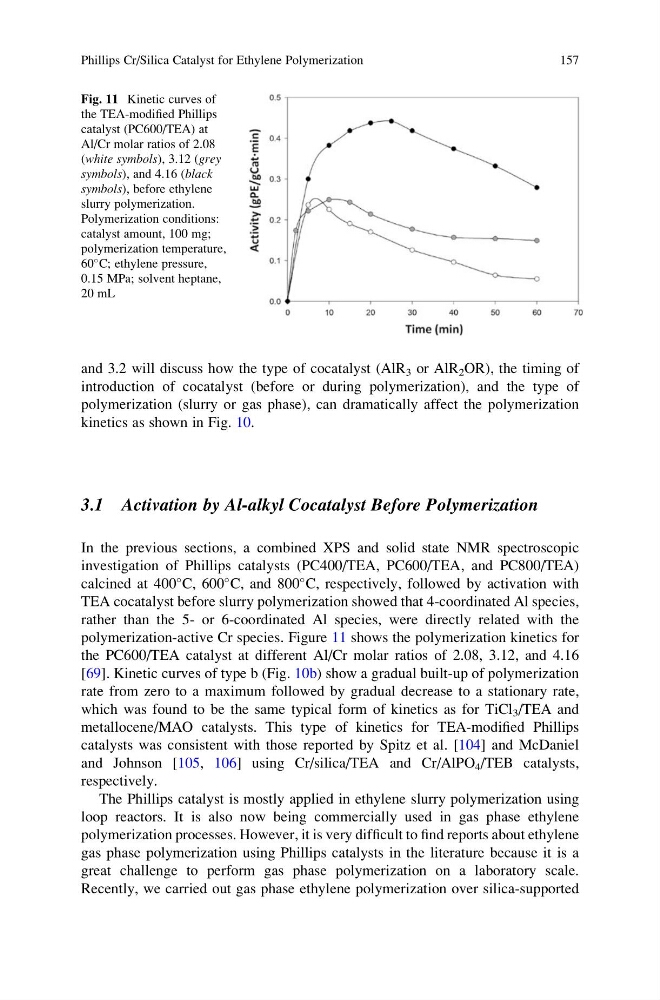
polymerization-active Cr species. Figure 11 shows the polymerization kinetics for
the PC600/TEA catalyst at different Al/Cr molar ratios of 2.08, 3.12, and 4.16
[69]. Kinetic curves of type b (Fig. 10b) show a gradual built-up of polymerization
rate from zero to a maximum followed by gradual decrease to a stationary rate,
which was found to be the same typical form of kinetics as for TiCl 3 /TEA and
metallocene/MAO catalysts. This type of kinetics for TEA-modified Phillips
catalysts was consistent with those reported by Spitz et al. [104] and McDaniel
and Johnson [105, 106] using Cr/silica/TEA and Cr/AlPO 4 /TEB catalysts,
respectively.
The Phillips catalyst is mostly applied in ethylene slurry polymerization using
loop reactors. It is also now being commercially used in gas phase ethylene
polymerization processes. However, it is very difficult to find reports about ethylene
gas phase polymerization using Phillips catalysts in the literature because it is a
great challenge to perform gas phase polymerization on a laboratory scale.
Recently, we carried out gas phase ethylene polymerization over silica-supported
Fig. 11 Kinetic curves of
the TEA-modified Phillips
catalyst (PC600/TEA) at
Al/Cr molar ratios of 2.08
(white symbols), 3.12 (grey
symbols), and 4.16 (black
symbols), before ethylene
slurry polymerization.
Polymerization conditions:
catalyst amount, 100 mg;
polymerization temperature,
60
C; ethylene pressure,
0.15 MPa; solvent heptane,
20 mL
Phillips Cr/Silica Catalyst for Ethylene Polymerization
157
introduction of cocatalyst (before or during polymerization), and the type of
polymerization (slurry or gas phase), can dramatically affect the polymerization
kinetics as shown in Fig. 10.
3.1 Activation by Al-alkyl Cocatalyst Before Polymerization
In the previous sections, a combined XPS and solid state NMR spectroscopic
investigation of Phillips catalysts (PC400/TEA, PC600/TEA, and PC800/TEA)
calcined at 400
C, 600
C, and 800
C, respectively, followed by activation with
TEA cocatalyst before slurry polymerization showed that 4-coordinated Al species,
rather than the 5- or 6-coordinated Al species, were directly related with the
polymerization-active Cr species. Figure 11 shows the polymerization kinetics for
the PC600/TEA catalyst at different Al/Cr molar ratios of 2.08, 3.12, and 4.16
[69]. Kinetic curves of type b (Fig. 10b) show a gradual built-up of polymerization
rate from zero to a maximum followed by gradual decrease to a stationary rate,
which was found to be the same typical form of kinetics as for TiCl 3 /TEA and
metallocene/MAO catalysts. This type of kinetics for TEA-modified Phillips
catalysts was consistent with those reported by Spitz et al. [104] and McDaniel
and Johnson [105, 106] using Cr/silica/TEA and Cr/AlPO 4 /TEB catalysts,
respectively.
The Phillips catalyst is mostly applied in ethylene slurry polymerization using
loop reactors. It is also now being commercially used in gas phase ethylene
polymerization processes. However, it is very difficult to find reports about ethylene
gas phase polymerization using Phillips catalysts in the literature because it is a
great challenge to perform gas phase polymerization on a laboratory scale.
Recently, we carried out gas phase ethylene polymerization over silica-supported
Fig. 11 Kinetic curves of
the TEA-modified Phillips
catalyst (PC600/TEA) at
Al/Cr molar ratios of 2.08
(white symbols), 3.12 (grey
symbols), and 4.16 (black
symbols), before ethylene
slurry polymerization.
Polymerization conditions:
catalyst amount, 100 mg;
polymerization temperature,
60
C; ethylene pressure,
0.15 MPa; solvent heptane,
20 mL
Phillips Cr/Silica Catalyst for Ethylene Polymerization
157