

kinetics and 1-hexene incorporation for ethylene/1-hexene copolymerization in
liquid 1-hexene. McDaniel and Johnson [105, 106] studied the effects of TEB on
the polymerization kinetics of the Phillips catalyst with different supports (AlPO 4 ,
SiO 2 , Al 2 O 3 ). Tait and coauthors [107] studied the effects of TiBA on kinetics and
polymer morphology with Phillips catalyst. Our series of studies on the Phillips
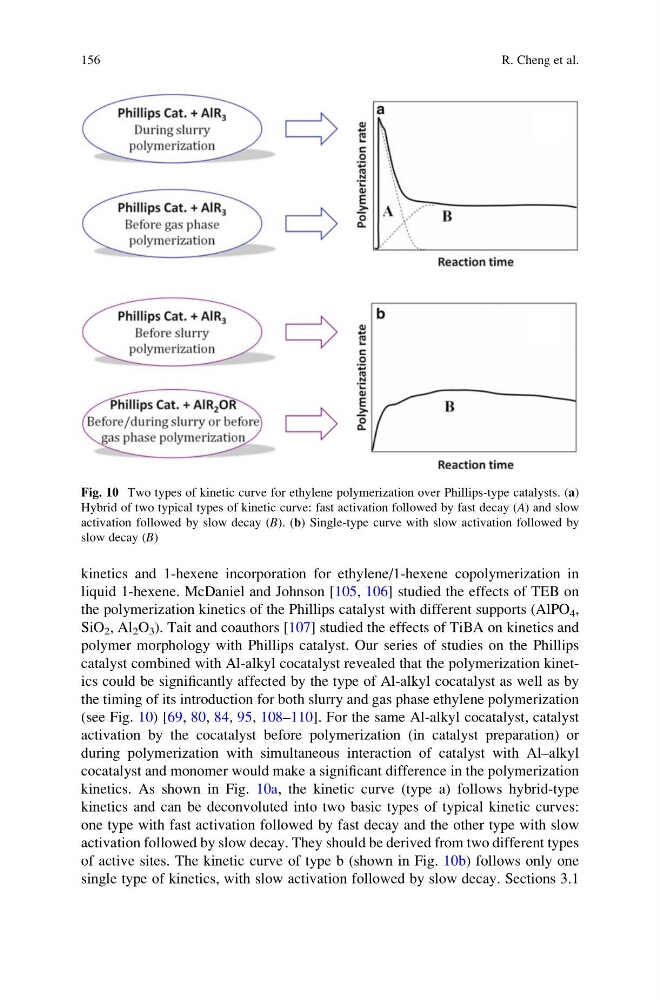
catalyst combined with Al-alkyl cocatalyst revealed that the polymerization kinetics could be significantly affected by the type of Al-alkyl cocatalyst as well as by
the timing of its introduction for both slurry and gas phase ethylene polymerization
(see Fig. 10) [69, 80, 84, 95, 108–110]. For the same Al-alkyl cocatalyst, catalyst
activation by the cocatalyst before polymerization (in catalyst preparation) or
during polymerization with simultaneous interaction of catalyst with Al–alkyl
cocatalyst and monomer would make a significant difference in the polymerization
kinetics. As shown in Fig. 10a, the kinetic curve (type a) follows hybrid-type
kinetics and can be deconvoluted into two basic types of typical kinetic curves:
one type with fast activation followed by fast decay and the other type with slow
activation followed by slow decay. They should be derived from two different types
of active sites. The kinetic curve of type b (shown in Fig. 10b) follows only one
single type of kinetics, with slow activation followed by slow decay. Sections 3.1
Fig. 10 Two types of kinetic curve for ethylene polymerization over Phillips-type catalysts. (a)
Hybrid of two typical types of kinetic curve: fast activation followed by fast decay (A) and slow
activation followed by slow decay (B). (b) Single-type curve with slow activation followed by
slow decay (B)
156
R. Cheng et al.
liquid 1-hexene. McDaniel and Johnson [105, 106] studied the effects of TEB on
the polymerization kinetics of the Phillips catalyst with different supports (AlPO 4 ,
SiO 2 , Al 2 O 3 ). Tait and coauthors [107] studied the effects of TiBA on kinetics and
polymer morphology with Phillips catalyst. Our series of studies on the Phillips
catalyst combined with Al-alkyl cocatalyst revealed that the polymerization kinetics could be significantly affected by the type of Al-alkyl cocatalyst as well as by
the timing of its introduction for both slurry and gas phase ethylene polymerization
(see Fig. 10) [69, 80, 84, 95, 108–110]. For the same Al-alkyl cocatalyst, catalyst
activation by the cocatalyst before polymerization (in catalyst preparation) or
during polymerization with simultaneous interaction of catalyst with Al–alkyl
cocatalyst and monomer would make a significant difference in the polymerization
kinetics. As shown in Fig. 10a, the kinetic curve (type a) follows hybrid-type
kinetics and can be deconvoluted into two basic types of typical kinetic curves:
one type with fast activation followed by fast decay and the other type with slow
activation followed by slow decay. They should be derived from two different types
of active sites. The kinetic curve of type b (shown in Fig. 10b) follows only one
single type of kinetics, with slow activation followed by slow decay. Sections 3.1
Fig. 10 Two types of kinetic curve for ethylene polymerization over Phillips-type catalysts. (a)
Hybrid of two typical types of kinetic curve: fast activation followed by fast decay (A) and slow
activation followed by slow decay (B). (b) Single-type curve with slow activation followed by
slow decay (B)
156
R. Cheng et al.