

by the twofold increase in k p values for active centers IV. k p values for active
centers III and IV are similar for catalysts A and B. So, the presence of internal
donor in TMC does not affect the k p values of isospecific active centers III and IV.
Thus, the SF method gives valuable information on the quantity of active
centers and their reactivity in the propagation reaction, the influence of catalyst
composition on these kinetic parameters, and on the distribution of the active
centers and their reactivity for the centers with various isospecificities. Of course,
these data only concern the initial stage of polymerization for time of polymerization less than 0.2 s. But, ZN catalysts undergo essential changes in the conditions
of the real process of polymerization because of interaction of the components
of the catalytic system with each other and with components of the reaction
environment. These interactions can lead to changes in the number of active
centers and in the distribution of the active centers with different reactivities.
Some reversible interactions can also occur between active centers and different
components of the catalyst and polymerization environment. These interactions
can be studied only for polymerization at different polymerization times. Therefore,
it is necessary to also have data on the number of active centers and propagation
rate constants at various stages of polymerization. As noted above, such data
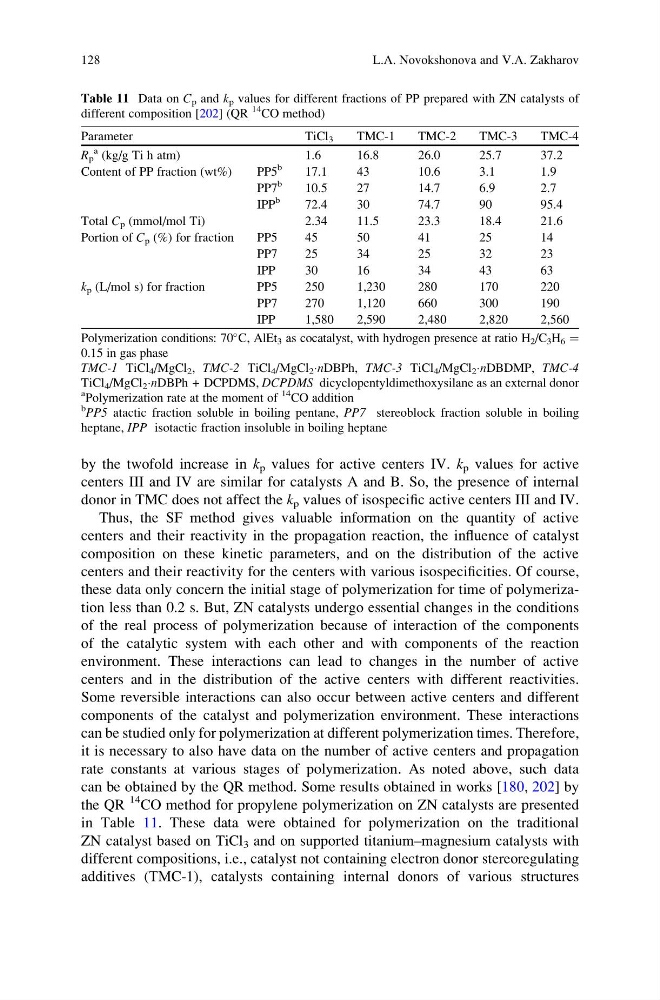
can be obtained by the QR method. Some results obtained in works [180, 202] by
the QR
14 CO method for propylene polymerization on ZN catalysts are presented
in Table 11. These data were obtained for polymerization on the traditional
ZN catalyst based on TiCl 3 and on supported titanium–magnesium catalysts with
different compositions, i.e., catalyst not containing electron donor stereoregulating
additives (ТМC-1), catalysts containing internal donors of various structures
Table 11 Data on C p and k p values for different fractions of PP prepared with ZN catalysts of
different composition [202] (QR
14
CO method)
Parameter
TiCl 3
TMC-1
TMC-2
TMC-3
TMC-4
R p
a (kg/g Ti h atm)
1.6
16.8
26.0
25.7
37.2
Content of PP fraction (wt%)
PP5
b
17.1
43
10.6
3.1
1.9
PP7
b
10.5
27
14.7
6.9
2.7
IPP
b
72.4
30
74.7
90
95.4
Total C p (mmol/mol Ti)
2.34
11.5
23.3
18.4
21.6
Portion of C p (%) for fraction
PP5
45
50
41
25
14
PP7
25
34
25
32
23
IPP
30
16
34
43
63
k p (L/mol s) for fraction
PP5
250
1,230
280
170
220
PP7
270
1,120
660
300
190
IPP
1,580
2,590
2,480
2,820
2,560
Polymerization conditions: 70
C, AlEt 3 as cocatalyst, with hydrogen presence at ratio H 2 /C 3 H 6 ¼
0.15 in gas phase
TMC-1 TiCl 4 /MgCl 2 , TMC-2 TiCl 4 /MgCl 2 ÁnDBPh, TMC-3 TiCl 4 /MgCl 2 ÁnDBDMP, TMC-4
TiCl 4 /MgCl 2 ÁnDBPh + DCPDMS, DCPDMS dicyclopentyldimethoxysilane as an external donor
a
Polymerization rate at the moment of
14
CO addition
b
PP5 atactic fraction soluble in boiling pentane, PP7 stereoblock fraction soluble in boiling
heptane, IPP isotactic fraction insoluble in boiling heptane
128
L.A. Novokshonova and V.A. Zakharov
centers III and IV are similar for catalysts A and B. So, the presence of internal
donor in TMC does not affect the k p values of isospecific active centers III and IV.
Thus, the SF method gives valuable information on the quantity of active
centers and their reactivity in the propagation reaction, the influence of catalyst
composition on these kinetic parameters, and on the distribution of the active
centers and their reactivity for the centers with various isospecificities. Of course,
these data only concern the initial stage of polymerization for time of polymerization less than 0.2 s. But, ZN catalysts undergo essential changes in the conditions
of the real process of polymerization because of interaction of the components
of the catalytic system with each other and with components of the reaction
environment. These interactions can lead to changes in the number of active
centers and in the distribution of the active centers with different reactivities.
Some reversible interactions can also occur between active centers and different
components of the catalyst and polymerization environment. These interactions
can be studied only for polymerization at different polymerization times. Therefore,
it is necessary to also have data on the number of active centers and propagation
rate constants at various stages of polymerization. As noted above, such data
can be obtained by the QR method. Some results obtained in works [180, 202] by
the QR
14 CO method for propylene polymerization on ZN catalysts are presented
in Table 11. These data were obtained for polymerization on the traditional
ZN catalyst based on TiCl 3 and on supported titanium–magnesium catalysts with
different compositions, i.e., catalyst not containing electron donor stereoregulating
additives (ТМC-1), catalysts containing internal donors of various structures
Table 11 Data on C p and k p values for different fractions of PP prepared with ZN catalysts of
different composition [202] (QR
14
CO method)
Parameter
TiCl 3
TMC-1
TMC-2
TMC-3
TMC-4
R p
a (kg/g Ti h atm)
1.6
16.8
26.0
25.7
37.2
Content of PP fraction (wt%)
PP5
b
17.1
43
10.6
3.1
1.9
PP7
b
10.5
27
14.7
6.9
2.7
IPP
b
72.4
30
74.7
90
95.4
Total C p (mmol/mol Ti)
2.34
11.5
23.3
18.4
21.6
Portion of C p (%) for fraction
PP5
45
50
41
25
14
PP7
25
34
25
32
23
IPP
30
16
34
43
63
k p (L/mol s) for fraction
PP5
250
1,230
280
170
220
PP7
270
1,120
660
300
190
IPP
1,580
2,590
2,480
2,820
2,560
Polymerization conditions: 70
C, AlEt 3 as cocatalyst, with hydrogen presence at ratio H 2 /C 3 H 6 ¼
0.15 in gas phase
TMC-1 TiCl 4 /MgCl 2 , TMC-2 TiCl 4 /MgCl 2 ÁnDBPh, TMC-3 TiCl 4 /MgCl 2 ÁnDBDMP, TMC-4
TiCl 4 /MgCl 2 ÁnDBPh + DCPDMS, DCPDMS dicyclopentyldimethoxysilane as an external donor
a
Polymerization rate at the moment of
14
CO addition
b
PP5 atactic fraction soluble in boiling pentane, PP7 stereoblock fraction soluble in boiling
heptane, IPP isotactic fraction insoluble in boiling heptane
128
L.A. Novokshonova and V.A. Zakharov