

meso-pentads). At the same time, values calculated for the isotactic fraction (K
i
p ),
which contains 99% of meso-pentads, do not depend on AlR 3 composition. Thus, the
composition of AlR 3 does not influence the reactivity of stereospecific active centers
but considerably influences both the total number of active centers (C
tot
p ), and the
number of stereospecific active centers (C
i
p ).
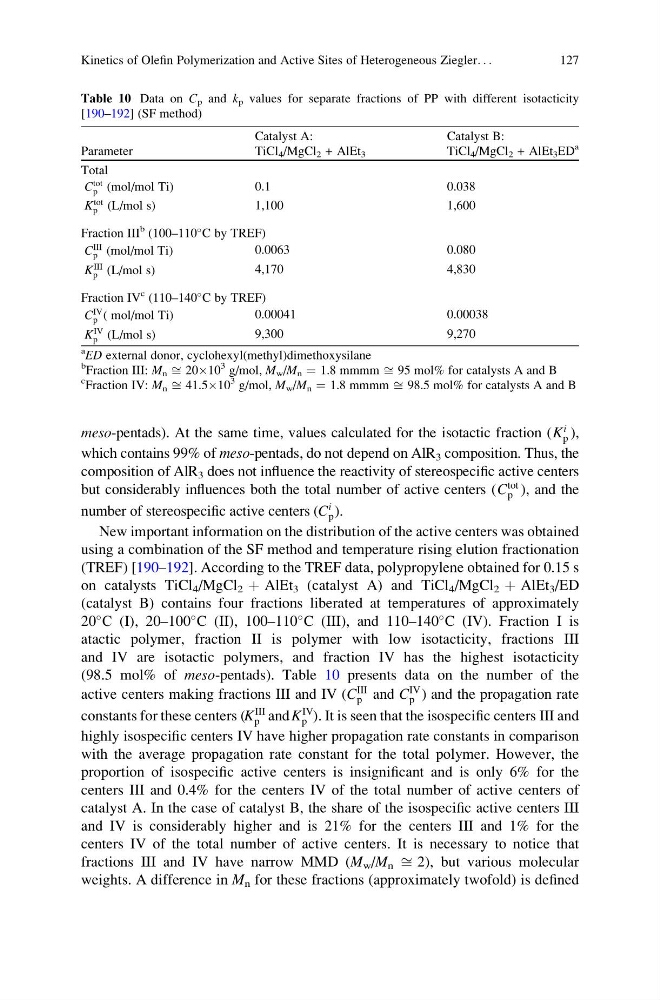
New important information on the distribution of the active centers was obtained
using a combination of the SF method and temperature rising elution fractionation
(TREF) [190–192]. According to the TREF data, polypropylene obtained for 0.15 s
on catalysts TiCl 4 /MgCl 2 þ AlEt 3 (catalyst A) and TiCl 4 /MgCl 2 þ AlEt 3 /ED
(catalyst B) contains four fractions liberated at temperatures of approximately
20
С (I), 20–100
C (II), 100–110
C (III), and 110–140
C (IV). Fraction I is
atactic polymer, fraction II is polymer with low isotacticity, fractions III
and IV are isotactic polymers, and fraction IV has the highest isotacticity
(98.5 mol% of meso-pentads). Table 10 presents data on the number of the
active centers making fractions III and IV (C
III
p and C
IV
p ) and the propagation rate
constants for these centers (K
III
p and K
IV
p ). It is seen that the isospecific centers III and
highly isospecific centers IV have higher propagation rate constants in comparison
with the average propagation rate constant for the total polymer. However, the
proportion of isospecific active centers is insignificant and is only 6% for the
centers III and 0.4% for the centers IV of the total number of active centers of
catalyst A. In the case of catalyst B, the share of the isospecific active centers III
and IV is considerably higher and is 21% for the centers III and 1% for the
centers IV of the total number of active centers. It is necessary to notice that
fractions III and IV have narrow ММD (M w /M n ffi 2), but various molecular
weights. A difference in M n for these fractions (approximately twofold) is defined
Table 10 Data on C p and k p values for separate fractions of PP with different isotacticity
[190–192] (SF method)
Parameter
Catalyst A:
TiCl 4 /MgCl 2 + AlEt 3
Catalyst B:
TiCl 4 /MgCl 2 + AlEt 3 ED
a
Total
C
tot
p (mol/mol Ti)
0.1
0.038
K
tot
p (L/mol s)
1,100
1,600
Fraction III
b (100–110
C by TREF)
C
III
p (mol/mol Ti)
0.0063
0.080
K
III
p (L/mol s)
4,170
4,830
Fraction IV
c (110–140
C by TREF)
C
IV
p ( mol/mol Ti)
0.00041
0.00038
K
IV
p (L/mol s)
9,300
9,270
a
ED external donor, cyclohexyl(methyl)dimethoxysilane
b
Fraction III: M n ffi 20Â10
3 g/mol, M w /M n ¼ 1.8 mmmm ffi 95 mol% for catalysts A and B
c
Fraction IV: M n ffi 41.5Â10
3 g/mol, M w /M n ¼ 1.8 mmmm ffi 98.5 mol% for catalysts A and B
Kinetics of Olefin Polymerization and Active Sites of Heterogeneous Ziegler. . .
127
i
p ),
which contains 99% of meso-pentads, do not depend on AlR 3 composition. Thus, the
composition of AlR 3 does not influence the reactivity of stereospecific active centers
but considerably influences both the total number of active centers (C
tot
p ), and the
number of stereospecific active centers (C
i
p ).
New important information on the distribution of the active centers was obtained
using a combination of the SF method and temperature rising elution fractionation
(TREF) [190–192]. According to the TREF data, polypropylene obtained for 0.15 s
on catalysts TiCl 4 /MgCl 2 þ AlEt 3 (catalyst A) and TiCl 4 /MgCl 2 þ AlEt 3 /ED
(catalyst B) contains four fractions liberated at temperatures of approximately
20
С (I), 20–100
C (II), 100–110
C (III), and 110–140
C (IV). Fraction I is
atactic polymer, fraction II is polymer with low isotacticity, fractions III
and IV are isotactic polymers, and fraction IV has the highest isotacticity
(98.5 mol% of meso-pentads). Table 10 presents data on the number of the
active centers making fractions III and IV (C
III
p and C
IV
p ) and the propagation rate
constants for these centers (K
III
p and K
IV
p ). It is seen that the isospecific centers III and
highly isospecific centers IV have higher propagation rate constants in comparison
with the average propagation rate constant for the total polymer. However, the
proportion of isospecific active centers is insignificant and is only 6% for the
centers III and 0.4% for the centers IV of the total number of active centers of
catalyst A. In the case of catalyst B, the share of the isospecific active centers III
and IV is considerably higher and is 21% for the centers III and 1% for the
centers IV of the total number of active centers. It is necessary to notice that
fractions III and IV have narrow ММD (M w /M n ffi 2), but various molecular
weights. A difference in M n for these fractions (approximately twofold) is defined
Table 10 Data on C p and k p values for separate fractions of PP with different isotacticity
[190–192] (SF method)
Parameter
Catalyst A:
TiCl 4 /MgCl 2 + AlEt 3
Catalyst B:
TiCl 4 /MgCl 2 + AlEt 3 ED
a
Total
C
tot
p (mol/mol Ti)
0.1
0.038
K
tot
p (L/mol s)
1,100
1,600
Fraction III
b (100–110
C by TREF)
C
III
p (mol/mol Ti)
0.0063
0.080
K
III
p (L/mol s)
4,170
4,830
Fraction IV
c (110–140
C by TREF)
C
IV
p ( mol/mol Ti)
0.00041
0.00038
K
IV
p (L/mol s)
9,300
9,270
a
ED external donor, cyclohexyl(methyl)dimethoxysilane
b
Fraction III: M n ffi 20Â10
3 g/mol, M w /M n ¼ 1.8 mmmm ffi 95 mol% for catalysts A and B
c
Fraction IV: M n ffi 41.5Â10
3 g/mol, M w /M n ¼ 1.8 mmmm ffi 98.5 mol% for catalysts A and B
Kinetics of Olefin Polymerization and Active Sites of Heterogeneous Ziegler. . .
127