

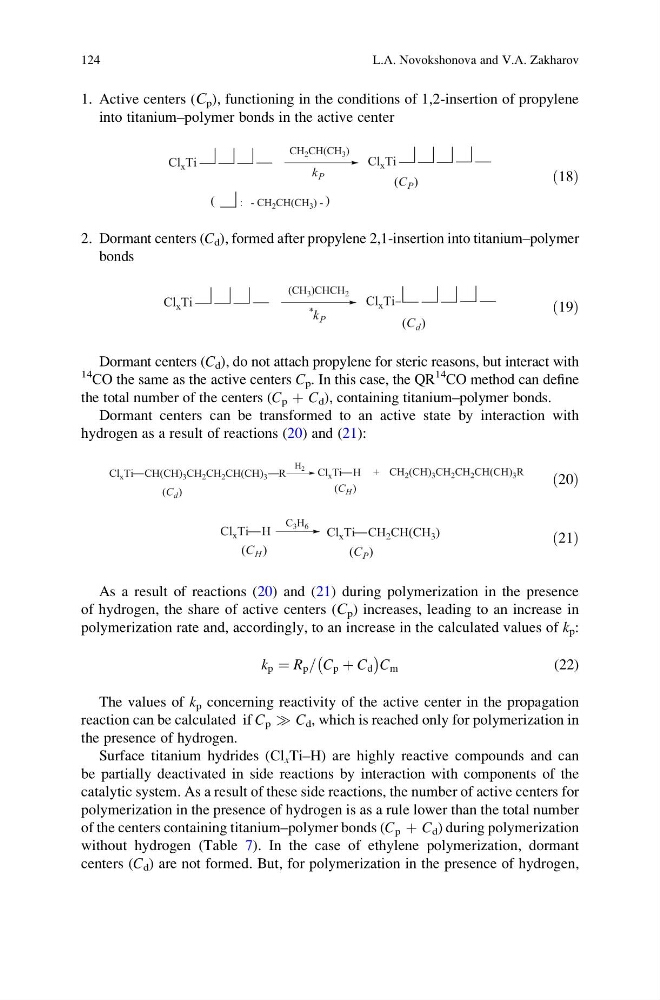
1. Active centers (С р ), functioning in the conditions of 1,2-insertion of propylene
into titanium–polymer bonds in the active center
ð18Þ
2. Dormant centers (C d ), formed after propylene 2,1-insertion into titanium–polymer
bonds
ð19Þ
Dormant centers (C d ), do not attach propylene for steric reasons, but interact with
14
СО the same as the active centers C p . In this case, the QR
14
СО method can define
the total number of the centers (C p þ C d ), containing titanium–polymer bonds.
Dormant centers can be transformed to an active state by interaction with
hydrogen as a result of reactions (20) and (21):
ð20Þ
ð21Þ
As a result of reactions (20) and (21) during polymerization in the presence
of hydrogen, the share of active centers (С р ) increases, leading to an increase in
polymerization rate and, accordingly, to an increase in the calculated values of k p :
k p ¼ R p = C p þ C d
À
Á
C m
(22)
The values of k p concerning reactivity of the active center in the propagation
reaction can be calculated if C p ) C d , which is reached only for polymerization in
the presence of hydrogen.
Surface titanium hydrides (Сl x Ti–H) are highly reactive compounds and can
be partially deactivated in side reactions by interaction with components of the
catalytic system. As a result of these side reactions, the number of active centers for
polymerization in the presence of hydrogen is as a rule lower than the total number
of the centers containing titanium–polymer bonds (C p þ C d ) during polymerization
without hydrogen (Table 7). In the case of ethylene polymerization, dormant
centers (C d ) are not formed. But, for polymerization in the presence of hydrogen,
124
L.A. Novokshonova and V.A. Zakharov
into titanium–polymer bonds in the active center
ð18Þ
2. Dormant centers (C d ), formed after propylene 2,1-insertion into titanium–polymer
bonds
ð19Þ
Dormant centers (C d ), do not attach propylene for steric reasons, but interact with
14
СО the same as the active centers C p . In this case, the QR
14
СО method can define
the total number of the centers (C p þ C d ), containing titanium–polymer bonds.
Dormant centers can be transformed to an active state by interaction with
hydrogen as a result of reactions (20) and (21):
ð20Þ
ð21Þ
As a result of reactions (20) and (21) during polymerization in the presence
of hydrogen, the share of active centers (С р ) increases, leading to an increase in
polymerization rate and, accordingly, to an increase in the calculated values of k p :
k p ¼ R p = C p þ C d
À
Á
C m
(22)
The values of k p concerning reactivity of the active center in the propagation
reaction can be calculated if C p ) C d , which is reached only for polymerization in
the presence of hydrogen.
Surface titanium hydrides (Сl x Ti–H) are highly reactive compounds and can
be partially deactivated in side reactions by interaction with components of the
catalytic system. As a result of these side reactions, the number of active centers for
polymerization in the presence of hydrogen is as a rule lower than the total number
of the centers containing titanium–polymer bonds (C p þ C d ) during polymerization
without hydrogen (Table 7). In the case of ethylene polymerization, dormant
centers (C d ) are not formed. But, for polymerization in the presence of hydrogen,
124
L.A. Novokshonova and V.A. Zakharov