

not influence the number of active centers nor the propagation rate constant, and
the hydrogen effect is not observed in conditions of quasi-living polymerization.
Later [185], it was shown that in these conditions hydrogen does not influence
the molecular weight of formed polymer. In works [74, 180], the hydrogen effect on
propylene polymerization on ТМC of various compositions and titanium trichloride
has been studied (using QR
14 CO method) for definition of the number of active
centers and propagation rate constants. It was found that the hydrogen effect is
reversible and that removal of hydrogen from polymerization decreases the polymerization rate to the value observed for polymerization without hydrogen.
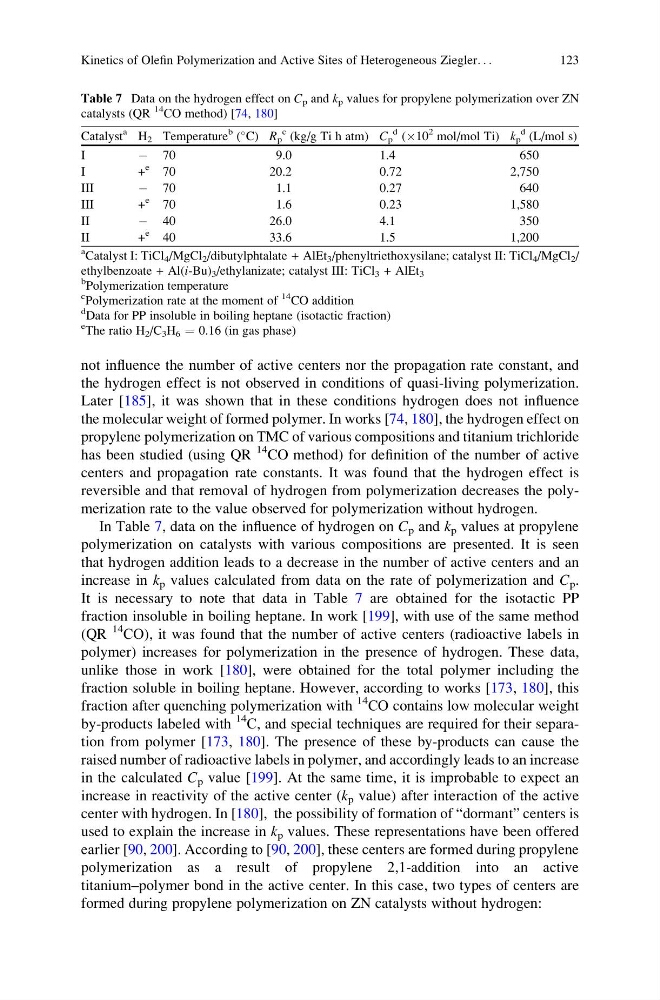
In Table 7, data on the influence of hydrogen on C p and k p values at propylene
polymerization on catalysts with various compositions are presented. It is seen
that hydrogen addition leads to a decrease in the number of active centers and an
increase in k p values calculated from data on the rate of polymerization and C p .
It is necessary to note that data in Table 7 are obtained for the isotactic PP
fraction insoluble in boiling heptane. In work [199], with use of the same method
(QR
14
СО), it was found that the number of active centers (radioactive labels in
polymer) increases for polymerization in the presence of hydrogen. These data,
unlike those in work [180], were obtained for the total polymer including the
fraction soluble in boiling heptane. However, according to works [173, 180], this
fraction after quenching polymerization with
14
СО contains low molecular weight
by-products labeled with
14
С, and special techniques are required for their separation from polymer [173, 180]. The presence of these by-products can cause the
raised number of radioactive labels in polymer, and accordingly leads to an increase
in the calculated C p value [199]. At the same time, it is improbable to expect an
increase in reactivity of the active center (k p value) after interaction of the active
center with hydrogen. In [180], the possibility of formation of “dormant” centers is
used to explain the increase in k p values. These representations have been offered
earlier [90, 200]. According to [90, 200], these centers are formed during propylene
polymerization as a result of propylene 2,1-addition into an active
titanium–polymer bond in the active center. In this case, two types of centers are
formed during propylene polymerization on ZN catalysts without hydrogen:
Table 7 Data on the hydrogen effect on C p and k p values for propylene polymerization over ZN
catalysts (QR
14
СО method) [74, 180]
Catalyst
a H 2 Temperature
b (
C) R p
c (kg/g Ti h atm) C p
d (Â10
2 mol/mol Ti) k p
d (L/mol s)
I
À 70
9.0
1.4
650
I
+
e
70
20.2
0.72
2,750
III
À 70
1.1
0.27
640
III
+
e
70
1.6
0.23
1,580
II
À 40
26.0
4.1
350
II
+
e
40
33.6
1.5
1,200
a
Catalyst I: TiCl 4 /MgCl 2 /dibutylphtalate + AlEt 3 /phenyltriethoxysilane; catalyst II: TiCl 4 /MgCl 2 /
ethylbenzoate + Al(i-Bu) 3 /ethylanizate; catalyst III: TiCl 3 + AlEt 3
b
Polymerization temperature
c
Polymerization rate at the moment of
14
CO addition
d
Data for PP insoluble in boiling heptane (isotactic fraction)
e
The ratio H 2 /C 3 H 6 ¼ 0.16 (in gas phase)
Kinetics of Olefin Polymerization and Active Sites of Heterogeneous Ziegler. . .
123
the hydrogen effect is not observed in conditions of quasi-living polymerization.
Later [185], it was shown that in these conditions hydrogen does not influence
the molecular weight of formed polymer. In works [74, 180], the hydrogen effect on
propylene polymerization on ТМC of various compositions and titanium trichloride
has been studied (using QR
14 CO method) for definition of the number of active
centers and propagation rate constants. It was found that the hydrogen effect is
reversible and that removal of hydrogen from polymerization decreases the polymerization rate to the value observed for polymerization without hydrogen.
In Table 7, data on the influence of hydrogen on C p and k p values at propylene
polymerization on catalysts with various compositions are presented. It is seen
that hydrogen addition leads to a decrease in the number of active centers and an
increase in k p values calculated from data on the rate of polymerization and C p .
It is necessary to note that data in Table 7 are obtained for the isotactic PP
fraction insoluble in boiling heptane. In work [199], with use of the same method
(QR
14
СО), it was found that the number of active centers (radioactive labels in
polymer) increases for polymerization in the presence of hydrogen. These data,
unlike those in work [180], were obtained for the total polymer including the
fraction soluble in boiling heptane. However, according to works [173, 180], this
fraction after quenching polymerization with
14
СО contains low molecular weight
by-products labeled with
14
С, and special techniques are required for their separation from polymer [173, 180]. The presence of these by-products can cause the
raised number of radioactive labels in polymer, and accordingly leads to an increase
in the calculated C p value [199]. At the same time, it is improbable to expect an
increase in reactivity of the active center (k p value) after interaction of the active
center with hydrogen. In [180], the possibility of formation of “dormant” centers is
used to explain the increase in k p values. These representations have been offered
earlier [90, 200]. According to [90, 200], these centers are formed during propylene
polymerization as a result of propylene 2,1-addition into an active
titanium–polymer bond in the active center. In this case, two types of centers are
formed during propylene polymerization on ZN catalysts without hydrogen:
Table 7 Data on the hydrogen effect on C p and k p values for propylene polymerization over ZN
catalysts (QR
14
СО method) [74, 180]
Catalyst
a H 2 Temperature
b (
C) R p
c (kg/g Ti h atm) C p
d (Â10
2 mol/mol Ti) k p
d (L/mol s)
I
À 70
9.0
1.4
650
I
+
e
70
20.2
0.72
2,750
III
À 70
1.1
0.27
640
III
+
e
70
1.6
0.23
1,580
II
À 40
26.0
4.1
350
II
+
e
40
33.6
1.5
1,200
a
Catalyst I: TiCl 4 /MgCl 2 /dibutylphtalate + AlEt 3 /phenyltriethoxysilane; catalyst II: TiCl 4 /MgCl 2 /
ethylbenzoate + Al(i-Bu) 3 /ethylanizate; catalyst III: TiCl 3 + AlEt 3
b
Polymerization temperature
c
Polymerization rate at the moment of
14
CO addition
d
Data for PP insoluble in boiling heptane (isotactic fraction)
e
The ratio H 2 /C 3 H 6 ¼ 0.16 (in gas phase)
Kinetics of Olefin Polymerization and Active Sites of Heterogeneous Ziegler. . .
123