

4 Reconstruction of Retinal OCT Images with Sparse Representation
87
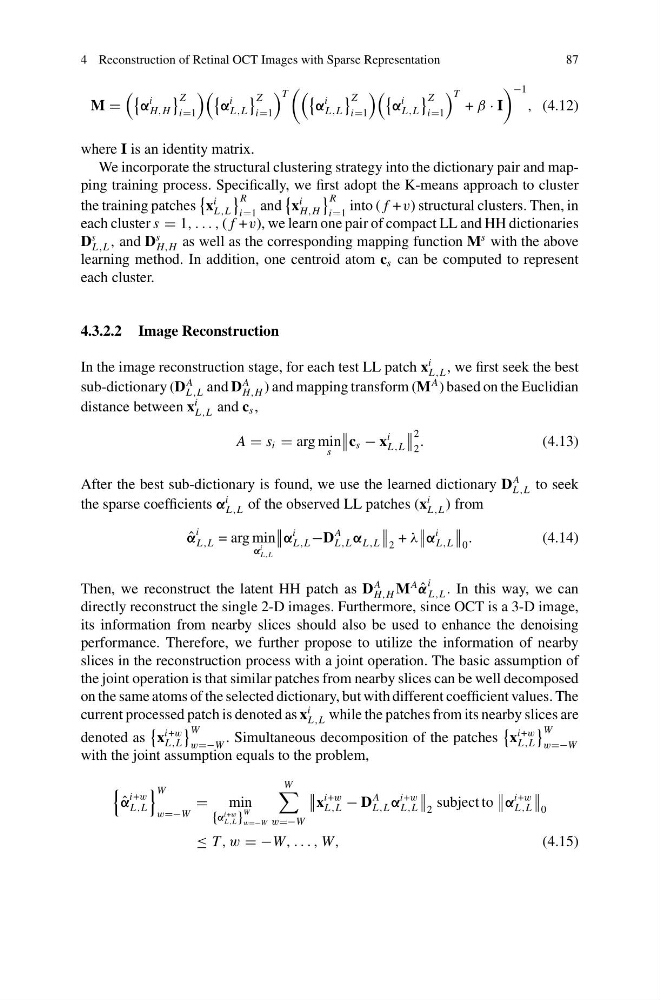
M
α
i
H,H
Z
i1
α
i
L ,L
Z
i1
T
α
i
L ,L
Z
i1
α
i
L ,L
Z
i1
T
+ β · I
−1
, (4.12)
where I is an identity matrix.
We incorporate the structural clustering strategy into the dictionary pair and mapping training process. Specifically, we first adopt the K-means approach to cluster
the training patches
x
i
L ,L
R
i1
and
x
i
H,H
R
i1
into ( f +v) structural clusters. Then, in
each cluster s 1, . . . , ( f +v), we learn one pair of compact LL and HH dictionaries
D
s
L ,L , and D
s
H,H as well as the corresponding mapping function M
s with the above
learning method. In addition, one centroid atom c s can be computed to represent
each cluster.
4.3.2.2 Image Reconstruction
In the image reconstruction stage, for each test LL patch x
i
L ,L , we first seek the best
sub-dictionary (D
A
L ,L and D
A
H,H ) and mapping transform (M
A ) based on the Euclidian
distance between x
i
L ,L and c s ,
A s i arg min
s
c s − x
i
L ,L
2
2
.
(4.13)
After the best sub-dictionary is found, we use the learned dictionary D
A
L ,L to seek
the sparse coefficients α
i
L ,L of the observed LL patches (x
i
L ,L ) from
ˆ
α
i
L ,L = arg min
α
i
L ,L
α
i
L ,L −D
A
L ,L α L ,L
2
+ λ
α
i
L ,L
0
.
(4.14)
Then, we reconstruct the latent HH patch as D
A
H,H M
A
ˆ
α
i
L ,L . In this way, we can
directly reconstruct the single 2-D images. Furthermore, since OCT is a 3-D image,
its information from nearby slices should also be used to enhance the denoising
performance. Therefore, we further propose to utilize the information of nearby
slices in the reconstruction process with a joint operation. The basic assumption of
the joint operation is that similar patches from nearby slices can be well decomposed
on the same atoms of the selected dictionary, but with different coefficient values. The
current processed patch is denoted as x
i
L ,L while the patches from its nearby slices are
denoted as
x
i+w
L ,L
W
w−W
. Simultaneous decomposition of the patches
x
i+w
L ,L
W
w−W
with the joint assumption equals to the problem,
ˆ
α
i+w
L ,L
W
w−W
min
{α
i+w
L ,L }
W
w−W
W
w−W
x
i+w
L ,L − D
A
L ,L α
i+w
L ,L
2
subject to
α
i+w
L ,L
0
≤ T, w −W, . . . , W,
(4.15)
87
M
α
i
H,H
Z
i1
α
i
L ,L
Z
i1
T
α
i
L ,L
Z
i1
α
i
L ,L
Z
i1
T
+ β · I
−1
, (4.12)
where I is an identity matrix.
We incorporate the structural clustering strategy into the dictionary pair and mapping training process. Specifically, we first adopt the K-means approach to cluster
the training patches
x
i
L ,L
R
i1
and
x
i
H,H
R
i1
into ( f +v) structural clusters. Then, in
each cluster s 1, . . . , ( f +v), we learn one pair of compact LL and HH dictionaries
D
s
L ,L , and D
s
H,H as well as the corresponding mapping function M
s with the above
learning method. In addition, one centroid atom c s can be computed to represent
each cluster.
4.3.2.2 Image Reconstruction
In the image reconstruction stage, for each test LL patch x
i
L ,L , we first seek the best
sub-dictionary (D
A
L ,L and D
A
H,H ) and mapping transform (M
A ) based on the Euclidian
distance between x
i
L ,L and c s ,
A s i arg min
s
c s − x
i
L ,L
2
2
.
(4.13)
After the best sub-dictionary is found, we use the learned dictionary D
A
L ,L to seek
the sparse coefficients α
i
L ,L of the observed LL patches (x
i
L ,L ) from
ˆ
α
i
L ,L = arg min
α
i
L ,L
α
i
L ,L −D
A
L ,L α L ,L
2
+ λ
α
i
L ,L
0
.
(4.14)
Then, we reconstruct the latent HH patch as D
A
H,H M
A
ˆ
α
i
L ,L . In this way, we can
directly reconstruct the single 2-D images. Furthermore, since OCT is a 3-D image,
its information from nearby slices should also be used to enhance the denoising
performance. Therefore, we further propose to utilize the information of nearby
slices in the reconstruction process with a joint operation. The basic assumption of
the joint operation is that similar patches from nearby slices can be well decomposed
on the same atoms of the selected dictionary, but with different coefficient values. The
current processed patch is denoted as x
i
L ,L while the patches from its nearby slices are
denoted as
x
i+w
L ,L
W
w−W
. Simultaneous decomposition of the patches
x
i+w
L ,L
W
w−W
with the joint assumption equals to the problem,
ˆ
α
i+w
L ,L
W
w−W
min
{α
i+w
L ,L }
W
w−W
W
w−W
x
i+w
L ,L − D
A
L ,L α
i+w
L ,L
2
subject to
α
i+w
L ,L
0
≤ T, w −W, . . . , W,
(4.15)