

3 Speckle Noise Reduction and Enhancement for OCT Images
55
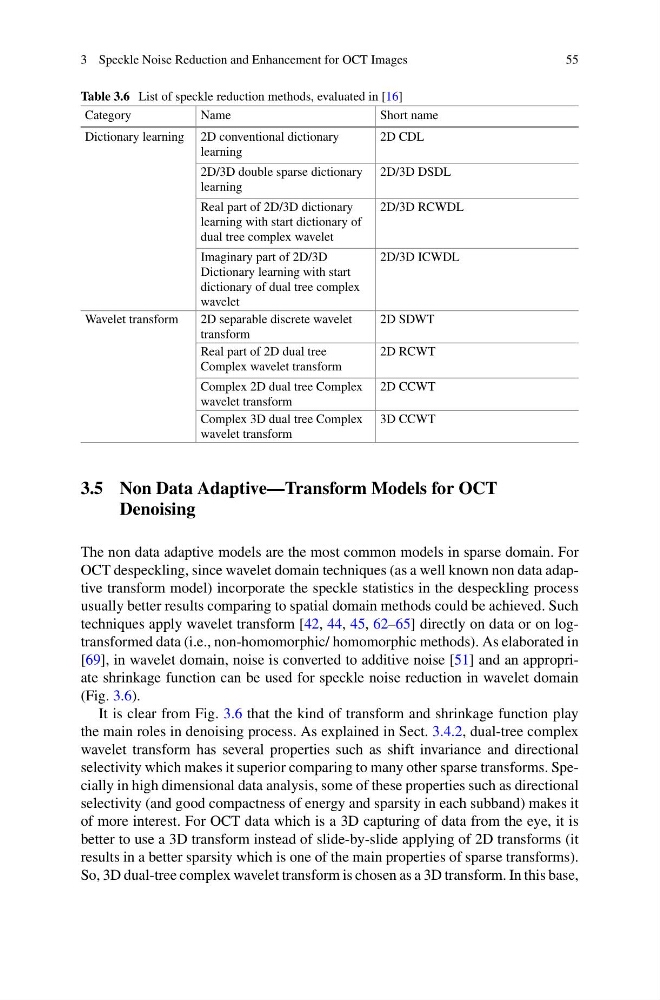
Table 3.6 List of speckle reduction methods, evaluated in [16]
Category
Name
Short name
Dictionary learning 2D conventional dictionary
learning
2D CDL
2D/3D double sparse dictionary
learning
2D/3D DSDL
Real part of 2D/3D dictionary
learning with start dictionary of
dual tree complex wavelet
2D/3D RCWDL
Imaginary part of 2D/3D
Dictionary learning with start
dictionary of dual tree complex
wavelet
2D/3D ICWDL
Wavelet transform
2D separable discrete wavelet
transform
2D SDWT
Real part of 2D dual tree
Complex wavelet transform
2D RCWT
Complex 2D dual tree Complex
wavelet transform
2D CCWT
Complex 3D dual tree Complex
wavelet transform
3D CCWT
3.5 Non Data Adaptive—Transform Models for OCT
Denoising
The non data adaptive models are the most common models in sparse domain. For
OCT despeckling, since wavelet domain techniques (as a well known non data adaptive transform model) incorporate the speckle statistics in the despeckling process
usually better results comparing to spatial domain methods could be achieved. Such
techniques apply wavelet transform [42, 44, 45, 62–65] directly on data or on logtransformed data (i.e., non-homomorphic/ homomorphic methods). As elaborated in
[69], in wavelet domain, noise is converted to additive noise [51] and an appropriate shrinkage function can be used for speckle noise reduction in wavelet domain
(Fig. 3.6).
It is clear from Fig. 3.6 that the kind of transform and shrinkage function play
the main roles in denoising process. As explained in Sect. 3.4.2, dual-tree complex
wavelet transform has several properties such as shift invariance and directional
selectivity which makes it superior comparing to many other sparse transforms. Specially in high dimensional data analysis, some of these properties such as directional
selectivity (and good compactness of energy and sparsity in each subband) makes it
of more interest. For OCT data which is a 3D capturing of data from the eye, it is
better to use a 3D transform instead of slide-by-slide applying of 2D transforms (it
results in a better sparsity which is one of the main properties of sparse transforms).
So, 3D dual-tree complex wavelet transform is chosen as a 3D transform. In this base,
55
Table 3.6 List of speckle reduction methods, evaluated in [16]
Category
Name
Short name
Dictionary learning 2D conventional dictionary
learning
2D CDL
2D/3D double sparse dictionary
learning
2D/3D DSDL
Real part of 2D/3D dictionary
learning with start dictionary of
dual tree complex wavelet
2D/3D RCWDL
Imaginary part of 2D/3D
Dictionary learning with start
dictionary of dual tree complex
wavelet
2D/3D ICWDL
Wavelet transform
2D separable discrete wavelet
transform
2D SDWT
Real part of 2D dual tree
Complex wavelet transform
2D RCWT
Complex 2D dual tree Complex
wavelet transform
2D CCWT
Complex 3D dual tree Complex
wavelet transform
3D CCWT
3.5 Non Data Adaptive—Transform Models for OCT
Denoising
The non data adaptive models are the most common models in sparse domain. For
OCT despeckling, since wavelet domain techniques (as a well known non data adaptive transform model) incorporate the speckle statistics in the despeckling process
usually better results comparing to spatial domain methods could be achieved. Such
techniques apply wavelet transform [42, 44, 45, 62–65] directly on data or on logtransformed data (i.e., non-homomorphic/ homomorphic methods). As elaborated in
[69], in wavelet domain, noise is converted to additive noise [51] and an appropriate shrinkage function can be used for speckle noise reduction in wavelet domain
(Fig. 3.6).
It is clear from Fig. 3.6 that the kind of transform and shrinkage function play
the main roles in denoising process. As explained in Sect. 3.4.2, dual-tree complex
wavelet transform has several properties such as shift invariance and directional
selectivity which makes it superior comparing to many other sparse transforms. Specially in high dimensional data analysis, some of these properties such as directional
selectivity (and good compactness of energy and sparsity in each subband) makes it
of more interest. For OCT data which is a 3D capturing of data from the eye, it is
better to use a 3D transform instead of slide-by-slide applying of 2D transforms (it
results in a better sparsity which is one of the main properties of sparse transforms).
So, 3D dual-tree complex wavelet transform is chosen as a 3D transform. In this base,