

11 Segmentation and Visualization of Drusen …
319
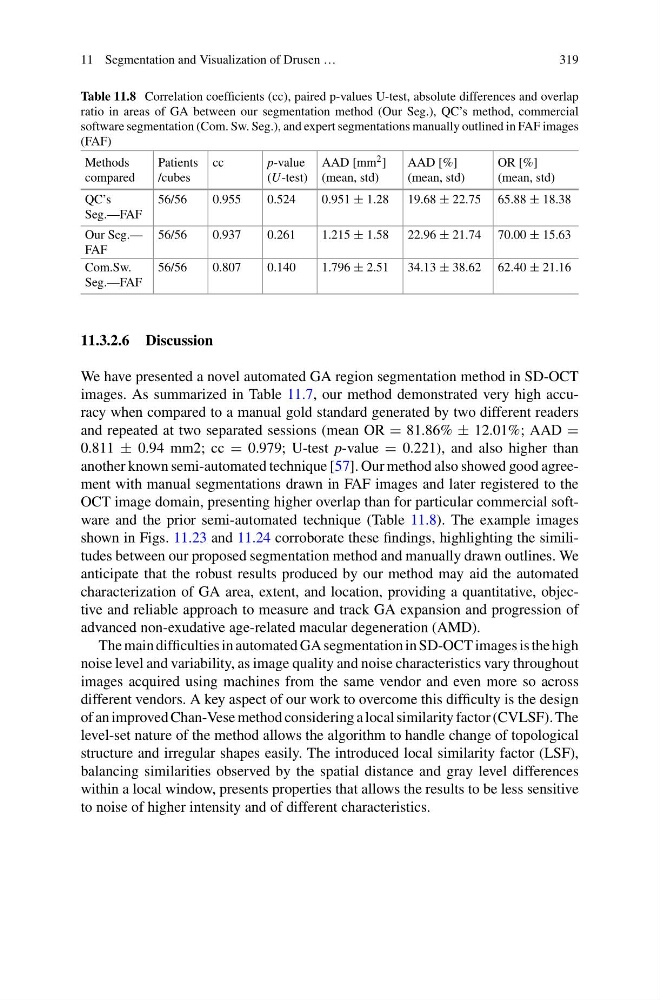
Table 11.8 Correlation coefficients (cc), paired p-values U-test, absolute differences and overlap
ratio in areas of GA between our segmentation method (Our Seg.), QC’s method, commercial
software segmentation (Com. Sw. Seg.), and expert segmentations manually outlined in FAF images
(FAF)
Methods
compared
Patients
/cubes
cc
p-value
(U-test)
AAD [mm 2 ]
(mean, std)
AAD [%]
(mean, std)
OR [%]
(mean, std)
QC’s
Seg.—FAF
56/56
0.955
0.524
0.951 ± 1.28 19.68 ± 22.75 65.88 ± 18.38
Our Seg.—
FAF
56/56
0.937
0.261
1.215 ± 1.58 22.96 ± 21.74 70.00 ± 15.63
Com.Sw.
Seg.—FAF
56/56
0.807
0.140
1.796 ± 2.51 34.13 ± 38.62 62.40 ± 21.16
11.3.2.6 Discussion
We have presented a novel automated GA region segmentation method in SD-OCT
images. As summarized in Table 11.7, our method demonstrated very high accuracy when compared to a manual gold standard generated by two different readers
and repeated at two separated sessions (mean OR 81.86% ± 12.01%; AAD
0.811 ± 0.94 mm2; cc 0.979; U-test p-value 0.221), and also higher than
another known semi-automated technique [57]. Our method also showed good agreement with manual segmentations drawn in FAF images and later registered to the
OCT image domain, presenting higher overlap than for particular commercial software and the prior semi-automated technique (Table 11.8). The example images
shown in Figs. 11.23 and 11.24 corroborate these findings, highlighting the similitudes between our proposed segmentation method and manually drawn outlines. We
anticipate that the robust results produced by our method may aid the automated
characterization of GA area, extent, and location, providing a quantitative, objective and reliable approach to measure and track GA expansion and progression of
advanced non-exudative age-related macular degeneration (AMD).
The main difficulties in automated GA segmentation in SD-OCT images is the high
noise level and variability, as image quality and noise characteristics vary throughout
images acquired using machines from the same vendor and even more so across
different vendors. A key aspect of our work to overcome this difficulty is the design
of an improved Chan-Vese method considering a local similarity factor (CVLSF). The
level-set nature of the method allows the algorithm to handle change of topological
structure and irregular shapes easily. The introduced local similarity factor (LSF),
balancing similarities observed by the spatial distance and gray level differences
within a local window, presents properties that allows the results to be less sensitive
to noise of higher intensity and of different characteristics.
319
Table 11.8 Correlation coefficients (cc), paired p-values U-test, absolute differences and overlap
ratio in areas of GA between our segmentation method (Our Seg.), QC’s method, commercial
software segmentation (Com. Sw. Seg.), and expert segmentations manually outlined in FAF images
(FAF)
Methods
compared
Patients
/cubes
cc
p-value
(U-test)
AAD [mm 2 ]
(mean, std)
AAD [%]
(mean, std)
OR [%]
(mean, std)
QC’s
Seg.—FAF
56/56
0.955
0.524
0.951 ± 1.28 19.68 ± 22.75 65.88 ± 18.38
Our Seg.—
FAF
56/56
0.937
0.261
1.215 ± 1.58 22.96 ± 21.74 70.00 ± 15.63
Com.Sw.
Seg.—FAF
56/56
0.807
0.140
1.796 ± 2.51 34.13 ± 38.62 62.40 ± 21.16
11.3.2.6 Discussion
We have presented a novel automated GA region segmentation method in SD-OCT
images. As summarized in Table 11.7, our method demonstrated very high accuracy when compared to a manual gold standard generated by two different readers
and repeated at two separated sessions (mean OR 81.86% ± 12.01%; AAD
0.811 ± 0.94 mm2; cc 0.979; U-test p-value 0.221), and also higher than
another known semi-automated technique [57]. Our method also showed good agreement with manual segmentations drawn in FAF images and later registered to the
OCT image domain, presenting higher overlap than for particular commercial software and the prior semi-automated technique (Table 11.8). The example images
shown in Figs. 11.23 and 11.24 corroborate these findings, highlighting the similitudes between our proposed segmentation method and manually drawn outlines. We
anticipate that the robust results produced by our method may aid the automated
characterization of GA area, extent, and location, providing a quantitative, objective and reliable approach to measure and track GA expansion and progression of
advanced non-exudative age-related macular degeneration (AMD).
The main difficulties in automated GA segmentation in SD-OCT images is the high
noise level and variability, as image quality and noise characteristics vary throughout
images acquired using machines from the same vendor and even more so across
different vendors. A key aspect of our work to overcome this difficulty is the design
of an improved Chan-Vese method considering a local similarity factor (CVLSF). The
level-set nature of the method allows the algorithm to handle change of topological
structure and irregular shapes easily. The introduced local similarity factor (LSF),
balancing similarities observed by the spatial distance and gray level differences
within a local window, presents properties that allows the results to be less sensitive
to noise of higher intensity and of different characteristics.