

10 Layer Segmentation and Analysis for Retina with Diseases
247
cost, surface 1 will have lower costs than surface 7 and can be correctly detected as
the optimal surface.
Different smoothness constraints x and y are used for detection of different
surfaces. Prior knowledge is used in determining the values, namely two facts: the
image resolution and the shape of surface. When the resolution is high, small values
are used to and ensure the smoothness of the surfaces preventing perturbation caused
by noise. On the contrary, when the resolution is low and when quick change in
surface height is possible, large values are needed to ensure the desired surface is
in the feasible surface set. For example, in the dataset for test, the resolution in ydirection is low, and quick changes may occur in surface 1 around the fovea and in
surface 11 above the PED region. Therefore, large y is set for these two surfaces.
In our method, two approaches are used to improve the performance of surface
detection. First, the surfaces with higher contrasts are detected first, and the surfaces
detected later are constrained in the subimage defined by previously detected ones.
This approach both reduces the interference of different edges and cuts the searching
space, resulting in improved accuracy and efficiency. Second, the multi-resolution
approach [2] is used to improve the efficiency of surface detection. A three-level
image pyramid is constructed by downsampling the image volume by a factor of 2
twice in z-direction. The graph search is first applied in the low resolution image
to get a initial result. Then, a rectangular subimage with its height representing the
refining range is constructed in the next higher resolution, so that the initial surface
position lies in the center. The surface position is then refined using graph search in
this subimage. For different surfaces, detection starts from different resolution levels
according to prior knowledge of their contrast. Different smoothness parameters are
set for different resolutions. The details for the detection orders, constraints, start
levels, and smoothness parameters used for the test dataset are given in Table 10.1.
Note that, with the aforementioned approaches, the global optimum property of the
graph search method is compromised.
10.2.2.2 Pre-processing
(1) Denoising by bilateral filtering
As the dominant quality degrading factor in OCT scans, the presence of speckle
noise may affect the accuracy and efficiency of image processing and analysis algorithms. Edge-preserving de-speckling methods are particularly important for segmentation tasks. In this study the bilateral filtering [32] is chosen. The bilateral filter
is essentially a weighted average filter, which is an improved version of Gaussian
filter. The weights decrease with both the difference in location (distance in the spatial domain S) and the difference in intensity (distance in the range domain R). The
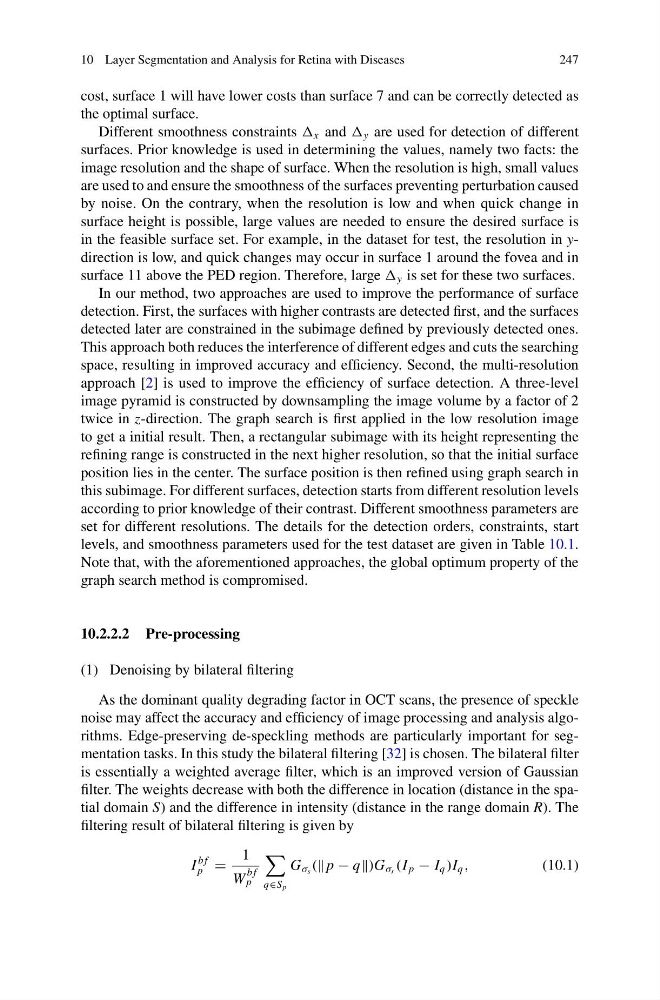
filtering result of bilateral filtering is given by
I
b f
p
1
W
b f
p
q∈S p
G σ s ( p − q)G σ r (I p − I q )I q ,
(10.1)
247
cost, surface 1 will have lower costs than surface 7 and can be correctly detected as
the optimal surface.
Different smoothness constraints x and y are used for detection of different
surfaces. Prior knowledge is used in determining the values, namely two facts: the
image resolution and the shape of surface. When the resolution is high, small values
are used to and ensure the smoothness of the surfaces preventing perturbation caused
by noise. On the contrary, when the resolution is low and when quick change in
surface height is possible, large values are needed to ensure the desired surface is
in the feasible surface set. For example, in the dataset for test, the resolution in ydirection is low, and quick changes may occur in surface 1 around the fovea and in
surface 11 above the PED region. Therefore, large y is set for these two surfaces.
In our method, two approaches are used to improve the performance of surface
detection. First, the surfaces with higher contrasts are detected first, and the surfaces
detected later are constrained in the subimage defined by previously detected ones.
This approach both reduces the interference of different edges and cuts the searching
space, resulting in improved accuracy and efficiency. Second, the multi-resolution
approach [2] is used to improve the efficiency of surface detection. A three-level
image pyramid is constructed by downsampling the image volume by a factor of 2
twice in z-direction. The graph search is first applied in the low resolution image
to get a initial result. Then, a rectangular subimage with its height representing the
refining range is constructed in the next higher resolution, so that the initial surface
position lies in the center. The surface position is then refined using graph search in
this subimage. For different surfaces, detection starts from different resolution levels
according to prior knowledge of their contrast. Different smoothness parameters are
set for different resolutions. The details for the detection orders, constraints, start
levels, and smoothness parameters used for the test dataset are given in Table 10.1.
Note that, with the aforementioned approaches, the global optimum property of the
graph search method is compromised.
10.2.2.2 Pre-processing
(1) Denoising by bilateral filtering
As the dominant quality degrading factor in OCT scans, the presence of speckle
noise may affect the accuracy and efficiency of image processing and analysis algorithms. Edge-preserving de-speckling methods are particularly important for segmentation tasks. In this study the bilateral filtering [32] is chosen. The bilateral filter
is essentially a weighted average filter, which is an improved version of Gaussian
filter. The weights decrease with both the difference in location (distance in the spatial domain S) and the difference in intensity (distance in the range domain R). The
filtering result of bilateral filtering is given by
I
b f
p
1
W
b f
p
q∈S p
G σ s ( p − q)G σ r (I p − I q )I q ,
(10.1)