

228
K. K. Vupparaboina et al.
is performed which is not only useful for volume estimation but also facilitated lifelike visualization of the choroid layer.
9.2.3.2.1 Geometrical Alignment Although eye anatomy is nominally a sphere, all
internal layers of the eye are not spherical. For example, the retinal shape deviates
considerably from a sphere, especially, near the fovea. Fortunately, the RPE, except
in the proximate region of the optic disc, is approximately spherical. In view of this
observation, RPE inner boundaries in all the OCT sections are aligned on a nominal
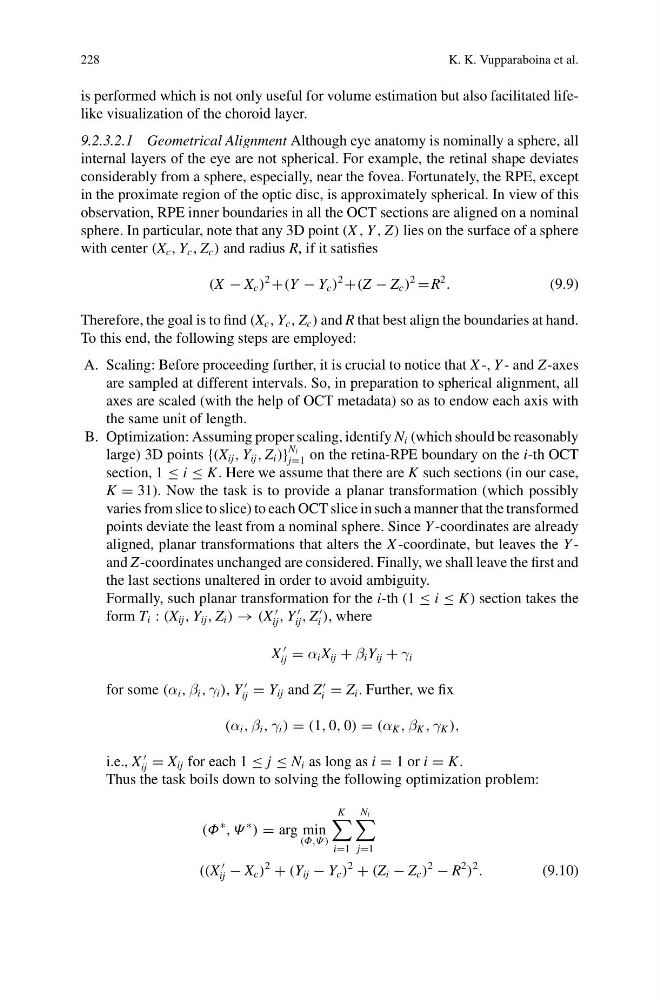
sphere. In particular, note that any 3D point (X , Y , Z) lies on the surface of a sphere
with center (X c , Y c , Z c ) and radius R, if it satisfies
(X − X c )
2
+(Y − Y c )
2
+(Z − Z c )
2
= R
2
.
(9.9)
Therefore, the goal is to find (X c , Y c , Z c ) and R that best align the boundaries at hand.
To this end, the following steps are employed:
A. Scaling: Before proceeding further, it is crucial to notice that X -, Y - and Z-axes
are sampled at different intervals. So, in preparation to spherical alignment, all
axes are scaled (with the help of OCT metadata) so as to endow each axis with
the same unit of length.
B. Optimization: Assuming proper scaling, identify N i (which should be reasonably
large) 3D points {(X ij , Y ij , Z i )}
N i
j=1 on the retina-RPE boundary on the i-th OCT
section, 1 ≤ i ≤ K. Here we assume that there are K such sections (in our case,
K = 31). Now the task is to provide a planar transformation (which possibly
varies from slice to slice) to each OCT slice in such a manner that the transformed
points deviate the least from a nominal sphere. Since Y -coordinates are already
aligned, planar transformations that alters the X -coordinate, but leaves the Y -
and Z-coordinates unchanged are considered. Finally, we shall leave the first and
the last sections unaltered in order to avoid ambiguity.
Formally, such planar transformation for the i-th (1 ≤ i ≤ K) section takes the
form T i : (X ij , Y ij , Z i ) → (X
ij , Y
ij , Z
i ), where
X
ij = α i X ij + β i Y ij + γ i
for some (α i , β i , γ i ), Y
ij = Y ij and Z
i = Z i . Further, we fix
(α i , β i , γ i ) = (1, 0, 0) = (α K , β K , γ K ),
i.e., X
ij = X ij for each 1 ≤ j ≤ N i as long as i = 1 or i = K.
Thus the task boils down to solving the following optimization problem:
(Φ
∗
, Ψ
∗
) = arg min
(Φ,Ψ )
K
i=1
N i
j=1
((X
ij − X c )
2
+ (Y ij − Y c )
2
+ (Z i − Z c )
2
− R
2
)
2
.
(9.10)
K. K. Vupparaboina et al.
is performed which is not only useful for volume estimation but also facilitated lifelike visualization of the choroid layer.
9.2.3.2.1 Geometrical Alignment Although eye anatomy is nominally a sphere, all
internal layers of the eye are not spherical. For example, the retinal shape deviates
considerably from a sphere, especially, near the fovea. Fortunately, the RPE, except
in the proximate region of the optic disc, is approximately spherical. In view of this
observation, RPE inner boundaries in all the OCT sections are aligned on a nominal
sphere. In particular, note that any 3D point (X , Y , Z) lies on the surface of a sphere
with center (X c , Y c , Z c ) and radius R, if it satisfies
(X − X c )
2
+(Y − Y c )
2
+(Z − Z c )
2
= R
2
.
(9.9)
Therefore, the goal is to find (X c , Y c , Z c ) and R that best align the boundaries at hand.
To this end, the following steps are employed:
A. Scaling: Before proceeding further, it is crucial to notice that X -, Y - and Z-axes
are sampled at different intervals. So, in preparation to spherical alignment, all
axes are scaled (with the help of OCT metadata) so as to endow each axis with
the same unit of length.
B. Optimization: Assuming proper scaling, identify N i (which should be reasonably
large) 3D points {(X ij , Y ij , Z i )}
N i
j=1 on the retina-RPE boundary on the i-th OCT
section, 1 ≤ i ≤ K. Here we assume that there are K such sections (in our case,
K = 31). Now the task is to provide a planar transformation (which possibly
varies from slice to slice) to each OCT slice in such a manner that the transformed
points deviate the least from a nominal sphere. Since Y -coordinates are already
aligned, planar transformations that alters the X -coordinate, but leaves the Y -
and Z-coordinates unchanged are considered. Finally, we shall leave the first and
the last sections unaltered in order to avoid ambiguity.
Formally, such planar transformation for the i-th (1 ≤ i ≤ K) section takes the
form T i : (X ij , Y ij , Z i ) → (X
ij , Y
ij , Z
i ), where
X
ij = α i X ij + β i Y ij + γ i
for some (α i , β i , γ i ), Y
ij = Y ij and Z
i = Z i . Further, we fix
(α i , β i , γ i ) = (1, 0, 0) = (α K , β K , γ K ),
i.e., X
ij = X ij for each 1 ≤ j ≤ N i as long as i = 1 or i = K.
Thus the task boils down to solving the following optimization problem:
(Φ
∗
, Ψ
∗
) = arg min
(Φ,Ψ )
K
i=1
N i
j=1
((X
ij − X c )
2
+ (Y ij − Y c )
2
+ (Z i − Z c )
2
− R
2
)
2
.
(9.10)