

5 Segmentation of OCT Scans Using Probabilistic Graphical Models
123
(since ln
(·) =
ln(·)) and leaving the max nodes unchanged (since ln max(·) =
max ln(·)). This allows us to treat our model as a fully fledged tractable probabilistic model. In particular, the posterior probability of a leaf node L k ∈ S is given by
L k (X k )
∂ S(X )
∂ L k
, where L k (X k ) denotes the value of L k for evidence X k , and
∂ S(X )
∂ L k
denotes the derivative of the SPN value S(X ) with respect to leaf node L k , which
can be computed in time that is linear in the number of SPN edges [30]. In our case,
leaf models constitute the retina segmentation model, and consequently posterior
marginals for these models can be computed efficiently, to assign a probability to
each choice of segmentation and priors. This property can be used to evaluate the
confidence of a segmentation and to suggest explicitly alternative segmentations
weighted by the respective probability - an aspect to be explored in our future work.
Learning Local Pathological Priors. There are various ways, how pathology specific modes can be obtain. Given a sufficient amount of labeled data, they can be
learning in a supervised fashion. In the semi-supervised case, one can hand-design
pathological modes according to the known properties of the pathology, as was done
in our preliminary experiments. For example, pathological modes for the circularshaped fluid deposits in AMD are very similar to sinusoidal functions.
Finally, it is also possible to learn priors in a completely unsupervised way by
defining a parametric shape model, e.g. a spline, perform a grid-search over parameter
configurations and select those splines that yielded the best fits in terms of the likelihood of the segmentations. While computationally expensive, this can be performed
offline, with only the best k splines used in the final model.
Acknowledgements Support of the German Science Foundation, grant GRK 1653, is gratefully
acknowledged.
Appendix
Derivation of the Objective (5.15)
In this section we will perform the derivations that are needed to rewrite the objective
J (q b , q c ) in (5.12) into the final optimization problem (5.15).
First Summand log P(c| y) of J(q b , q c )
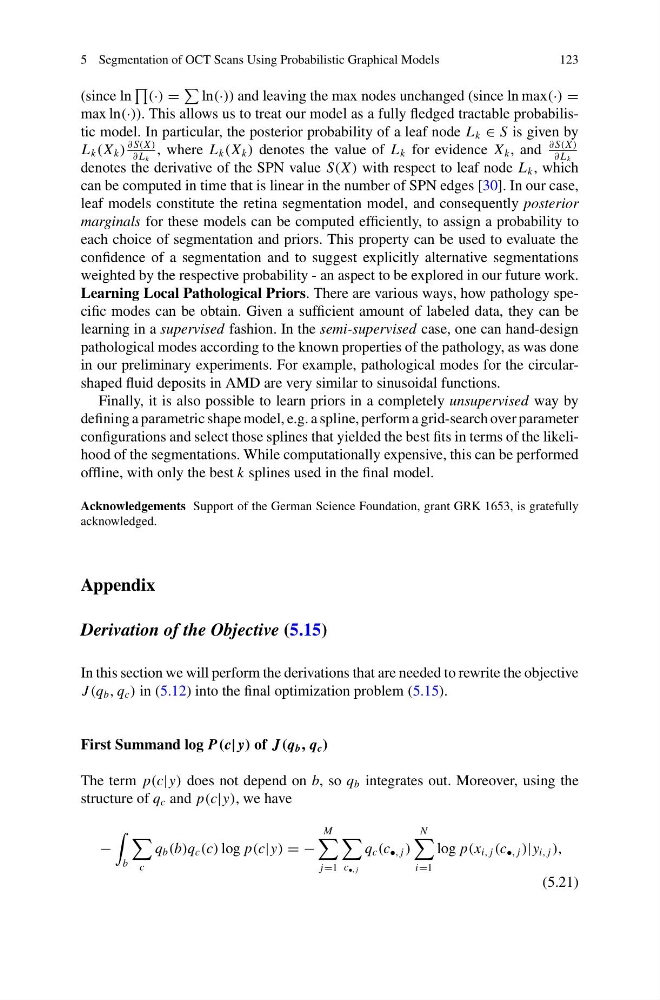
The term p(c|y) does not depend on b, so q b integrates out. Moreover, using the
structure of q c and p(c|y), we have
−
b
c
q b (b)q c (c) log p(c|y) = −
M
j=1
c •, j
q c (c •, j )
N
i=1
log p(x i, j (c •, j )|y i, j ),
(5.21)
123
(since ln
(·) =
ln(·)) and leaving the max nodes unchanged (since ln max(·) =
max ln(·)). This allows us to treat our model as a fully fledged tractable probabilistic model. In particular, the posterior probability of a leaf node L k ∈ S is given by
L k (X k )
∂ S(X )
∂ L k
, where L k (X k ) denotes the value of L k for evidence X k , and
∂ S(X )
∂ L k
denotes the derivative of the SPN value S(X ) with respect to leaf node L k , which
can be computed in time that is linear in the number of SPN edges [30]. In our case,
leaf models constitute the retina segmentation model, and consequently posterior
marginals for these models can be computed efficiently, to assign a probability to
each choice of segmentation and priors. This property can be used to evaluate the
confidence of a segmentation and to suggest explicitly alternative segmentations
weighted by the respective probability - an aspect to be explored in our future work.
Learning Local Pathological Priors. There are various ways, how pathology specific modes can be obtain. Given a sufficient amount of labeled data, they can be
learning in a supervised fashion. In the semi-supervised case, one can hand-design
pathological modes according to the known properties of the pathology, as was done
in our preliminary experiments. For example, pathological modes for the circularshaped fluid deposits in AMD are very similar to sinusoidal functions.
Finally, it is also possible to learn priors in a completely unsupervised way by
defining a parametric shape model, e.g. a spline, perform a grid-search over parameter
configurations and select those splines that yielded the best fits in terms of the likelihood of the segmentations. While computationally expensive, this can be performed
offline, with only the best k splines used in the final model.
Acknowledgements Support of the German Science Foundation, grant GRK 1653, is gratefully
acknowledged.
Appendix
Derivation of the Objective (5.15)
In this section we will perform the derivations that are needed to rewrite the objective
J (q b , q c ) in (5.12) into the final optimization problem (5.15).
First Summand log P(c| y) of J(q b , q c )
The term p(c|y) does not depend on b, so q b integrates out. Moreover, using the
structure of q c and p(c|y), we have
−
b
c
q b (b)q c (c) log p(c|y) = −
M
j=1
c •, j
q c (c •, j )
N
i=1
log p(x i, j (c •, j )|y i, j ),
(5.21)