

Solutions
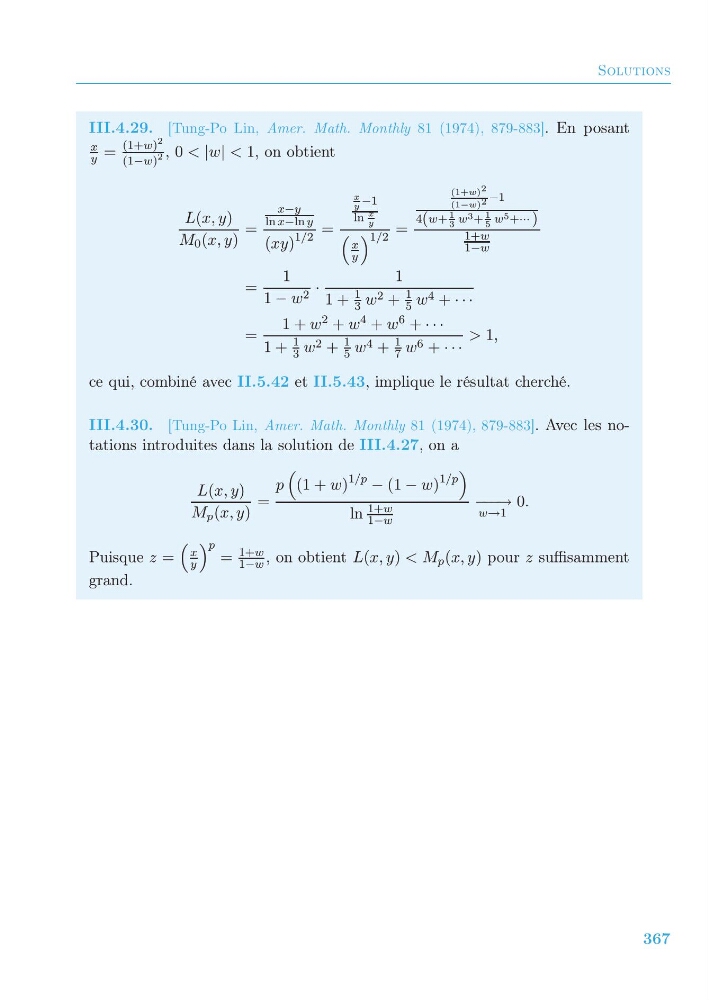
III.4.29. [Tung-Po Lin, Amer. Math. Monthly 81 (1974), 879-883]. En posant
x
y =
(1+w)
2
(1−w)
2 , 0 < |w| < 1, on obtient
L(x, y)
M 0 (x, y)
=
x−y
ln x−ln y
(xy)
1/2
=
x
y
−1
ln
x
y
x
y
1/2 =
(1+w) 2
(1−w) 2 −1
4(w+
1
3
w 3 +
1
5
w 5 +··· )
1+w
1−w
=
1
1 − w 2 ·
1
1 +
1
3 w 2 +
1
5 w 4 + · · ·
=
1 + w 2 + w 4 + w 6 + · · ·
1 +
1
3 w 2 +
1
5 w 4 +
1
7 w 6 + · · ·
> 1,
ce qui, combiné avec II.5.42 et II.5.43, implique le résultat cherché.
III.4.30. [Tung-Po Lin, Amer. Math. Monthly 81 (1974), 879-883]. Avec les notations introduites dans la solution de III.4.27, on a
L(x, y)
M p (x, y)
=
p
(1 + w)
1/p
− (1 − w)
1/p
ln
1+w
1−w
− −− →
w→1
0.
Puisque z =
x
y
p
=
1+w
1−w , on obtient L(x, y) < M p (x, y) pour z suffisamment
grand.
367
III.4.29. [Tung-Po Lin, Amer. Math. Monthly 81 (1974), 879-883]. En posant
x
y =
(1+w)
2
(1−w)
2 , 0 < |w| < 1, on obtient
L(x, y)
M 0 (x, y)
=
x−y
ln x−ln y
(xy)
1/2
=
x
y
−1
ln
x
y
x
y
1/2 =
(1+w) 2
(1−w) 2 −1
4(w+
1
3
w 3 +
1
5
w 5 +··· )
1+w
1−w
=
1
1 − w 2 ·
1
1 +
1
3 w 2 +
1
5 w 4 + · · ·
=
1 + w 2 + w 4 + w 6 + · · ·
1 +
1
3 w 2 +
1
5 w 4 +
1
7 w 6 + · · ·
> 1,
ce qui, combiné avec II.5.42 et II.5.43, implique le résultat cherché.
III.4.30. [Tung-Po Lin, Amer. Math. Monthly 81 (1974), 879-883]. Avec les notations introduites dans la solution de III.4.27, on a
L(x, y)
M p (x, y)
=
p
(1 + w)
1/p
− (1 − w)
1/p
ln
1+w
1−w
− −− →
w→1
0.
Puisque z =
x
y
p
=
1+w
1−w , on obtient L(x, y) < M p (x, y) pour z suffisamment
grand.
367