

it results in gaps in the spectral distribution of solar radiation as apparent in Figure 5.5.
Ozone absorbs radiation with wavelengths below 300 nm. Depletion of ozone from the
atmosphere allows more ultraviolet radiation to reach the Earth, with consequent harmful
effects upon biological systems. CO 2 molecules contribute to the absorption of solar
radiation at wavelengths above 1 µm. By changing the CO 2 content in the atmosphere the
absorption in the infrared is enhanced, which has consequences for our climate.
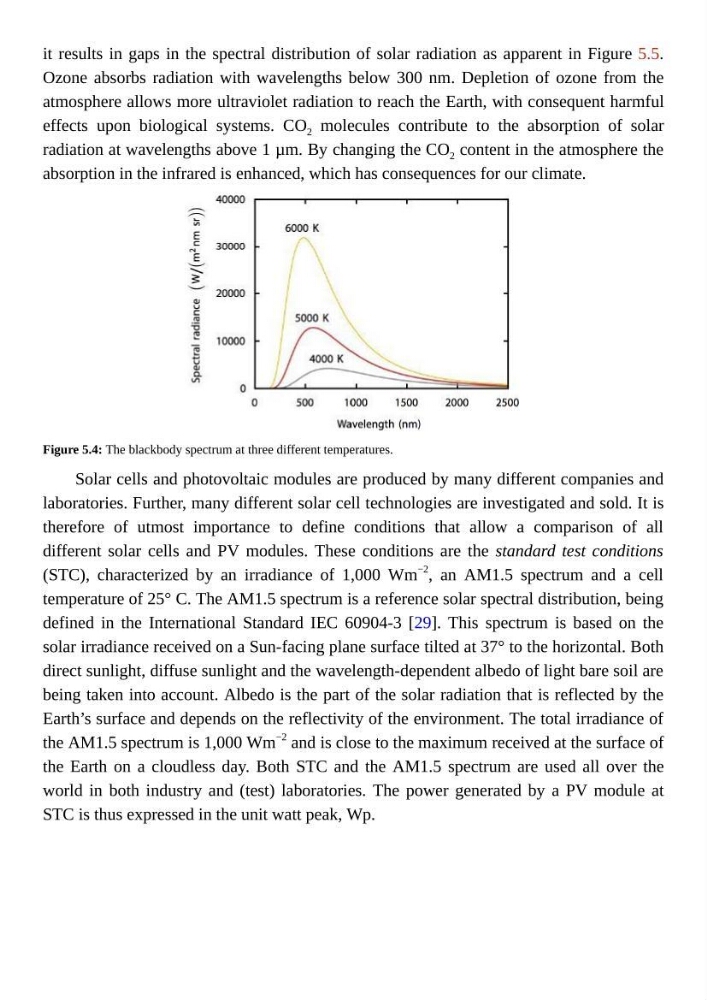
Figure 5.4: The blackbody spectrum at three different temperatures.
Solar cells and photovoltaic modules are produced by many different companies and
laboratories. Further, many different solar cell technologies are investigated and sold. It is
therefore of utmost importance to define conditions that allow a comparison of all
different solar cells and PV modules. These conditions are the standard test conditions
(STC), characterized by an irradiance of 1,000 Wm
−2
, an AM1.5 spectrum and a cell
temperature of 25° C. The AM1.5 spectrum is a reference solar spectral distribution, being
defined in the International Standard IEC 60904-3 [29]. This spectrum is based on the
solar irradiance received on a Sun-facing plane surface tilted at 37° to the horizontal. Both
direct sunlight, diffuse sunlight and the wavelength-dependent albedo of light bare soil are
being taken into account. Albedo is the part of the solar radiation that is reflected by the
Earth’s surface and depends on the reflectivity of the environment. The total irradiance of
the AM1.5 spectrum is 1,000 Wm
−2 and is close to the maximum received at the surface of
the Earth on a cloudless day. Both STC and the AM1.5 spectrum are used all over the
world in both industry and (test) laboratories. The power generated by a PV module at
STC is thus expressed in the unit watt peak, Wp.
Ozone absorbs radiation with wavelengths below 300 nm. Depletion of ozone from the
atmosphere allows more ultraviolet radiation to reach the Earth, with consequent harmful
effects upon biological systems. CO 2 molecules contribute to the absorption of solar
radiation at wavelengths above 1 µm. By changing the CO 2 content in the atmosphere the
absorption in the infrared is enhanced, which has consequences for our climate.
Figure 5.4: The blackbody spectrum at three different temperatures.
Solar cells and photovoltaic modules are produced by many different companies and
laboratories. Further, many different solar cell technologies are investigated and sold. It is
therefore of utmost importance to define conditions that allow a comparison of all
different solar cells and PV modules. These conditions are the standard test conditions
(STC), characterized by an irradiance of 1,000 Wm
−2
, an AM1.5 spectrum and a cell
temperature of 25° C. The AM1.5 spectrum is a reference solar spectral distribution, being
defined in the International Standard IEC 60904-3 [29]. This spectrum is based on the
solar irradiance received on a Sun-facing plane surface tilted at 37° to the horizontal. Both
direct sunlight, diffuse sunlight and the wavelength-dependent albedo of light bare soil are
being taken into account. Albedo is the part of the solar radiation that is reflected by the
Earth’s surface and depends on the reflectivity of the environment. The total irradiance of
the AM1.5 spectrum is 1,000 Wm
−2 and is close to the maximum received at the surface of
the Earth on a cloudless day. Both STC and the AM1.5 spectrum are used all over the
world in both industry and (test) laboratories. The power generated by a PV module at
STC is thus expressed in the unit watt peak, Wp.