

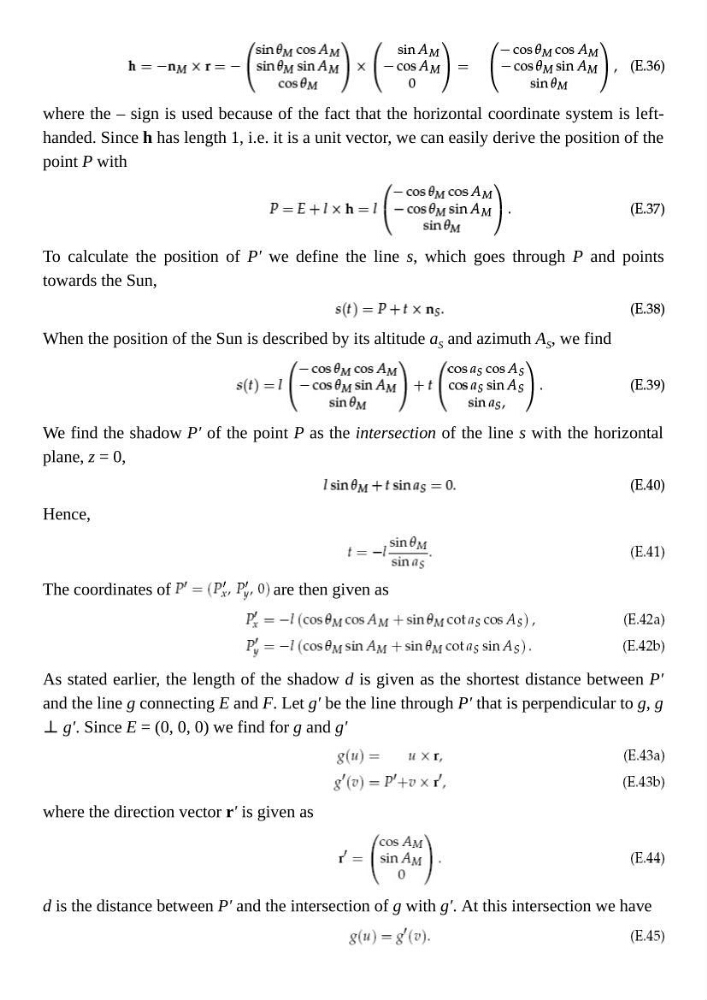
where the – sign is used because of the fact that the horizontal coordinate system is lefthanded. Since h has length 1, i.e. it is a unit vector, we can easily derive the position of the
point P with
To calculate the position of P′ we define the line s, which goes through P and points
towards the Sun,
When the position of the Sun is described by its altitude a S and azimuth A S , we find
We find the shadow P′ of the point P as the intersection of the line s with the horizontal
plane, z = 0,
Hence,
The coordinates of
are then given as
As stated earlier, the length of the shadow d is given as the shortest distance between P′
and the line g connecting E and F. Let g′ be the line through P′ that is perpendicular to g, g
⊥ g′. Since E = (0, 0, 0) we find for g and g′
where the direction vector r′ is given as
d is the distance between P′ and the intersection of g with g′. At this intersection we have
point P with
To calculate the position of P′ we define the line s, which goes through P and points
towards the Sun,
When the position of the Sun is described by its altitude a S and azimuth A S , we find
We find the shadow P′ of the point P as the intersection of the line s with the horizontal
plane, z = 0,
Hence,
The coordinates of
are then given as
As stated earlier, the length of the shadow d is given as the shortest distance between P′
and the line g connecting E and F. Let g′ be the line through P′ that is perpendicular to g, g
⊥ g′. Since E = (0, 0, 0) we find for g and g′
where the direction vector r′ is given as
d is the distance between P′ and the intersection of g with g′. At this intersection we have