

4.
5.
The energy levels of the material have to be adequate to couple with the energy
needed for the reactions. In particular, the energy levels of the reactions have to
be located in the energy bandgap of the semiconductor, which is called the
favourable position. To further enhance the reaction, a catalyst may be added to
the semiconductor surface.
On the practical side, it is important that the materials used are photochemically
stable and relatively cheap. From these criteria we can conclude that the main
technical challenges to be addressed are light absorption, the separation of
charges and the catalysis of the reaction.
The absorption and catalysis problems can be tackled by carefully choosing the
semiconductor material and its corresponding catalyst. Several materials can be
considered for solar water splitting. Some of the most popular materials studied for this
application are titanium dioxide (TiO 2 ), tungsten oxide (WO 3 ), bismuth vanadate (BiVO 4 ),
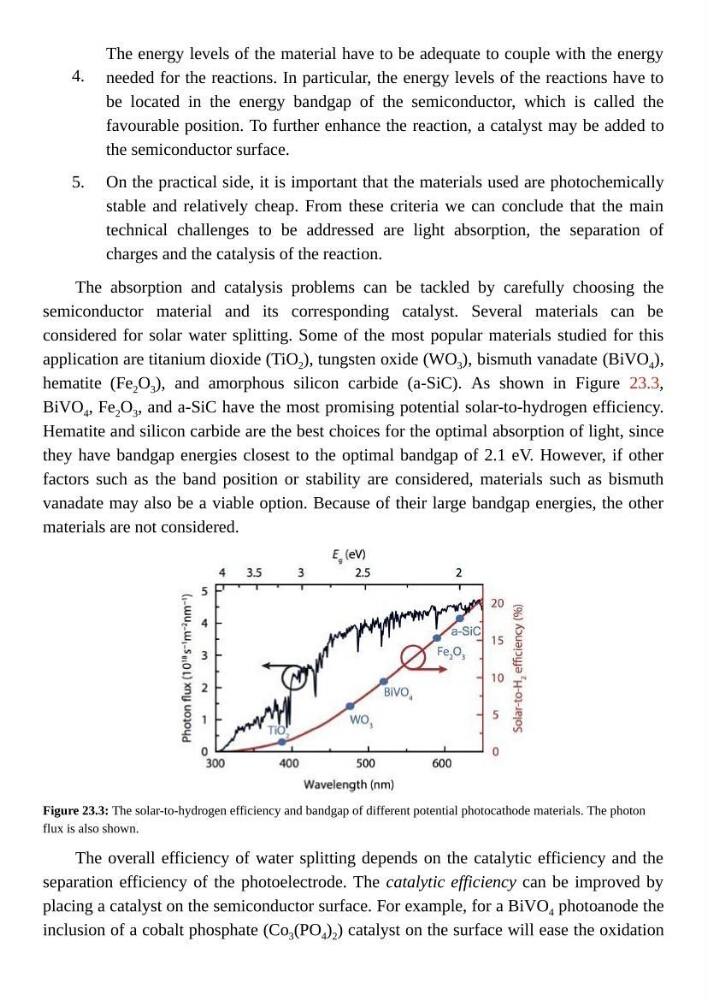
hematite (Fe 2 O 3 ), and amorphous silicon carbide (a-SiC). As shown in Figure 23.3,
BiVO 4 , Fe 2 O 3 , and a-SiC have the most promising potential solar-to-hydrogen efficiency.
Hematite and silicon carbide are the best choices for the optimal absorption of light, since
they have bandgap energies closest to the optimal bandgap of 2.1 eV. However, if other
factors such as the band position or stability are considered, materials such as bismuth
vanadate may also be a viable option. Because of their large bandgap energies, the other
materials are not considered.
Figure 23.3: The solar-to-hydrogen efficiency and bandgap of different potential photocathode materials. The photon
flux is also shown.
The overall efficiency of water splitting depends on the catalytic efficiency and the
separation efficiency of the photoelectrode. The catalytic efficiency can be improved by
placing a catalyst on the semiconductor surface. For example, for a BiVO 4 photoanode the
inclusion of a cobalt phosphate (Co 3 (PO 4 ) 2 ) catalyst on the surface will ease the oxidation
5.
The energy levels of the material have to be adequate to couple with the energy
needed for the reactions. In particular, the energy levels of the reactions have to
be located in the energy bandgap of the semiconductor, which is called the
favourable position. To further enhance the reaction, a catalyst may be added to
the semiconductor surface.
On the practical side, it is important that the materials used are photochemically
stable and relatively cheap. From these criteria we can conclude that the main
technical challenges to be addressed are light absorption, the separation of
charges and the catalysis of the reaction.
The absorption and catalysis problems can be tackled by carefully choosing the
semiconductor material and its corresponding catalyst. Several materials can be
considered for solar water splitting. Some of the most popular materials studied for this
application are titanium dioxide (TiO 2 ), tungsten oxide (WO 3 ), bismuth vanadate (BiVO 4 ),
hematite (Fe 2 O 3 ), and amorphous silicon carbide (a-SiC). As shown in Figure 23.3,
BiVO 4 , Fe 2 O 3 , and a-SiC have the most promising potential solar-to-hydrogen efficiency.
Hematite and silicon carbide are the best choices for the optimal absorption of light, since
they have bandgap energies closest to the optimal bandgap of 2.1 eV. However, if other
factors such as the band position or stability are considered, materials such as bismuth
vanadate may also be a viable option. Because of their large bandgap energies, the other
materials are not considered.
Figure 23.3: The solar-to-hydrogen efficiency and bandgap of different potential photocathode materials. The photon
flux is also shown.
The overall efficiency of water splitting depends on the catalytic efficiency and the
separation efficiency of the photoelectrode. The catalytic efficiency can be improved by
placing a catalyst on the semiconductor surface. For example, for a BiVO 4 photoanode the
inclusion of a cobalt phosphate (Co 3 (PO 4 ) 2 ) catalyst on the surface will ease the oxidation