

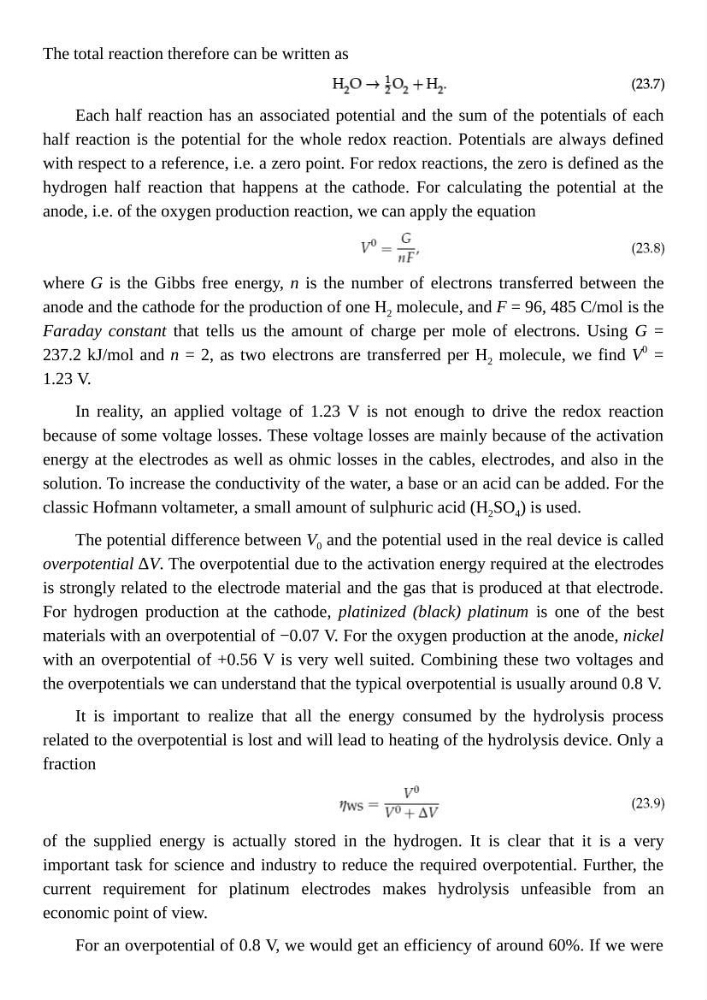
The total reaction therefore can be written as
Each half reaction has an associated potential and the sum of the potentials of each
half reaction is the potential for the whole redox reaction. Potentials are always defined
with respect to a reference, i.e. a zero point. For redox reactions, the zero is defined as the
hydrogen half reaction that happens at the cathode. For calculating the potential at the
anode, i.e. of the oxygen production reaction, we can apply the equation
where G is the Gibbs free energy, n is the number of electrons transferred between the
anode and the cathode for the production of one H 2 molecule, and F = 96, 485 C/mol is the
Faraday constant that tells us the amount of charge per mole of electrons. Using G =
237.2 kJ/mol and n = 2, as two electrons are transferred per H 2 molecule, we find V
0 =
1.23 V.
In reality, an applied voltage of 1.23 V is not enough to drive the redox reaction
because of some voltage losses. These voltage losses are mainly because of the activation
energy at the electrodes as well as ohmic losses in the cables, electrodes, and also in the
solution. To increase the conductivity of the water, a base or an acid can be added. For the
classic Hofmann voltameter, a small amount of sulphuric acid (H 2 SO 4 ) is used.
The potential difference between V 0 and the potential used in the real device is called
overpotential ΔV. The overpotential due to the activation energy required at the electrodes
is strongly related to the electrode material and the gas that is produced at that electrode.
For hydrogen production at the cathode, platinized (black) platinum is one of the best
materials with an overpotential of −0.07 V. For the oxygen production at the anode, nickel
with an overpotential of +0.56 V is very well suited. Combining these two voltages and
the overpotentials we can understand that the typical overpotential is usually around 0.8 V.
It is important to realize that all the energy consumed by the hydrolysis process
related to the overpotential is lost and will lead to heating of the hydrolysis device. Only a
fraction
of the supplied energy is actually stored in the hydrogen. It is clear that it is a very
important task for science and industry to reduce the required overpotential. Further, the
current requirement for platinum electrodes makes hydrolysis unfeasible from an
economic point of view.
For an overpotential of 0.8 V, we would get an efficiency of around 60%. If we were
Each half reaction has an associated potential and the sum of the potentials of each
half reaction is the potential for the whole redox reaction. Potentials are always defined
with respect to a reference, i.e. a zero point. For redox reactions, the zero is defined as the
hydrogen half reaction that happens at the cathode. For calculating the potential at the
anode, i.e. of the oxygen production reaction, we can apply the equation
where G is the Gibbs free energy, n is the number of electrons transferred between the
anode and the cathode for the production of one H 2 molecule, and F = 96, 485 C/mol is the
Faraday constant that tells us the amount of charge per mole of electrons. Using G =
237.2 kJ/mol and n = 2, as two electrons are transferred per H 2 molecule, we find V
0 =
1.23 V.
In reality, an applied voltage of 1.23 V is not enough to drive the redox reaction
because of some voltage losses. These voltage losses are mainly because of the activation
energy at the electrodes as well as ohmic losses in the cables, electrodes, and also in the
solution. To increase the conductivity of the water, a base or an acid can be added. For the
classic Hofmann voltameter, a small amount of sulphuric acid (H 2 SO 4 ) is used.
The potential difference between V 0 and the potential used in the real device is called
overpotential ΔV. The overpotential due to the activation energy required at the electrodes
is strongly related to the electrode material and the gas that is produced at that electrode.
For hydrogen production at the cathode, platinized (black) platinum is one of the best
materials with an overpotential of −0.07 V. For the oxygen production at the anode, nickel
with an overpotential of +0.56 V is very well suited. Combining these two voltages and
the overpotentials we can understand that the typical overpotential is usually around 0.8 V.
It is important to realize that all the energy consumed by the hydrolysis process
related to the overpotential is lost and will lead to heating of the hydrolysis device. Only a
fraction
of the supplied energy is actually stored in the hydrogen. It is clear that it is a very
important task for science and industry to reduce the required overpotential. Further, the
current requirement for platinum electrodes makes hydrolysis unfeasible from an
economic point of view.
For an overpotential of 0.8 V, we would get an efficiency of around 60%. If we were