

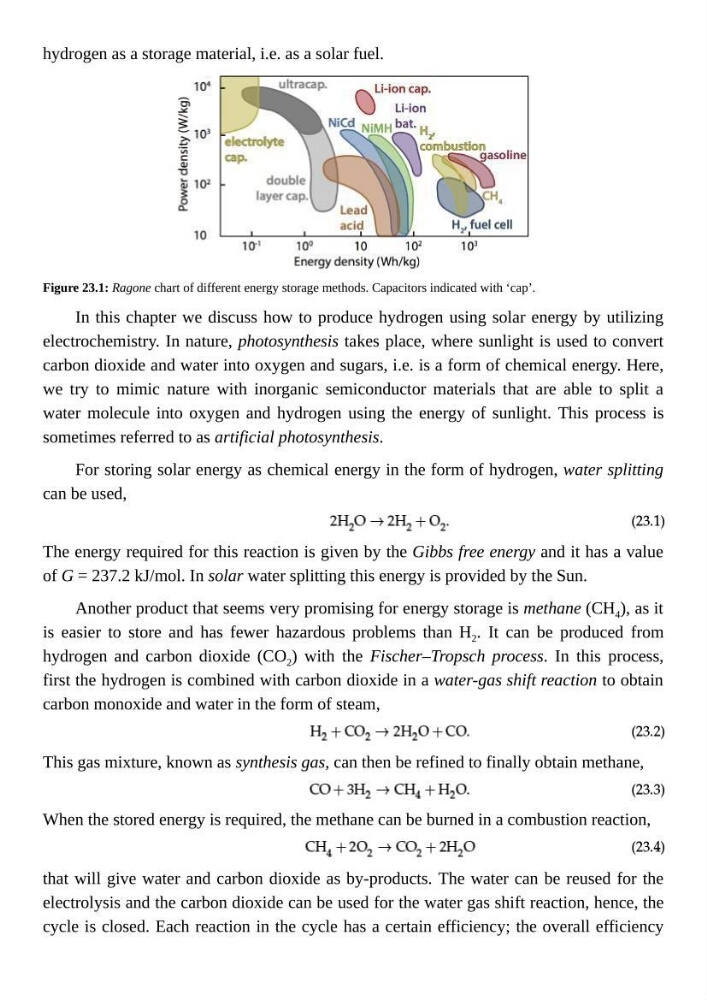
hydrogen as a storage material, i.e. as a solar fuel.
Figure 23.1: Ragone chart of different energy storage methods. Capacitors indicated with ‘cap’.
In this chapter we discuss how to produce hydrogen using solar energy by utilizing
electrochemistry. In nature, photosynthesis takes place, where sunlight is used to convert
carbon dioxide and water into oxygen and sugars, i.e. is a form of chemical energy. Here,
we try to mimic nature with inorganic semiconductor materials that are able to split a
water molecule into oxygen and hydrogen using the energy of sunlight. This process is
sometimes referred to as artificial photosynthesis.
For storing solar energy as chemical energy in the form of hydrogen, water splitting
can be used,
The energy required for this reaction is given by the Gibbs free energy and it has a value
of G = 237.2 kJ/mol. In solar water splitting this energy is provided by the Sun.
Another product that seems very promising for energy storage is methane (CH 4 ), as it
is easier to store and has fewer hazardous problems than H 2 . It can be produced from
hydrogen and carbon dioxide (CO 2 ) with the Fischer–Tropsch process. In this process,
first the hydrogen is combined with carbon dioxide in a water-gas shift reaction to obtain
carbon monoxide and water in the form of steam,
This gas mixture, known as synthesis gas, can then be refined to finally obtain methane,
When the stored energy is required, the methane can be burned in a combustion reaction,
that will give water and carbon dioxide as by-products. The water can be reused for the
electrolysis and the carbon dioxide can be used for the water gas shift reaction, hence, the
cycle is closed. Each reaction in the cycle has a certain efficiency; the overall efficiency
Figure 23.1: Ragone chart of different energy storage methods. Capacitors indicated with ‘cap’.
In this chapter we discuss how to produce hydrogen using solar energy by utilizing
electrochemistry. In nature, photosynthesis takes place, where sunlight is used to convert
carbon dioxide and water into oxygen and sugars, i.e. is a form of chemical energy. Here,
we try to mimic nature with inorganic semiconductor materials that are able to split a
water molecule into oxygen and hydrogen using the energy of sunlight. This process is
sometimes referred to as artificial photosynthesis.
For storing solar energy as chemical energy in the form of hydrogen, water splitting
can be used,
The energy required for this reaction is given by the Gibbs free energy and it has a value
of G = 237.2 kJ/mol. In solar water splitting this energy is provided by the Sun.
Another product that seems very promising for energy storage is methane (CH 4 ), as it
is easier to store and has fewer hazardous problems than H 2 . It can be produced from
hydrogen and carbon dioxide (CO 2 ) with the Fischer–Tropsch process. In this process,
first the hydrogen is combined with carbon dioxide in a water-gas shift reaction to obtain
carbon monoxide and water in the form of steam,
This gas mixture, known as synthesis gas, can then be refined to finally obtain methane,
When the stored energy is required, the methane can be burned in a combustion reaction,
that will give water and carbon dioxide as by-products. The water can be reused for the
electrolysis and the carbon dioxide can be used for the water gas shift reaction, hence, the
cycle is closed. Each reaction in the cycle has a certain efficiency; the overall efficiency