

hand, the industry learns to increase the energy conversion efficiency without increasing
the cost via betterr understanding the production process and hence increasing the
production yield. On the other hand, industry also learns to produce more efficiently,
which means that the manpower required per production unit can be reduced. Also, the
materials and energy required for producing the PV modules becomes less and less per
production unit. In addition, also upscaling reduces the cost. Learning curves usually show
an exponentially decreasing cost price, until the technology or product is fully developed.
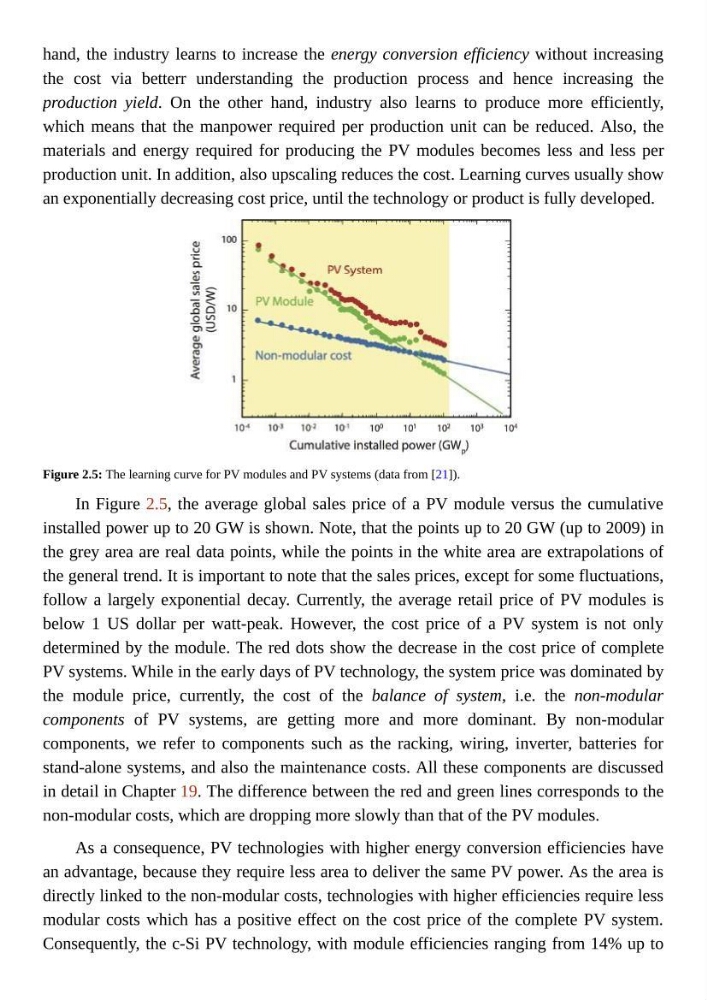
Figure 2.5: The learning curve for PV modules and PV systems (data from [21]).
In Figure 2.5, the average global sales price of a PV module versus the cumulative
installed power up to 20 GW is shown. Note, that the points up to 20 GW (up to 2009) in
the grey area are real data points, while the points in the white area are extrapolations of
the general trend. It is important to note that the sales prices, except for some fluctuations,
follow a largely exponential decay. Currently, the average retail price of PV modules is
below 1 US dollar per watt-peak. However, the cost price of a PV system is not only
determined by the module. The red dots show the decrease in the cost price of complete
PV systems. While in the early days of PV technology, the system price was dominated by
the module price, currently, the cost of the balance of system, i.e. the non-modular
components of PV systems, are getting more and more dominant. By non-modular
components, we refer to components such as the racking, wiring, inverter, batteries for
stand-alone systems, and also the maintenance costs. All these components are discussed
in detail in Chapter 19. The difference between the red and green lines corresponds to the
non-modular costs, which are dropping more slowly than that of the PV modules.
As a consequence, PV technologies with higher energy conversion efficiencies have
an advantage, because they require less area to deliver the same PV power. As the area is
directly linked to the non-modular costs, technologies with higher efficiencies require less
modular costs which has a positive effect on the cost price of the complete PV system.
Consequently, the c-Si PV technology, with module efficiencies ranging from 14% up to
the cost via betterr understanding the production process and hence increasing the
production yield. On the other hand, industry also learns to produce more efficiently,
which means that the manpower required per production unit can be reduced. Also, the
materials and energy required for producing the PV modules becomes less and less per
production unit. In addition, also upscaling reduces the cost. Learning curves usually show
an exponentially decreasing cost price, until the technology or product is fully developed.
Figure 2.5: The learning curve for PV modules and PV systems (data from [21]).
In Figure 2.5, the average global sales price of a PV module versus the cumulative
installed power up to 20 GW is shown. Note, that the points up to 20 GW (up to 2009) in
the grey area are real data points, while the points in the white area are extrapolations of
the general trend. It is important to note that the sales prices, except for some fluctuations,
follow a largely exponential decay. Currently, the average retail price of PV modules is
below 1 US dollar per watt-peak. However, the cost price of a PV system is not only
determined by the module. The red dots show the decrease in the cost price of complete
PV systems. While in the early days of PV technology, the system price was dominated by
the module price, currently, the cost of the balance of system, i.e. the non-modular
components of PV systems, are getting more and more dominant. By non-modular
components, we refer to components such as the racking, wiring, inverter, batteries for
stand-alone systems, and also the maintenance costs. All these components are discussed
in detail in Chapter 19. The difference between the red and green lines corresponds to the
non-modular costs, which are dropping more slowly than that of the PV modules.
As a consequence, PV technologies with higher energy conversion efficiencies have
an advantage, because they require less area to deliver the same PV power. As the area is
directly linked to the non-modular costs, technologies with higher efficiencies require less
modular costs which has a positive effect on the cost price of the complete PV system.
Consequently, the c-Si PV technology, with module efficiencies ranging from 14% up to