

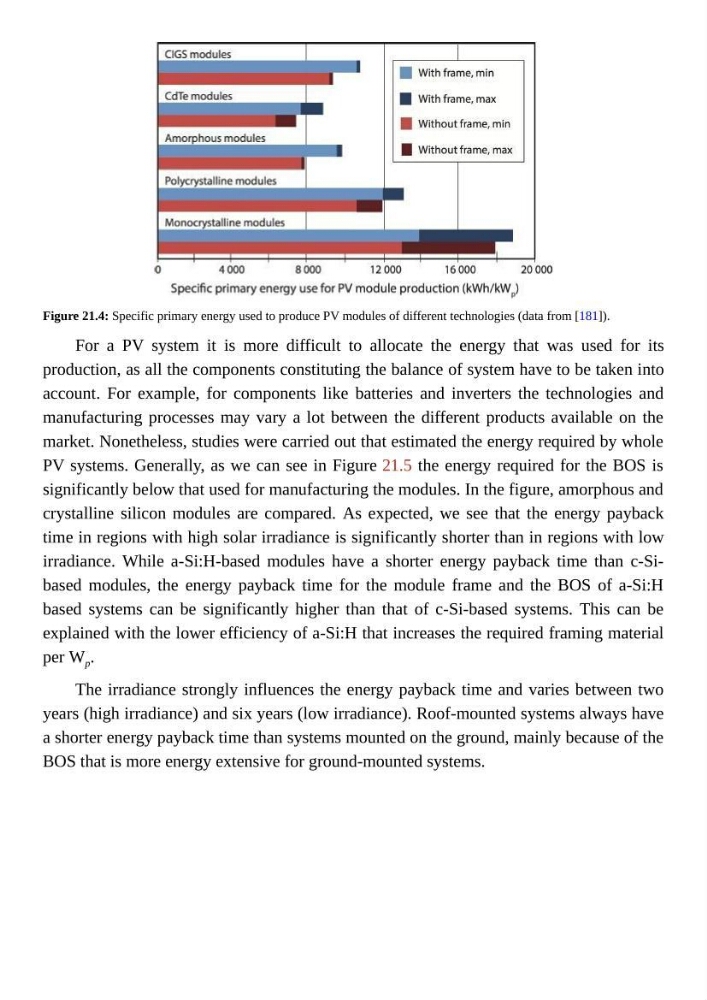
Figure 21.4: Specific primary energy used to produce PV modules of different technologies (data from [181]).
For a PV system it is more difficult to allocate the energy that was used for its
production, as all the components constituting the balance of system have to be taken into
account. For example, for components like batteries and inverters the technologies and
manufacturing processes may vary a lot between the different products available on the
market. Nonetheless, studies were carried out that estimated the energy required by whole
PV systems. Generally, as we can see in Figure 21.5 the energy required for the BOS is
significantly below that used for manufacturing the modules. In the figure, amorphous and
crystalline silicon modules are compared. As expected, we see that the energy payback
time in regions with high solar irradiance is significantly shorter than in regions with low
irradiance. While a-Si:H-based modules have a shorter energy payback time than c-Sibased modules, the energy payback time for the module frame and the BOS of a-Si:H
based systems can be significantly higher than that of c-Si-based systems. This can be
explained with the lower efficiency of a-Si:H that increases the required framing material
per W p .
The irradiance strongly influences the energy payback time and varies between two
years (high irradiance) and six years (low irradiance). Roof-mounted systems always have
a shorter energy payback time than systems mounted on the ground, mainly because of the
BOS that is more energy extensive for ground-mounted systems.
For a PV system it is more difficult to allocate the energy that was used for its
production, as all the components constituting the balance of system have to be taken into
account. For example, for components like batteries and inverters the technologies and
manufacturing processes may vary a lot between the different products available on the
market. Nonetheless, studies were carried out that estimated the energy required by whole
PV systems. Generally, as we can see in Figure 21.5 the energy required for the BOS is
significantly below that used for manufacturing the modules. In the figure, amorphous and
crystalline silicon modules are compared. As expected, we see that the energy payback
time in regions with high solar irradiance is significantly shorter than in regions with low
irradiance. While a-Si:H-based modules have a shorter energy payback time than c-Sibased modules, the energy payback time for the module frame and the BOS of a-Si:H
based systems can be significantly higher than that of c-Si-based systems. This can be
explained with the lower efficiency of a-Si:H that increases the required framing material
per W p .
The irradiance strongly influences the energy payback time and varies between two
years (high irradiance) and six years (low irradiance). Roof-mounted systems always have
a shorter energy payback time than systems mounted on the ground, mainly because of the
BOS that is more energy extensive for ground-mounted systems.