

(b)
(c)
(d)
20.5
(a)
(b)
20.6
(a)
(b)
(c)
20.7
(a)
(b)
The output current decreases.
The output voltage decreases.
The output current increases.
Consider a PV module with the following external parameters at STC: P max = 320 W, V OC = 45 V, I SC = 8 A,
NOCT = 40 °C and the temperature coefficient of power is −1 W/°C.
If the ambient temperature rises to 35 °C while the irradiance is 1,000 W/m 2 , what is the cell level
temperature, calculated with the NOCT model?
What is the new power output of the PV module under the new ambient temperature of 35 °C and 1,000
W/m 2 irradiance?
A module of 1.65×1.00 m 2 with an efficiency of 18% is placed in the Netherlands. On average, the Netherlands
has 1,568 sun hours per year. Assume standard test conditions (STC) which are 1,000 W/m 2 , cell temperature
of 25 °C and AM1.5 spectrum.
Calculate the power generated by the solar module at standard test conditions.
Calculate the energy generated by the module during a year in the Netherlands.
Calculate the air mass (AM) when the sun is 25°, 40°, and 65°from the zenith.
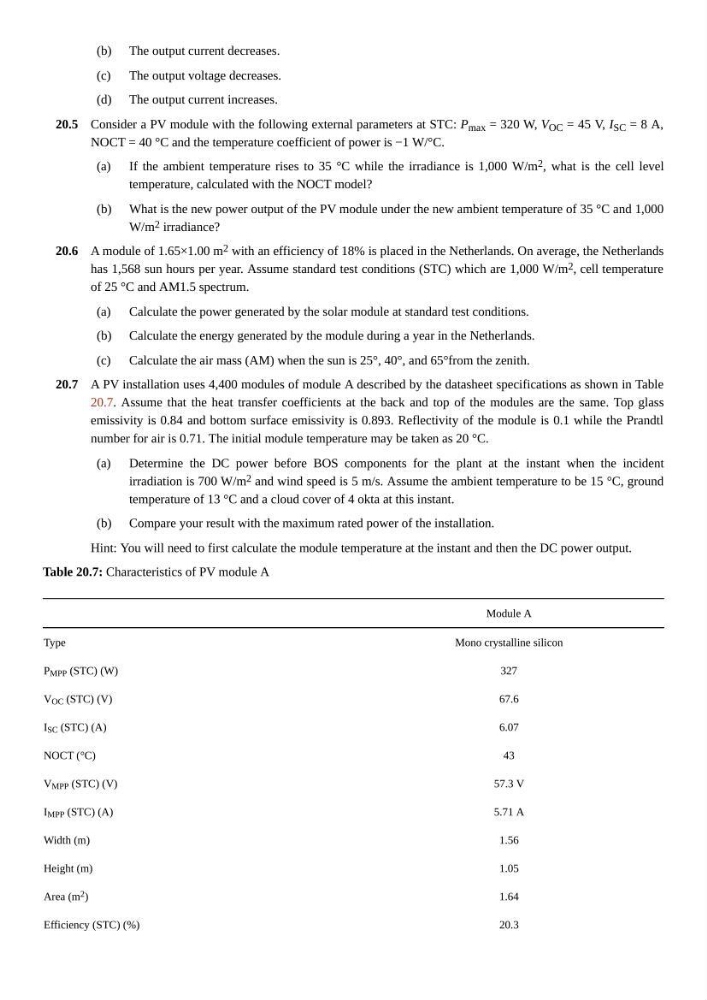
A PV installation uses 4,400 modules of module A described by the datasheet specifications as shown in Table
20.7. Assume that the heat transfer coefficients at the back and top of the modules are the same. Top glass
emissivity is 0.84 and bottom surface emissivity is 0.893. Reflectivity of the module is 0.1 while the Prandtl
number for air is 0.71. The initial module temperature may be taken as 20 °C.
Determine the DC power before BOS components for the plant at the instant when the incident
irradiation is 700 W/m 2 and wind speed is 5 m/s. Assume the ambient temperature to be 15 °C, ground
temperature of 13 °C and a cloud cover of 4 okta at this instant.
Compare your result with the maximum rated power of the installation.
Hint: You will need to first calculate the module temperature at the instant and then the DC power output.
Table 20.7: Characteristics of PV module A
Module A
Type
Mono crystalline silicon
P MPP (STC) (W)
327
V OC (STC) (V)
67.6
I SC (STC) (A)
6.07
NOCT (°C)
43
V MPP (STC) (V)
57.3 V
I MPP (STC) (A)
5.71 A
Width (m)
1.56
Height (m)
1.05
Area (m 2 )
1.64
Efficiency (STC) (%)
20.3
(c)
(d)
20.5
(a)
(b)
20.6
(a)
(b)
(c)
20.7
(a)
(b)
The output current decreases.
The output voltage decreases.
The output current increases.
Consider a PV module with the following external parameters at STC: P max = 320 W, V OC = 45 V, I SC = 8 A,
NOCT = 40 °C and the temperature coefficient of power is −1 W/°C.
If the ambient temperature rises to 35 °C while the irradiance is 1,000 W/m 2 , what is the cell level
temperature, calculated with the NOCT model?
What is the new power output of the PV module under the new ambient temperature of 35 °C and 1,000
W/m 2 irradiance?
A module of 1.65×1.00 m 2 with an efficiency of 18% is placed in the Netherlands. On average, the Netherlands
has 1,568 sun hours per year. Assume standard test conditions (STC) which are 1,000 W/m 2 , cell temperature
of 25 °C and AM1.5 spectrum.
Calculate the power generated by the solar module at standard test conditions.
Calculate the energy generated by the module during a year in the Netherlands.
Calculate the air mass (AM) when the sun is 25°, 40°, and 65°from the zenith.
A PV installation uses 4,400 modules of module A described by the datasheet specifications as shown in Table
20.7. Assume that the heat transfer coefficients at the back and top of the modules are the same. Top glass
emissivity is 0.84 and bottom surface emissivity is 0.893. Reflectivity of the module is 0.1 while the Prandtl
number for air is 0.71. The initial module temperature may be taken as 20 °C.
Determine the DC power before BOS components for the plant at the instant when the incident
irradiation is 700 W/m 2 and wind speed is 5 m/s. Assume the ambient temperature to be 15 °C, ground
temperature of 13 °C and a cloud cover of 4 okta at this instant.
Compare your result with the maximum rated power of the installation.
Hint: You will need to first calculate the module temperature at the instant and then the DC power output.
Table 20.7: Characteristics of PV module A
Module A
Type
Mono crystalline silicon
P MPP (STC) (W)
327
V OC (STC) (V)
67.6
I SC (STC) (A)
6.07
NOCT (°C)
43
V MPP (STC) (V)
57.3 V
I MPP (STC) (A)
5.71 A
Width (m)
1.56
Height (m)
1.05
Area (m 2 )
1.64
Efficiency (STC) (%)
20.3