

20.6
20.1
(a)
(b)
(c)
(d)
(e)
(f)
(g)
20.2
20.3
(a)
(b)
(c)
(d)
20.4
(a)
Exercises
The Smith family have a small house in the country side which is not connected to the grid. The place enjoys
3.5 equivalent sun hours. Therefore, Mr Smith has decided to install an off-grid PV system in the house to
supply their electricity. He will be using PV modules with the following specifications: P nom = 100 W p , V MPP =
16 V, I MPP = 6.25 A, V OC = 18 V, I SC = 7 A. We may assume that the combined efficiency of the cables, the
charge controller and the battery system is 90% and that of the inverter is 96%. As the house is only used at the
weekend, only two days of autonomy will be needed. In this case, batteries with the following specifications
will be used: capacity 100 Ah, voltage 12 V, maximum allowed depth of discharge 50%. The daily house
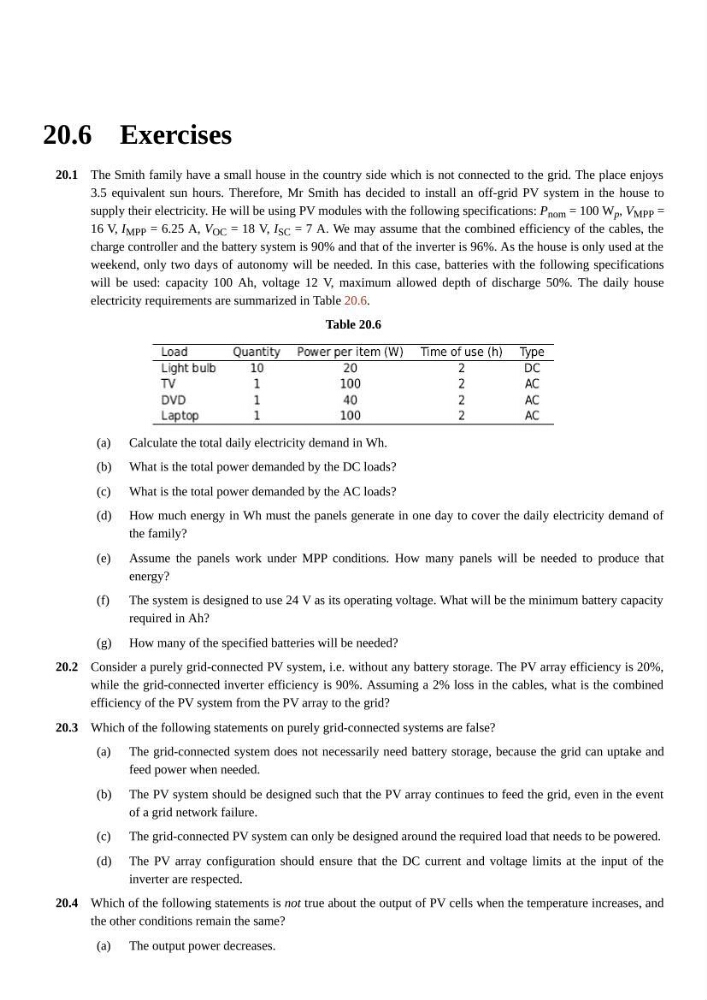
electricity requirements are summarized in Table 20.6.
Table 20.6
Calculate the total daily electricity demand in Wh.
What is the total power demanded by the DC loads?
What is the total power demanded by the AC loads?
How much energy in Wh must the panels generate in one day to cover the daily electricity demand of
the family?
Assume the panels work under MPP conditions. How many panels will be needed to produce that
energy?
The system is designed to use 24 V as its operating voltage. What will be the minimum battery capacity
required in Ah?
How many of the specified batteries will be needed?
Consider a purely grid-connected PV system, i.e. without any battery storage. The PV array efficiency is 20%,
while the grid-connected inverter efficiency is 90%. Assuming a 2% loss in the cables, what is the combined
efficiency of the PV system from the PV array to the grid?
Which of the following statements on purely grid-connected systems are false?
The grid-connected system does not necessarily need battery storage, because the grid can uptake and
feed power when needed.
The PV system should be designed such that the PV array continues to feed the grid, even in the event
of a grid network failure.
The grid-connected PV system can only be designed around the required load that needs to be powered.
The PV array configuration should ensure that the DC current and voltage limits at the input of the
inverter are respected.
Which of the following statements is not true about the output of PV cells when the temperature increases, and
the other conditions remain the same?
The output power decreases.
20.1
(a)
(b)
(c)
(d)
(e)
(f)
(g)
20.2
20.3
(a)
(b)
(c)
(d)
20.4
(a)
Exercises
The Smith family have a small house in the country side which is not connected to the grid. The place enjoys
3.5 equivalent sun hours. Therefore, Mr Smith has decided to install an off-grid PV system in the house to
supply their electricity. He will be using PV modules with the following specifications: P nom = 100 W p , V MPP =
16 V, I MPP = 6.25 A, V OC = 18 V, I SC = 7 A. We may assume that the combined efficiency of the cables, the
charge controller and the battery system is 90% and that of the inverter is 96%. As the house is only used at the
weekend, only two days of autonomy will be needed. In this case, batteries with the following specifications
will be used: capacity 100 Ah, voltage 12 V, maximum allowed depth of discharge 50%. The daily house
electricity requirements are summarized in Table 20.6.
Table 20.6
Calculate the total daily electricity demand in Wh.
What is the total power demanded by the DC loads?
What is the total power demanded by the AC loads?
How much energy in Wh must the panels generate in one day to cover the daily electricity demand of
the family?
Assume the panels work under MPP conditions. How many panels will be needed to produce that
energy?
The system is designed to use 24 V as its operating voltage. What will be the minimum battery capacity
required in Ah?
How many of the specified batteries will be needed?
Consider a purely grid-connected PV system, i.e. without any battery storage. The PV array efficiency is 20%,
while the grid-connected inverter efficiency is 90%. Assuming a 2% loss in the cables, what is the combined
efficiency of the PV system from the PV array to the grid?
Which of the following statements on purely grid-connected systems are false?
The grid-connected system does not necessarily need battery storage, because the grid can uptake and
feed power when needed.
The PV system should be designed such that the PV array continues to feed the grid, even in the event
of a grid network failure.
The grid-connected PV system can only be designed around the required load that needs to be powered.
The PV array configuration should ensure that the DC current and voltage limits at the input of the
inverter are respected.
Which of the following statements is not true about the output of PV cells when the temperature increases, and
the other conditions remain the same?
The output power decreases.