

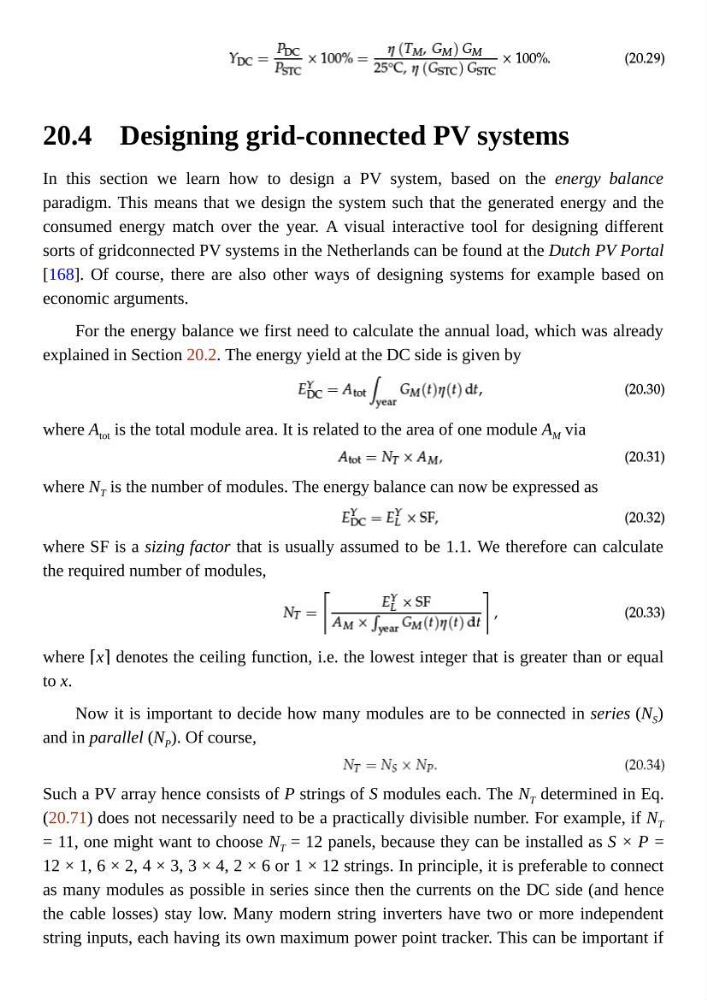
20.4 Designing grid-connected PV systems
In this section we learn how to design a PV system, based on the energy balance
paradigm. This means that we design the system such that the generated energy and the
consumed energy match over the year. A visual interactive tool for designing different
sorts of gridconnected PV systems in the Netherlands can be found at the Dutch PV Portal
[168]. Of course, there are also other ways of designing systems for example based on
economic arguments.
For the energy balance we first need to calculate the annual load, which was already
explained in Section 20.2. The energy yield at the DC side is given by
where A tot is the total module area. It is related to the area of one module A M via
where N T is the number of modules. The energy balance can now be expressed as
where SF is a sizing factor that is usually assumed to be 1.1. We therefore can calculate
the required number of modules,
where ⌈x⌉ denotes the ceiling function, i.e. the lowest integer that is greater than or equal
to x.
Now it is important to decide how many modules are to be connected in series (N S )
and in parallel (N P ). Of course,
Such a PV array hence consists of P strings of S modules each. The N T determined in Eq.
(20.71) does not necessarily need to be a practically divisible number. For example, if N T
= 11, one might want to choose N T = 12 panels, because they can be installed as S × P =
12 × 1, 6 × 2, 4 × 3, 3 × 4, 2 × 6 or 1 × 12 strings. In principle, it is preferable to connect
as many modules as possible in series since then the currents on the DC side (and hence
the cable losses) stay low. Many modern string inverters have two or more independent
string inputs, each having its own maximum power point tracker. This can be important if
In this section we learn how to design a PV system, based on the energy balance
paradigm. This means that we design the system such that the generated energy and the
consumed energy match over the year. A visual interactive tool for designing different
sorts of gridconnected PV systems in the Netherlands can be found at the Dutch PV Portal
[168]. Of course, there are also other ways of designing systems for example based on
economic arguments.
For the energy balance we first need to calculate the annual load, which was already
explained in Section 20.2. The energy yield at the DC side is given by
where A tot is the total module area. It is related to the area of one module A M via
where N T is the number of modules. The energy balance can now be expressed as
where SF is a sizing factor that is usually assumed to be 1.1. We therefore can calculate
the required number of modules,
where ⌈x⌉ denotes the ceiling function, i.e. the lowest integer that is greater than or equal
to x.
Now it is important to decide how many modules are to be connected in series (N S )
and in parallel (N P ). Of course,
Such a PV array hence consists of P strings of S modules each. The N T determined in Eq.
(20.71) does not necessarily need to be a practically divisible number. For example, if N T
= 11, one might want to choose N T = 12 panels, because they can be installed as S × P =
12 × 1, 6 × 2, 4 × 3, 3 × 4, 2 × 6 or 1 × 12 strings. In principle, it is preferable to connect
as many modules as possible in series since then the currents on the DC side (and hence
the cable losses) stay low. Many modern string inverters have two or more independent
string inputs, each having its own maximum power point tracker. This can be important if