

where A M is the module area. If the efficiency temperature coefficient ∂η/∂T is not given in
the datasheet, it can be obtained by rearranging
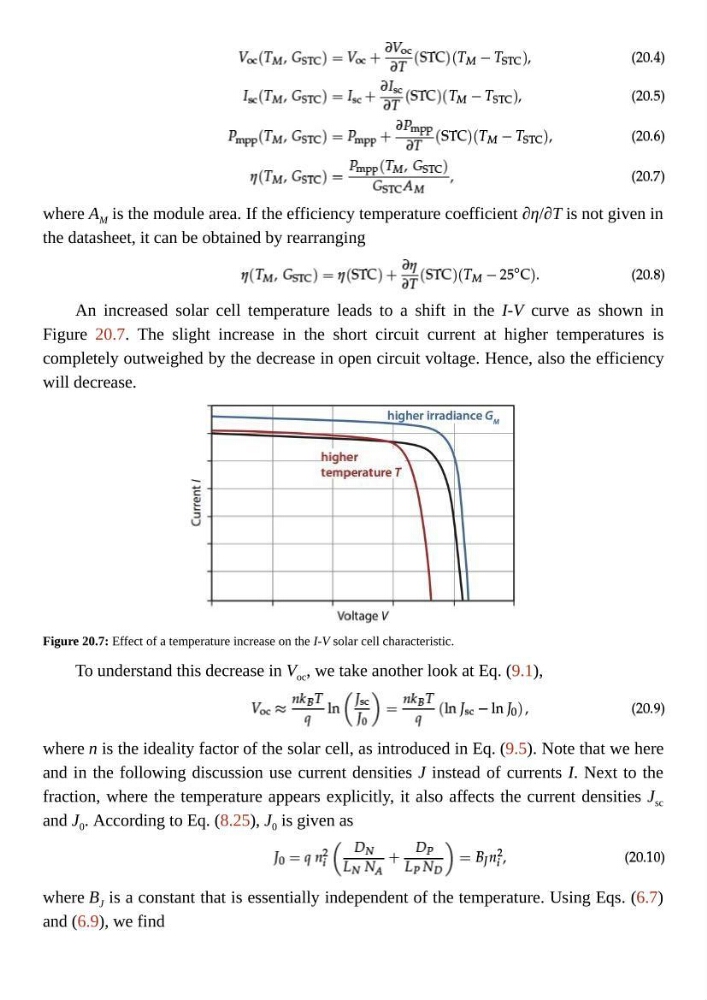
An increased solar cell temperature leads to a shift in the I-V curve as shown in
Figure 20.7. The slight increase in the short circuit current at higher temperatures is
completely outweighed by the decrease in open circuit voltage. Hence, also the efficiency
will decrease.
Figure 20.7: Effect of a temperature increase on the I-V solar cell characteristic.
To understand this decrease in V oc , we take another look at Eq. (9.1),
where n is the ideality factor of the solar cell, as introduced in Eq. (9.5). Note that we here
and in the following discussion use current densities J instead of currents I. Next to the
fraction, where the temperature appears explicitly, it also affects the current densities J sc
and J 0 . According to Eq. (8.25), J 0 is given as
where B J is a constant that is essentially independent of the temperature. Using Eqs. (6.7)
and (6.9), we find
the datasheet, it can be obtained by rearranging
An increased solar cell temperature leads to a shift in the I-V curve as shown in
Figure 20.7. The slight increase in the short circuit current at higher temperatures is
completely outweighed by the decrease in open circuit voltage. Hence, also the efficiency
will decrease.
Figure 20.7: Effect of a temperature increase on the I-V solar cell characteristic.
To understand this decrease in V oc , we take another look at Eq. (9.1),
where n is the ideality factor of the solar cell, as introduced in Eq. (9.5). Note that we here
and in the following discussion use current densities J instead of currents I. Next to the
fraction, where the temperature appears explicitly, it also affects the current densities J sc
and J 0 . According to Eq. (8.25), J 0 is given as
where B J is a constant that is essentially independent of the temperature. Using Eqs. (6.7)
and (6.9), we find