

20.3.2
As both the NOCT model and the INOCT approach do not take the wind speed into
account, the module temperature might not be accurately predicted, particularly in
locations with high wind speeds. The Duffie–Beckman (DB) model provides an extension
to the NOCT model using an additional empirical term to take the wind speed into account
[165]. In this model, the cell temperature T M is given as
where w is the wind speed at module height and T is the transmittance of the front layers
of the module. α is the absorptivity of the module, hence the product Tα gives the fraction
of incident light that is absorbed by the solar cells; usually, Tα is assumed to be 0.9 [165].
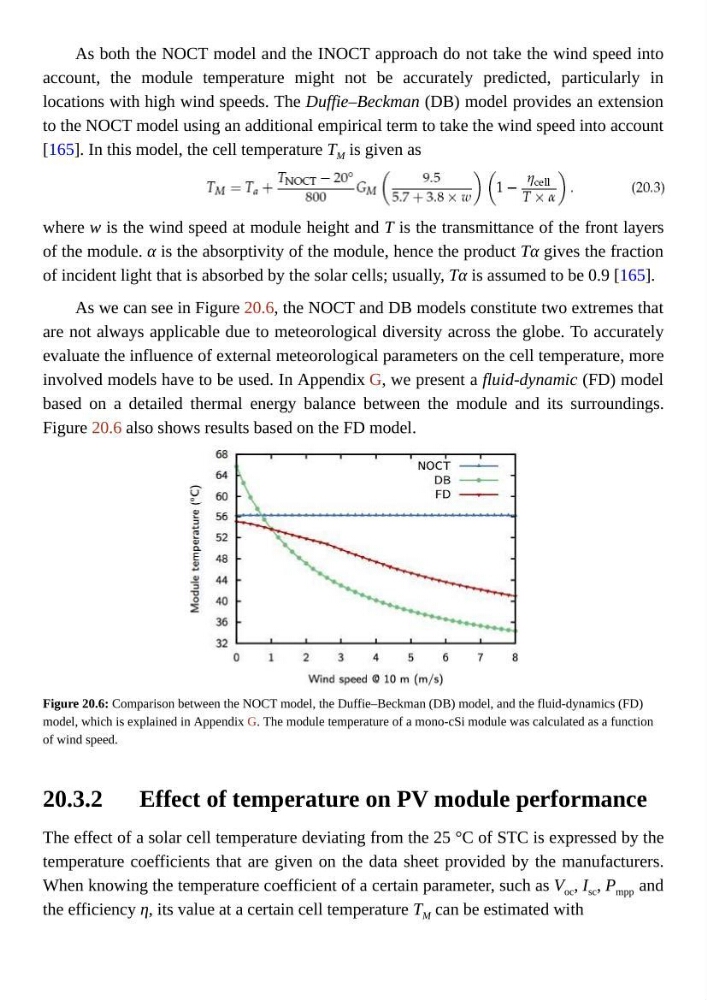
As we can see in Figure 20.6, the NOCT and DB models constitute two extremes that
are not always applicable due to meteorological diversity across the globe. To accurately
evaluate the influence of external meteorological parameters on the cell temperature, more
involved models have to be used. In Appendix G, we present a fluid-dynamic (FD) model
based on a detailed thermal energy balance between the module and its surroundings.
Figure 20.6 also shows results based on the FD model.
Figure 20.6: Comparison between the NOCT model, the Duffie–Beckman (DB) model, and the fluid-dynamics (FD)
model, which is explained in Appendix G. The module temperature of a mono-cSi module was calculated as a function
of wind speed.
Effect of temperature on PV module performance
The effect of a solar cell temperature deviating from the 25 °C of STC is expressed by the
temperature coefficients that are given on the data sheet provided by the manufacturers.
When knowing the temperature coefficient of a certain parameter, such as V oc , I sc , P mpp and
the efficiency η, its value at a certain cell temperature T M can be estimated with
As both the NOCT model and the INOCT approach do not take the wind speed into
account, the module temperature might not be accurately predicted, particularly in
locations with high wind speeds. The Duffie–Beckman (DB) model provides an extension
to the NOCT model using an additional empirical term to take the wind speed into account
[165]. In this model, the cell temperature T M is given as
where w is the wind speed at module height and T is the transmittance of the front layers
of the module. α is the absorptivity of the module, hence the product Tα gives the fraction
of incident light that is absorbed by the solar cells; usually, Tα is assumed to be 0.9 [165].
As we can see in Figure 20.6, the NOCT and DB models constitute two extremes that
are not always applicable due to meteorological diversity across the globe. To accurately
evaluate the influence of external meteorological parameters on the cell temperature, more
involved models have to be used. In Appendix G, we present a fluid-dynamic (FD) model
based on a detailed thermal energy balance between the module and its surroundings.
Figure 20.6 also shows results based on the FD model.
Figure 20.6: Comparison between the NOCT model, the Duffie–Beckman (DB) model, and the fluid-dynamics (FD)
model, which is explained in Appendix G. The module temperature of a mono-cSi module was calculated as a function
of wind speed.
Effect of temperature on PV module performance
The effect of a solar cell temperature deviating from the 25 °C of STC is expressed by the
temperature coefficients that are given on the data sheet provided by the manufacturers.
When knowing the temperature coefficient of a certain parameter, such as V oc , I sc , P mpp and
the efficiency η, its value at a certain cell temperature T M can be estimated with