

weather and plan a reserve energy capacity stored in the batteries. Because of this reserve,
the PV system is not dependent on energy generated by PV modules for a certain period of
time, called days of autonomy. The required days of autonomy depend on the type of
loads. For critical loads such as components for telecommunications systems the
autonomy can be ten days or more, for residential use it is usually five days or less. This
depends also on the weather at the PV system location.
The capacity [Ah] of the batteries is calculated by multiplying the daily total DC
energy requirement of the PV system including loads and system losses (calculated in step
2 and expressed in Ah) by the number of days of recommended reserve time. In order to
prolong the life of lead-acid batteries, which are most commonly used, it is recommended
that the battery is discharged maximally by 80%. If this value is decreased, the battery
lifetime is prolonged, but the system becomes more expensive. In the end, a cost
evaluation has to be made in order to choose the optimal configuration.
Example
The total DC requirements of loads plus the system losses are 45.6 Ah. The recommended reserve time capacity
for the installation site in the Netherlands is five days. Battery capacity required by the system is 45.6 Ah × 5 =
228 Ah. The minimal battery capacity for a safe operation is therefore 228 Ah / 0.8 = 285 Ah.
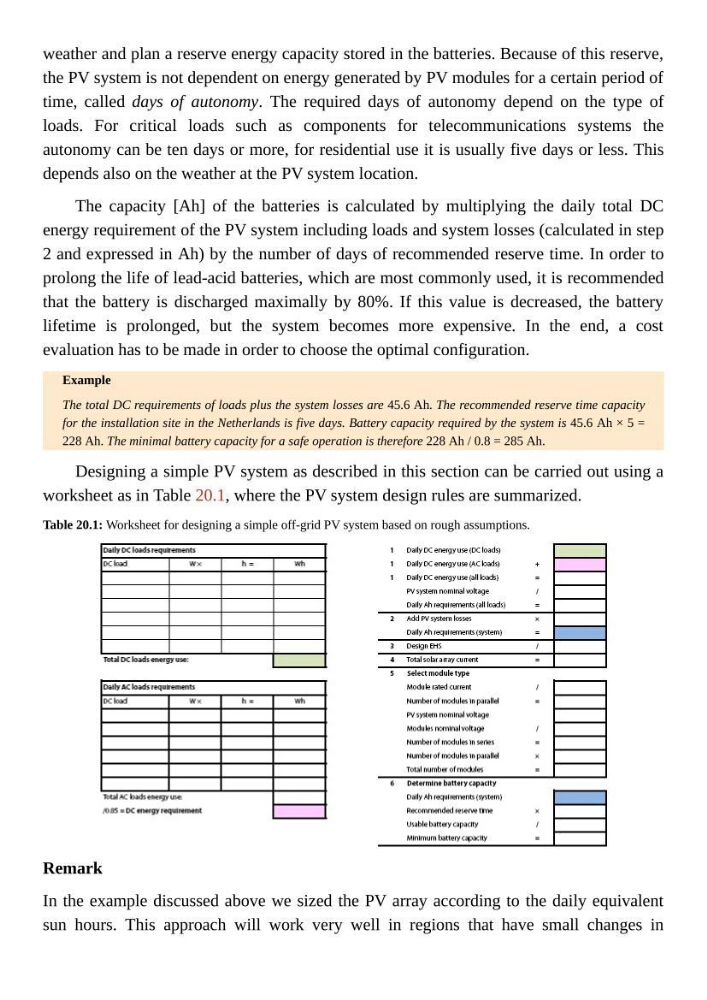
Designing a simple PV system as described in this section can be carried out using a
worksheet as in Table 20.1, where the PV system design rules are summarized.
Table 20.1: Worksheet for designing a simple off-grid PV system based on rough assumptions.
Remark
In the example discussed above we sized the PV array according to the daily equivalent
sun hours. This approach will work very well in regions that have small changes in
the PV system is not dependent on energy generated by PV modules for a certain period of
time, called days of autonomy. The required days of autonomy depend on the type of
loads. For critical loads such as components for telecommunications systems the
autonomy can be ten days or more, for residential use it is usually five days or less. This
depends also on the weather at the PV system location.
The capacity [Ah] of the batteries is calculated by multiplying the daily total DC
energy requirement of the PV system including loads and system losses (calculated in step
2 and expressed in Ah) by the number of days of recommended reserve time. In order to
prolong the life of lead-acid batteries, which are most commonly used, it is recommended
that the battery is discharged maximally by 80%. If this value is decreased, the battery
lifetime is prolonged, but the system becomes more expensive. In the end, a cost
evaluation has to be made in order to choose the optimal configuration.
Example
The total DC requirements of loads plus the system losses are 45.6 Ah. The recommended reserve time capacity
for the installation site in the Netherlands is five days. Battery capacity required by the system is 45.6 Ah × 5 =
228 Ah. The minimal battery capacity for a safe operation is therefore 228 Ah / 0.8 = 285 Ah.
Designing a simple PV system as described in this section can be carried out using a
worksheet as in Table 20.1, where the PV system design rules are summarized.
Table 20.1: Worksheet for designing a simple off-grid PV system based on rough assumptions.
Remark
In the example discussed above we sized the PV array according to the daily equivalent
sun hours. This approach will work very well in regions that have small changes in