

(c)
(d)
19.16
19.17
19.18
(a)
(b)
(c)
(d)
cables?
Would switching to thicker cables with a cross-section of 10 mm 2 be helpful in decreasing such relative
power loss?
Now repeat questions (a) to (c) for aluminium cables with a conductivity of 35.5 S m mm −2 .
Consider three identical solar modules connected to a charge controller by two copper cables that have lengths
of 6 m and conductivity of 59.6 S m mm −2 . The average battery charging voltage is 12 V and the maximum
power of a single solar module is 100 Wp. Calculate the required cross-section of the cables if the allowed
power loss in the cables is 5%.
350 watt-hours of energy is required daily from a small PV system with a battery. The DC system voltage is 12
V. Calculate the capacity of the battery needed if its depth of discharge is 30%.
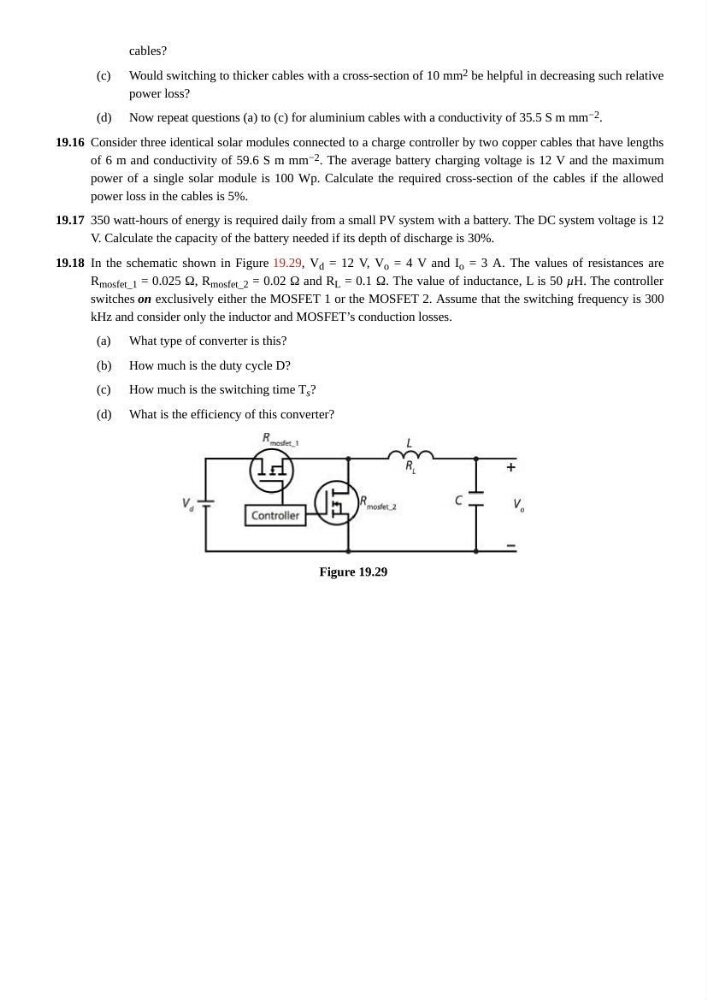
In the schematic shown in Figure 19.29, V d = 12 V, V o = 4 V and I o = 3 A. The values of resistances are
R mosfet_1 = 0.025 Ω, R mosfet_2 = 0.02 Ω and R L = 0.1 Ω. The value of inductance, L is 50 µH. The controller
switches on exclusively either the MOSFET 1 or the MOSFET 2. Assume that the switching frequency is 300
kHz and consider only the inductor and MOSFET’s conduction losses.
What type of converter is this?
How much is the duty cycle D?
How much is the switching time T s ?
What is the efficiency of this converter?
Figure 19.29
(d)
19.16
19.17
19.18
(a)
(b)
(c)
(d)
cables?
Would switching to thicker cables with a cross-section of 10 mm 2 be helpful in decreasing such relative
power loss?
Now repeat questions (a) to (c) for aluminium cables with a conductivity of 35.5 S m mm −2 .
Consider three identical solar modules connected to a charge controller by two copper cables that have lengths
of 6 m and conductivity of 59.6 S m mm −2 . The average battery charging voltage is 12 V and the maximum
power of a single solar module is 100 Wp. Calculate the required cross-section of the cables if the allowed
power loss in the cables is 5%.
350 watt-hours of energy is required daily from a small PV system with a battery. The DC system voltage is 12
V. Calculate the capacity of the battery needed if its depth of discharge is 30%.
In the schematic shown in Figure 19.29, V d = 12 V, V o = 4 V and I o = 3 A. The values of resistances are
R mosfet_1 = 0.025 Ω, R mosfet_2 = 0.02 Ω and R L = 0.1 Ω. The value of inductance, L is 50 µH. The controller
switches on exclusively either the MOSFET 1 or the MOSFET 2. Assume that the switching frequency is 300
kHz and consider only the inductor and MOSFET’s conduction losses.
What type of converter is this?
How much is the duty cycle D?
How much is the switching time T s ?
What is the efficiency of this converter?
Figure 19.29