

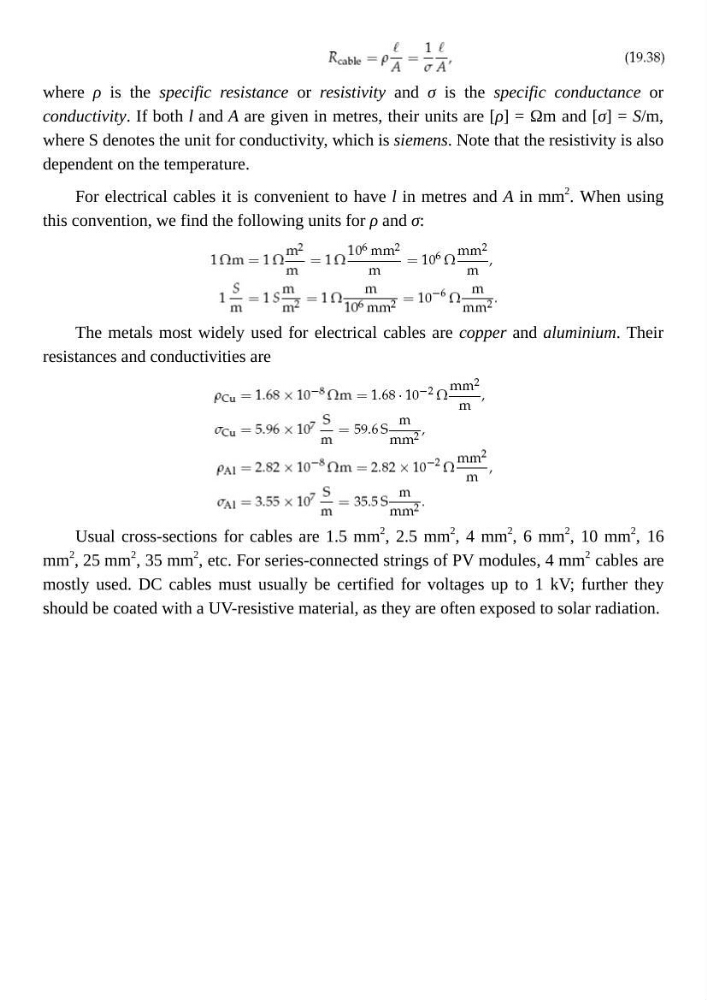
where ρ is the specific resistance or resistivity and σ is the specific conductance or
conductivity. If both l and A are given in metres, their units are [ρ] = Ωm and [σ] = S/m,
where S denotes the unit for conductivity, which is siemens. Note that the resistivity is also
dependent on the temperature.
For electrical cables it is convenient to have l in metres and A in mm
2
. When using
this convention, we find the following units for ρ and σ:
The metals most widely used for electrical cables are copper and aluminium. Their
resistances and conductivities are
Usual cross-sections for cables are 1.5 mm
2 , 2.5 mm
2
, 4 mm
2
, 6 mm
2
, 10 mm
2
, 16
mm
2
, 25 mm
2
, 35 mm
2
, etc. For series-connected strings of PV modules, 4 mm
2
cables are
mostly used. DC cables must usually be certified for voltages up to 1 kV; further they
should be coated with a UV-resistive material, as they are often exposed to solar radiation.
conductivity. If both l and A are given in metres, their units are [ρ] = Ωm and [σ] = S/m,
where S denotes the unit for conductivity, which is siemens. Note that the resistivity is also
dependent on the temperature.
For electrical cables it is convenient to have l in metres and A in mm
2
. When using
this convention, we find the following units for ρ and σ:
The metals most widely used for electrical cables are copper and aluminium. Their
resistances and conductivities are
Usual cross-sections for cables are 1.5 mm
2 , 2.5 mm
2
, 4 mm
2
, 6 mm
2
, 10 mm
2
, 16
mm
2
, 25 mm
2
, 35 mm
2
, etc. For series-connected strings of PV modules, 4 mm
2
cables are
mostly used. DC cables must usually be certified for voltages up to 1 kV; further they
should be coated with a UV-resistive material, as they are often exposed to solar radiation.